Use this guide as a starting point alongside the detailed sources below. Health concerns, unexplained changes in behavior, or feeding problems belong with an amphibian veterinarian.
Adult enclosure recommendation
Our recommended minimum: 2′ × 18″ × 3′ (61 × 45.8 × 91.5 cm), length × depth × height.
Preferred target: 2′ × 2′ × 4′ (61 × 61 × 122 cm), length × depth × height.
Usable internal space for 1 adult animal. One adult Pelodryas caerulea, including a large female approaching 5″ (13 cm) body length. One animal only; not a group preset.
Height is the usable internal envelope, including the space reserved for substrate and water. Check the remaining movement space and lamp clearance after installation.
The extra depth and height allow broader connected perches, several shaded resting sites and easier access to the bath below. Preserve these routes after plants and lamps are installed; this is a functional preference, not a tested optimum.
Veterinary and specialist accounts call for tall housing and broad supporting perches but do not test exact welfare thresholds. Our larger editorial layout reserves furnished horizontal routes, height, shaded choices and safe bath access beyond their smaller aquarium examples.
- Floor space
- At least 2′ × 18″ (61 × 46 cm) of usable floor with an accessible bath and a route beneath furnishings.
- Climbing space
- Anchored broad horizontal supports, gentle connections and more than one shaded resting site throughout the 3′ (92 cm) internal height; maintain measured lamp clearance.
- Substrate
- A planted option uses 3–4″ (8–10 cm) of soil or coconut fiber plus any drainage within the internal height. Keep useful climbing space above it.
- Water
- A continuously available shallow whole-body bath with easy exit, below folded-leg resting body height; clean daily and after fouling with chlorine/chloramine-free water.
- Security and ventilation
- One frog, positively secured lid and openings, effective cross-ventilation, thermostatic heat control where needed and protected fixtures.
Meeting these dimensions alone does not establish suitability. Check the usable layout, environmental conditions, equipment clearance and the individual animal’s requirements before occupation.
Choose a frog you can watch for years
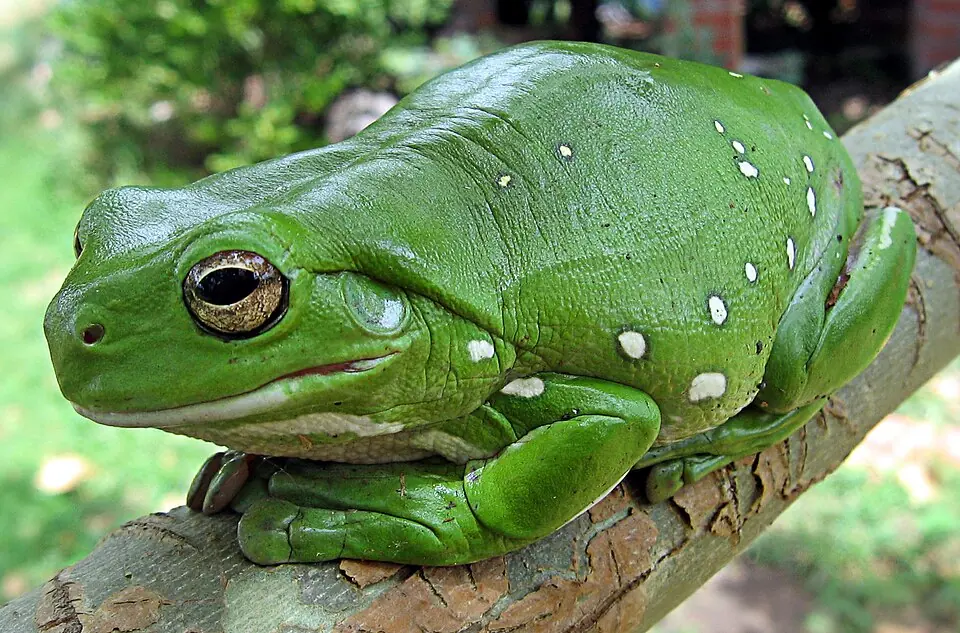
White’s tree frogs are substantial, mostly nocturnal climbers. A frog sitting quietly on one perch during the day still needs a network of supports, places to hide and a choice of conditions after dark. Large females may reach roughly 4–5″ (10–13 cm) in body length. Plan for more than a decade of care, with the possibility of twenty years or longer; long-lived reports are a planning warning, not a prediction for an individual.
This guide covers Pelodryas caerulea, also familiar as Litoria caerulea or Ranoidea caerulea. The common name Australian green tree frog can be ambiguous, and a white-lipped tree frog is a different animal. Ask for the scientific identity, captive-bred origin, recent food and any health history. Color names and the seller’s word “dumpy” do not replace those records.
The everyday work is straightforward but persistent: replace dirty water, inspect the animal and its environment, keep feeder insects properly, and notice changes in weight or movement. A hands-off display frog suits this routine better than someone seeking a pet to hold. Include lamp replacement, live food, electricity and access to a veterinarian who sees amphibians in the acquisition decision.
Give one adult connected climbing space
For one adult, our recommended minimum is 2′ × 18″ × 3′ (61 × 46 × 92 cm) of usable internal length × depth × height. Our preferred target is 2′ × 2′ × 4′ (61 × 61 × 122 cm). The larger layout gives more room for horizontal supports and concealed routes at different heights. These are editorial recommendations that expand smaller published terrarium examples; no experiment has established one exact minimum for this frog.
Use the height as furnished living space. Anchor broad horizontal branches or cork shelves that support the frog’s whole body, with gentle connecting angles and foliage or cork cover around resting places. Include more than one sheltered perch so the frog can choose warmth and shade while concealed. Thin vertical twigs and an otherwise empty tower do little for a heavy adult.
The dimensions include bedding and drainage. A planted enclosure might use 3–4″ (8–10 cm) of fertilizer- and pesticide-free soil or coconut fiber above a drainage arrangement, reducing the clear climbing height by that amount and more where drainage is installed. Keep lamp clearance, an accessible bath and a route to the floor after furnishing. A positively secured ventilated lid and closed cable gaps must contain the current frog, including a small juvenile.
This numerical recommendation covers one frog. Shared housing needs separate assessment of animal size, resource access, feeding and disease risk; adding a nominal number of gallons is insufficient. No existing Creature Corner construction project is identified here as a reviewed species fit.
Test temperatures at the perches
For ordinary active maintenance, arrange daytime air around 76–82°F (24–28°C) across occupied perches, with the cooler sheltered route toward the lower end and a warmer choice toward the upper end. Let night air fall to about 68–72°F (20–22°C). These are selected practical operating ranges from veterinary and experienced keeper guidance, rather than measured biological limits. Young frogs need particular care to avoid drying under heat.
Use independent digital probes at the actual perch positions and near the lower refuge. Check the warmest accessible surfaces separately with an infrared thermometer. A thermostat probe controls the heater; it cannot tell you that every perch is appropriate. Heat only as much of the enclosure as necessary, use compatible thermostatic control, and prevent the frog reaching hot fittings or guards.
This maintenance plan does not require a hot basking patch. The published ultraviolet lighting guide (UV-Tool (an ultraviolet lighting reference)) lists a 97°F (36°C) substrate-surface reference, while the veterinary page caps a basking area at about 90°F (32°C). Those are different surface protocols, not alternative ambient readings. Our lower air-based maintenance plan follows the species-specific veterinary and producer guidance. Retain shade, ventilation and a cooler route instead of combining the hottest parts of every source.
Test the finished empty setup through several complete day and night cycles before arrival. Record room temperature, probe positions and the results. This is our preparation practice, not evidence that a particular number of days certifies the system. Repeat measurements after changing lamps, branches, screening or the room’s heating and cooling.
Make ultraviolet exposure voluntary
Provide a consistent 12-hour light period followed by 12 hours of darkness. We recommend a modest ultraviolet B (UVB) opportunity, measured as ultraviolet index (UVI), of about 0.7–1.0 at an exposed usable perch, with UVI 0 inside sheltered resting places. The UV-Tool places this species in its partial-sun category; our selected low exposure is a practical option, not a dose demonstrated to optimize lifelong health.
Measure toward the lamp at the frog’s back height and at its closest reachable point. Mesh, reflector, lamp age, distance and upper branches can change exposure substantially. Follow the specific fixture’s installation and replacement directions and remeasure after rearranging. A lamp labeled “5%” does not tell you the UVI delivered to a frog. Preserve sheltered warmth as well as shade, so it is never necessary to sit under ultraviolet to stay comfortable.
Dietary vitamin D3 and ultraviolet provision belong in one nutritional plan. Ultraviolet does not supply dietary calcium or vitamin A, and adding a lamp is not a reason to stack multiple vitamin powders. If night heat is necessary, use suitable controlled equipment that does not illuminate the enclosure. Do not imitate older red-night-bulb advice or give intermittent intense ultraviolet boosts.
Keep a clean bath and a drying cycle
Provide a stable shallow water dish continuously. The frog must fit comfortably while resting with its head above water and climb out easily; the water should be shallower than the height of its folded-leg resting body. Clean and refill it at least daily and immediately after feces or other contamination. Place it where you can service it without dismantling the climbing structure.
Treat tap water for the actual supply’s chlorine and chloramine before it touches the frog, its substrate or its misting equipment. Letting water stand does not reliably remove chloramine. Use a suitable conditioner as directed, and investigate unusually soft, hard or contaminated water with the veterinarian rather than assuming bottled water is automatically appropriate. Keep chemicals, aerosols, fertilizers and cleaning residues out of the system.
For a healthy adult, start around 40–60% relative humidity between mistings, with a brief rise toward 60–70% after misting. Record this at a stated air location and its local temperature. This is an experienced-keeper operating reference, not proof that every number outside it is dangerous. Young frogs need closer hydration observation and commonly use around 50% between brief peaks. Moist refuges and fresh bath access remain necessary even when the air meter looks satisfactory.
Let exposed leaves and perches lose visible surface water between mistings while retaining moisture lower in the bedding. Cross-ventilation should clear stagnant air without drying every refuge. Heavy condensation all day, a sour substrate or an enclosure that must be sealed to hold a percentage indicates a design problem. Direct repeated spraying of the frog is unnecessary; mist the habitat according to its measured drying pattern.
Feed the frog you have, rather than its appetite
Use a rotation of appropriately sized cultured crickets, suitable roaches, earthworms and other suitable insect larvae. Feed insects a proper gut-loading diet before offering them. Gut loading means improving the feeder’s nutrition first; keeping insects alive on scraps is not the same process. Avoid wild prey, which brings uncertain pesticides and parasites into a sensitive enclosure.
For a settled adult, an initial meal of roughly three or four suitable adult crickets, or a comparable amount of other prey, twice weekly is a useful veterinary starting framework. Offer at dusk, observe swallowing and record what was actually eaten. Smaller growing froglets need smaller prey and usually daily meals. Do not translate one cricket count directly into the same count of large worms or roaches.
Adjust portions and frequency with growth, weight trend, movement and veterinary body-condition assessment. These frogs can continue to strike when they do not need more food. A more prominent facial fold alone is not a complete obesity score, and food enthusiasm is not proof of nutritional adequacy. Routine mouse treats are unnecessary for an insect-based pet diet.
Offer prey from a clean feeding station or suitable soft-tipped tongs without forcing the mouth open. Avoid loose bark, gravel or moss where a strike will collect it with the prey. Remove uneaten insects, especially before they hide around a resting frog. A missed meal after arrival can occur, but persistent refusal or weight loss calls for an environment and health review.
Choose one coherent supplement routine
Insect meals need calcium and an appropriate vitamin/mineral plan that includes vitamin A. Select an amphibian-suitable product or coordinated combination with readable directions for the animal’s stage and ultraviolet provision. Lightly coat prey just before feeding as that plan directs. Photograph the labels and record the actual products, vitamin D3 content, dates and frequency, so another caretaker or the veterinarian can review what the frog receives.
Published schedules use different products and even different feeding frequencies. They cannot be combined safely by applying every powder on every meal. Do not add separate vitamin A or concentrated vitamin D3 on top of an all-in-one formula without a specific clinical reason. Keep powder dry, stored as directed and within its stated useful life. Weakness, swelling or poor prey capture need examination rather than an improvised vitamin dose.
Make the planted floor serviceable
A planted adult system can use fertilizer- and pesticide-free moisture-retaining soil or coconut fiber with clean hardwood leaf litter and drainage. Keep feeding away from loose particles. Robust plants and anchored branches must withstand an adult landing on them. Do not use sharp plastic edges, aromatic wood shavings, treated garden soil or abrasive artificial turf. Pesticide residues on new plants are a reason to prepare them separately before installation.
During separate arrival observation, moist plain paper can make waste easier to inspect, alongside proper perches, cover and water. Replace it whenever soiled and before it dries out or becomes foul. This short observation arrangement does not remove the adult’s need for furnished space.
Inspect daily for feces, dead insects, dirty water and damaged furnishings. Remove contamination promptly; a clean-up crew cannot do this inspection for you. Remove visible dirt from equipment before disinfection. Use a product documented for amphibian equipment, following its dilution and contact-time directions, then rinse thoroughly and clear residues before reuse. Keep dedicated tools and avoid carrying dirty misting water or soil between enclosures.
Let the frog show you its routine
Expect more activity around dusk and at night, with quiet sheltered rest during the day. Record where it rests, whether it can grip and perch normally, and its regular appetite and waste pattern. Males can call loudly. A change in color alone has many possible contexts and does not establish a diagnosis; a new skin lesion or a change paired with poor appetite deserves attention.
Keep handling for necessary moves and examinations. Guide the frog into a clean damp container where possible. If support is necessary, use moistened powder-free gloves and hold it low over a secure surface without squeezing. Oils, salts, lotions and soap traces on hands are unsuitable for its skin. Normal skin turnover may include eating the shed; do not peel skin or give routine baths to force a shed.
Do not turn maintenance into a breeding cycle
A small frog needs secure openings, accessible food, suitably shallow water and close moisture checks. Temporary simple housing can make those checks easier, but its replacement must be planned before growth crowds the perches or bath. Keep comparable temperature, shelter and exposure choices rather than placing a juvenile in a bright bare tank to make it easier to find.
Seasonal cycling, group introductions, rain chambers and tadpole rearing are separate projects. They are not required to keep a nonbreeding pet comfortable. Do not lower water provision or deliberately chill a frog because an older breeding account describes that technique. Seek advice when appetite or activity changes without an obvious healthy explanation.
Use observations to ask for help early
Arrange an amphibian-veterinary examination and a separate arrival period with its own tools. Quarantine length should reflect the source and other animals present; veterinary guidance often gives six to eight weeks, but tests and individual risk can change the plan. Captive breeding reduces some collection concerns without guaranteeing freedom from infection. Record the supplier’s last meals, recent weight and any treatment. Before buying, check local ownership and property restrictions. Never release the animal outdoors.
Get prompt veterinary advice for raw or red skin, cloudy eyes, swelling, weakness, difficulty perching, impaired righting, abnormal breathing, persistent digestive changes or appetite loss with weight loss. These signs have several possible causes. Do not diagnose “red leg,” treat with antibiotics or increase vitamins from appearance alone.
During the first week, keep disturbance low, check climate and bath access every day, offer the established prey, remove leftovers and record results. Wash hands after servicing, keep equipment out of food preparation areas and follow public-health guidance for household members who are more vulnerable to infection. Frogs can carry Salmonella while appearing well.
Prepare a complete working setup
Before acquisition, have the adult enclosure or a clearly planned grow-out transition, positively secured ventilation, broad anchored perches, shaded refuges, maintained bedding, an easy-clean shallow bath, suitable water conditioner and dedicated cleaning containers. Add independent digital air probes, a surface thermometer, a hygrometer, a timer and compatible control and guards for any heater.
For the chosen ultraviolet plan, obtain an appropriate fixture and access to a suitable UVI meter rather than purchasing by lamp percentage alone. Prepare live-food housing and gut-load, the chosen supplement labels, soft feeding equipment, an animal record and a scale usable with a container.
Sources & further reading
Read the full recommendations and check details for your animal, equipment, and local conditions.
- Pelodryas caerulea (White, 1790) | Amphibian Species of the World
- Environment and Husbandry for Amphibians
- Reptiles and Amphibians: Healthy Pets, Healthy People
- How much UV-B does my reptile need? The UV-Tool, a guide to the selection of UV lighting for reptiles and amphibians in captivity (UV: ultraviolet)
- Feeding Pet Frogs and Toads
- Short Tongue Syndrome or Hypovitaminosis A in Frogs and Toads
- White's Tree Frog Care
- Keeping White's Treefrogs
Original Creature Corner guide. Editorial fact and citation checks are recorded; independent veterinary review has not been performed.