Use this guide as a starting point alongside the detailed sources below. Health concerns, unexplained changes in behavior, or feeding problems belong with a reptile veterinarian.
Adult enclosure recommendation
Our recommended minimum: 5′ × 2′ × 2′ (152.4 × 61 × 61 cm), length × depth × height.
Preferred target: 6′ × 3′ × 3′ (182.9 × 91.5 × 91.5 cm), length × depth × height.
Usable internal space for 1 adult animal. One adult Python regius up to 5′ (152 cm) total length. A confirmed adult no longer than 4′ (121.92 cm) has a smaller numerical case; longer adults require a longer enclosure.
Height is the usable internal envelope, including the space reserved for substrate and water. Check the remaining movement space and lamp clearance after installation.
Our preferred 6′ × 3′ × 3′ (183 × 91 × 91 cm) plan, also represented among specialist housing examples, increases climbing, turning and refuge choices for a 4′–5′ (121.92–152.4 cm) adult. It is not a scientifically proven optimum.
Our recommended minimum extends the specialist's 4′ × 2′ × 2′ (121.92 × 60.96 × 60.96 cm) baseline to match a 5′ (152.4 cm) adult's full length. The wider and taller preferred plan supports covered climbing and separation between resources. Housing research supports behavioural opportunities but does not validate these precise thresholds.
Keep enclosure length at least equal to total snake length, retaining at least 2′ (61 cm) depth and height for ordinary adults; provide greater depth/height where the animal and furnishing require it. A 6′ (183 cm) adult needs at least 6′ × 2′ × 2′ (183 × 61 × 61 cm); we prefer 6′ × 3′ × 3′ (183 × 91 × 91 cm). The rule uses total length including tail, not snout-to-vent length.
Confirmed adult no longer than 4′ (122 cm) total length
Our recommended minimum: 4′ × 2′ × 2′ (122 × 61 × 61 cm), length × depth × height. Specialist baseline plus full-length extension; not a default for a longer adult.
Preferred target: 6′ × 3′ × 3′ (182.9 × 91.5 × 91.5 cm), length × depth × height.
- Floor space
- Retain a 5′ × 2′ (152 × 61 cm) usable internal footprint for a 5′ (152.4 cm) adult, with continuous routes around hides and the water vessel.
- Climbing space
- Provide anchored branches or platforms for either sex, with covered routes and measured lamp clearance. The 2′ (61 cm) internal envelope is furnished vertical space, not empty air.
- Substrate
- A practical starting layer is 4″ (10 cm) of moisture-retaining bedding. It occupies part of the internal height, leaving about 20″ (51 cm) before fixtures; the preferred enclosure leaves about 32″ (81 cm).
- Water
- Clean drinking water daily in a stable vessel; provide voluntary whole-body immersion with an easy exit where it fits without crowding movement.
- Security and ventilation
- One animal; secure openings at the current snake's size, guards and thermostats, effective ventilation and dry sheltered retreats at different temperatures.
Meeting these dimensions alone does not establish suitability. Check the usable layout, environmental conditions, equipment clearance and the individual animal’s requirements before occupation.
A quiet snake, a long commitment
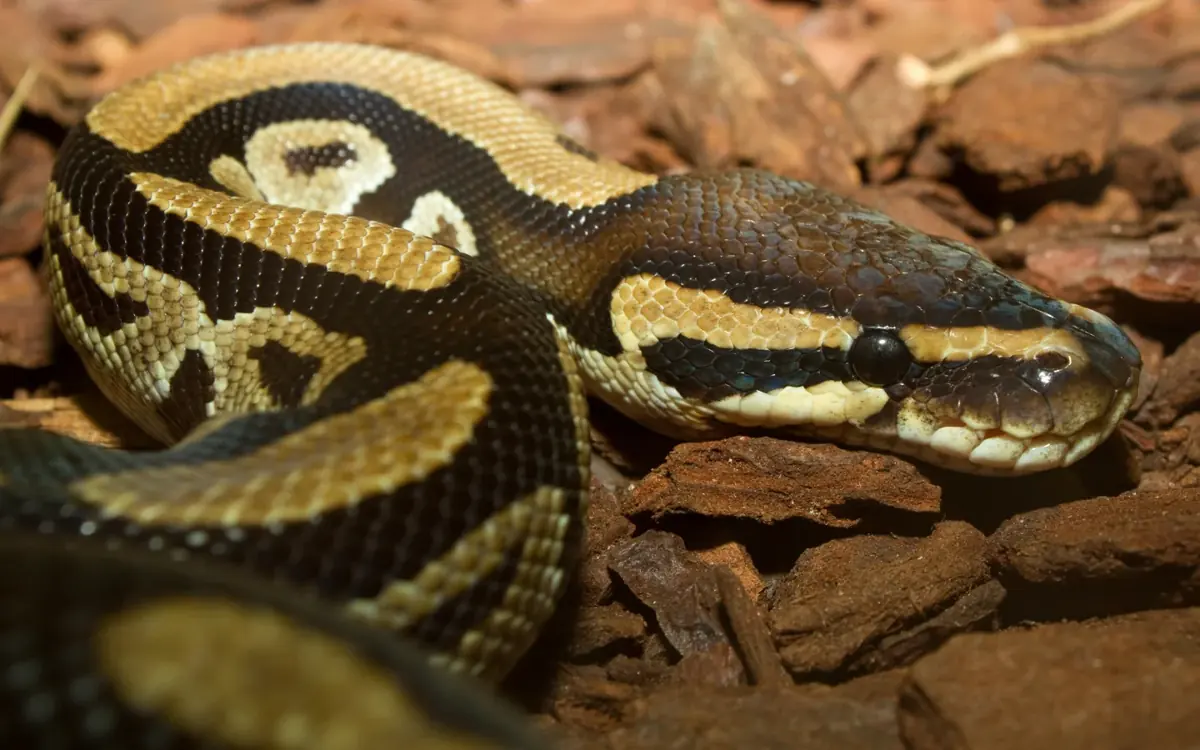
A ball python may spend much of the day concealed and become easier to observe in the evening. That does not mean it needs little space or stimulation. This West and Central African species, also called the royal python, uses sheltered ground-level places and can climb when given suitable support. In a captive housing study, snakes used opportunities to climb, burrow, bask and bathe that were unavailable in shallow racks. The study supports offering those choices; it does not establish one perfect enclosure or lighting dose.
Before acquiring one, be comfortable storing and preparing whole rodents, checking an enclosed environment every day and arranging reptile-veterinary care. Adult length is often roughly ≈ 47.244″–59.055″ (1.2–1.5 m), with individual variation. Plan for decades: some care guidance describes 30 years or more, although a published lifespan is not a prediction for your animal. Budget for adult housing, controlled heating, monitoring, prey, electricity, replacement lamps and a veterinary reserve. Arrange another competent caretaker for absences and future changes in your circumstances.
Also consider who shares the home. Because of infection risk, the CDC (Centers for Disease Control and Prevention) does not recommend reptiles for households with young children, adults 65 or older, or people with weakened immune systems. Its handling and feeder-rodent boundaries are explained in the hygiene section below.
Choose space the whole snake can use
For one adult ball python up to 5′ (152 cm) total length, our recommended minimum is 5′ × 2′ × 2′ (152 × 61 × 61 cm), length × depth × height of usable internal space. We prefer 6′ × 3′ × 3′ (183 × 91 × 91 cm) for more climbing and covered routes. A confirmed adult no longer than 4′ (122 cm) can use a minimum 4′ × 2′ × 2′ (122 × 61 × 61 cm). These are specialist-informed welfare recommendations, not experimentally validated thresholds.
Keep the enclosure at least as long as the actual snake, including its tail. A 6′ (183 cm) adult therefore needs at least 6′ × 2′ × 2′ (183 × 61 × 61 cm), with 6′ × 3′ × 3′ (182.88 × 91.44 × 91.44 cm) preferred. Allow more depth and height if the furnishings crowd turning or climbing. Sex helps estimate adult size but does not remove either sex's need to climb. A juvenile home is temporary unless it already meets the adult plan.
Provide covered ground routes, whole-body hides at different temperatures and stable climbing supports. A 4″ (10 cm) bedding layer occupies part of the stated internal height, leaving about 20″ (51 cm) above it in the minimum or 32″ (81 cm) in the preferred home, before fixtures. Retain room for a stable drinking vessel and optional easy-exit soaking basin. Secure openings, guard equipment and keep access for cleaning. Dimensions alone cannot establish suitability: the finished enclosure must provide usable movement, refuge, climate choices and safe service access.
Make shelter compatible with movement
Place snug retreats toward both the heated and cooler ends, each large enough for the whole coiled snake but enclosed enough to provide close cover. Add a maintained humid retreat and sheltered routes between resources. A snake should be able to choose a temperature without having to trade away concealment. Check hide fit as it grows, and offer comparable security at both ends before assuming that preference for one hide means the other temperature is wrong.
Provide stable branches or platforms and cover that allow exploration without trapping the snake. Support heavy rocks and structures independently of loose substrate so digging cannot undermine them. Climbing opportunities are appropriate for either sex; this guide does not use unverified field percentages to decide which animals may climb. Every reachable perch also changes the snake’s distance from heat and UV lamps, so remeasure exposure after rearranging the enclosure.
Use one clearly measured heat plan
For healthy, nonbreeding maintenance, provide a daytime basking substrate surface of 95–104°F (35–40°C), daytime ambient air of 82–86°F (28–30°C) and nighttime air of 75–79°F (24–26°C). These are three different measurements. The basking target describes an accessible surface beneath the heat source, not hide air or the snake's body.
Heat one end and provide sheltered routes away from the basking surface. Measure occupied-height air on both sides and inside retreats. Arrange the lower part of the daytime air range toward the cooler retreat and the upper part toward the heated side. At night, turn visible and UV lights off and check occupied air, including the cooler retreat, against the night range. Use suitable controlled non-light heat when needed.
We retain the Baines UV-Tool (an ultraviolet lighting reference) summer reference because it clearly distinguishes surface, day air and night air. Using it for ordinary year-round maintenance and arranging its ambient range between retreats are our practical choices, not separate published hide setpoints. Other credible protocols are cooler; the disagreement and its measurement context are explained below.
Check the environment as well as the controller
Use independent digital thermometers for air and an infrared thermometer for accessible surfaces. For air, position probes at a documented occupied height without laying them on substrate or exposing them directly to the heating beam. For surfaces, check the usable basking patch and any hotter reachable edges or raised furnishings, following the instrument’s instructions. An infrared thermometer does not measure air. One central reading cannot show what is happening in both retreats.
Connect each heat source to compatible thermostatic control and secure the control probe as its actual equipment instructions require. That probe controls the heater; the independent thermometers check the result. Guard hot fittings and prevent access to bulbs and heaters, including from climbing routes. Check that guards and nearby surfaces do not create a reachable hazard. Choose heater output for the real room and enclosure, then verify the final arrangement; a universal wattage or copied thermostat setting cannot do that work. Recheck after equipment, furnishing or room-condition changes.
Offer daylight, UV and complete shade
Set a consistent 12-hour daylight period and 12 hours of darkness. Offer a low-level UV opportunity around UVI 1.0 at the reachable basking position, falling to zero inside shelter. Measure at the snake's back height with a suitable meter directed toward the lamp, including its closest reachable position. Fixture, distance, mesh and branches all affect the result; follow the lamp's actual installation and replacement instructions.
For albinos, the RSPCA (Royal Society for the Prevention of Cruelty to Animals) gives a lower maximum of UVI 0.7 with shade. That is guidance, not a dose proven safe for every sensitive morph. Preserve covered warmth and obtain individual advice when sensitivity or health affects the lighting plan. We recommend voluntary UV exposure without claiming that a particular dose guarantees lifelong benefit or substitutes for a balanced diet.
Manage moisture and drinking water together
Maintain a daytime reference around 60–80% relative humidity at a documented middle-enclosure point, recording its local temperature. Check the humid refuge separately and investigate conditions at both ends when troubleshooting. Relative humidity changes with temperature; a middle probe is not an average of the whole habitat.
Keep ventilation, a maintained humid retreat and clean dry resting surfaces. Humidity may rise as temperatures fall at night, but do not seal the enclosure or force sustained saturation to imitate weather records. Inspect bedding and condensation as well as the meter. This operating choice follows specialist and veterinary guidance, while the lower RSPCA range is discussed below.
Provide clean drinking water in a stable accessible bowl, refreshed daily and immediately after contamination. A vessel large enough for voluntary whole-body immersion with an easy exit adds a choice where the layout permits. Retain useful floor routes and do not force routine baths. Persistent unusual soaking or other changes need investigation, not an automatic humidity diagnosis.
Choose bedding you can maintain
A reptile-appropriate moisture-retaining substrate can support humidity and digging while allowing dry resting areas. A layer about ≈ 3.937″ (10 cm) deep is a practical starting option from ReptiFiles rather than a biological minimum. Choose depth around the actual enclosure height, cleaning access and secure supports; substrate must not undermine heavy furnishings or make the snake unexpectedly closer to a lamp. Avoid treated or aromatic materials, unknown additives and carpet that is difficult to keep clean.
Plain paper can make waste and health changes easier to inspect during temporary observation, but it does not manage humidity for you: retain a suitable refuge and verify the environment. A planted or bioactive system also needs inspection and waste management. Its substrate recipe and replacement schedule depend on the system; no particular commercial mix is required, and adding a clean-up crew does not make the enclosure self-cleaning.
Prepare whole prey safely
Use appropriately sized, commercially reared frozen-thawed whole rodents as the practical staple. Whole prey supplies tissues and nutrients that pieces of meat do not, and wild-caught rodents introduce avoidable uncertainties. Obtain the snake’s established prey type and size before acquisition. Living rodents can seriously injure a snake; if an animal will not take frozen-thawed prey, arrange an experienced reptile veterinarian’s transition plan rather than treating live feeding as harmless.
Keep feeder rodents in designated, closed containers separated from human food. Thaw under refrigeration, then warm the completely thawed prey shortly before offering; a warm outside does not prove the centre is thawed. Do not microwave it. Use dedicated preparation containers away from kitchen food surfaces and follow the supplier’s storage guidance. Frozen rodents can still carry germs, so freezing does not replace handwashing or cleaning the equipment.
Our practical preference is to offer with tongs inside the enclosure, keeping the prey clear of loose substrate on a clean feeding surface where feasible, then leave the snake undisturbed. Some veterinary sources recommend a separate feeding enclosure; neither location has been shown here to train away biting. Remove unused prey promptly and plan the next offer from the animal’s history and condition, rather than leaving food in the enclosure or repeatedly presenting larger meals.
Match meal size and interval to the animal
For an otherwise healthy snake, start with one whole prey item around, and no wider than, the snake’s midbody, following the ARAV (Association of Reptile and Amphibian Veterinarians) leaflet’s practical rule. Record prey type and size or mass with the date. RSPCA allows slightly wider prey; neither width rule is a measured calorie requirement. Do not add a percentage-of-body-mass rule as a second compulsory target, or enlarge a meal merely because the snake accepts more food.
Our starting framework is approximately every 7 days for established growing young, every 10–14 days for subadults, and around every 14 days for mature adults. These are monitored starting intervals drawn from species-specific care guidance, not deadlines or a proven optimum. Other published schedules differ, including Thieme’s 14–21 days for adults. Review meal size and interval together against growth, body condition and feeding history. An animal that is thin, obese, ill, recovering or reproducing needs an individual plan rather than this default.
Keep comparable weights and body views alongside meal, refusal, shed and waste records. Ask a reptile veterinarian to assess condition and the trend instead of aiming for one universal adult weight. With good-quality whole prey, RSPCA and veterinary guidance generally do not call for routine vitamin or mineral additions. ReptiFiles advises occasional supplementation, but no universal ball-python dose was established by this review. Do not automatically dust meals with calcium, vitamin D3 or multivitamins; discuss an unusual diet, poor prey quality or suspected deficiency with the veterinarian.
Treat refusal as information
A missed meal can occur around shedding or reproductive changes, but it can also signal disturbance, unsuitable conditions or disease. Check the actual air and surface measurements, retreat security, recent handling, prey preparation and the dates of previous meals. Record the refusal and compare weight and condition over time. Interest in another meal does not prove it is needed, and refusal does not prove the animal is simply seasonal.
Do not offer progressively larger food every day, force-feed or wait for a fixed percentage of weight loss before seeking help. No single safe fasting duration applies to every ball python. Contact a reptile veterinarian for a persistent change; seek advice earlier for a new or growing snake that is not eating, any weight loss or other signs of illness. Take the feeding history and environmental log so the problem can be assessed rather than repeatedly changing equipment or food at random.
Let handling remain a choice
Once a healthy snake has settled, begin short, calm handling sessions close to a secure surface. Scoop and support its body rather than grabbing the head or tail, and keep it away from your face. A withdrawn head, tense defensive posture or attempts to escape are reasons to stop. A motionless ball is not proof that the animal enjoys the interaction, and there is no daily handling quota to meet.
Allow at least 48 hours of quiet after feeding, and longer if the animal remains unsettled. That interval does not prove digestion has finished; also defer optional handling during shedding or arrival care. Outside the enclosure, room conditions and the individual’s response matter more than trying to reach a fixed session length. Within it, stable climbing, concealment and exploration provide activity without requiring human contact.
Inspect the shed without pulling it off
Duller skin and cloudy eyes can precede shedding. Reduce optional handling, keep clean water and the maintained humid refuge available, and provide stable textured furnishings the snake can use. After the shed, inspect the discarded skin, including the tail tip and eye coverings. A difficult shed has several possible causes; it is not automatically proof that one humidity reading was too low.
Obtain veterinary advice for retained eye coverings or persistent incomplete shedding. Do not peel the spectacles off the eyes or start routine forced soaking as a substitute for assessment. Bring the shed history and the humidity and temperature records. Repeated problems need the whole animal and its setup considered together.
Review care as the snake grows
Young snakes need small, secure retreats, appropriate water access and openings that cannot become escape routes. A larger furnished enclosure can work when these resources are easy to reach; there is no requirement to keep a youngster in a bare, shallow box. Recheck hide fit, usable enclosure length and climbing supports as the animal grows. Do not automatically raise temperatures or retain a juvenile feeding pace throughout adulthood.
This guide is for nonbreeding maintenance and does not prescribe cooling, brumation or induced fasting. Seasonal or reproductive changes can affect behaviour and appetite, but they do not rule out illness. A suspected gravid female that is weak, unresponsive or struggling needs urgent veterinary advice; breeding nutrition and egg management require a separate plan. New changes in an older snake also deserve assessment rather than an assumption that age explains them.
Prepare the arrival before the purchase
Obtain the animal’s identity, origin, recent weights, meal dates, prey type and size, shedding history and any veterinary records. Arrange an initial reptile-veterinary examination and ask what samples or screening are appropriate. If other reptiles are present, prepare a separate enclosure and dedicated tools, service established animals first and agree observation and release criteria with the veterinarian. A fixed number of quarantine days or one negative test cannot guarantee clearance of every infection.
Before arrival, run the fully furnished empty enclosure for at least a week, following RSPCA’s practical preparation advice. Record day and night air, basking surfaces, middle-point humidity and refuge condition, and check UVI, shade, security and water access. Adjust the final setup before occupancy; one week does not test every seasonal room condition.
During the initial week, complete essential care quietly and minimize optional handling, allowing longer if the animal remains unsettled. Do not repeatedly uncover it to check whether it has relaxed. Choose the first feeding opportunity from the previous meal history, the animal’s state and acclimation; there is no universal arrival-day deadline. Keep water, observations and a useful record consistent from the start.
Build a routine you can sustain
Each day, check water, waste, security, equipment and the animal without unnecessary disturbance. Remove waste promptly and clean any soiled bowl or furnishing. For a routine non-bioactive enclosure, approximately monthly full cleaning is an RSPCA starting schedule, with earlier cleaning for contamination. Other sources recommend different intervals; substrate systems and disease risks change the work required, so a calendar is not proof that an enclosure is hygienic.
Keep the snake in secure, appropriate temporary accommodation while cleaning. Remove physical dirt before applying a suitable disinfectant, and follow that product’s dilution, contact-time, rinsing and drying instructions before return. Use dedicated reptile tools and an appropriate cleanup area away from human food preparation. Wash hands after contact with the snake, its equipment or feeder rodents. Healthy-looking reptiles and frozen prey can still carry germs.
CDC advises that children under 5 should not touch reptiles or their environments. Children under 5, adults 65 or older, pregnant people and people with weakened immune systems should not handle feeder rodents. Keep these boundaries in the household care plan; another person taking over feeding does not remove the CDC’s broader recommendation about at-risk households.
Know when observation is not enough
Open-mouth or laboured breathing, abnormal discharge and marked lethargy need urgent contact with a reptile veterinarian. Separate an affected animal from other reptiles and report the environmental readings. Respiratory disease can be infectious: an experiment in ball pythons demonstrated disease after nidovirus infection. That does not diagnose your snake, but it explains why simply drying the enclosure is not a treatment. Do not start home antibiotics or steam protocols.
Arrange assessment for regurgitation, persistent appetite change, declining condition, abnormal swelling or repeated shedding difficulty. Significant burns or prey wounds, prolapse, severe weakness, collapse, or a weak suspected gravid female warrant urgent advice. These signs have several possible causes. Avoid home parasite drugs, laxatives, assisted feeding or egg manipulation; the useful first steps are safe separation where needed, prompt professional contact and an accurate history.
Troubleshoot without chasing one number
If the snake uses only one retreat, compare concealment, fit and the actual air and contact surfaces before moving the thermostat. Security may explain the choice. If humidity drops soon after spraying, inspect sensor position, simultaneous temperature, substrate moisture and ventilation; repeated surface misting can create brief peaks while the underlying setup remains unsuitable. Preserve dry resting choices while correcting the cause.
If a raised branch makes a previously measured lamp installation unsuitable, change the access or equipment arrangement and measure again. If meals are repeatedly refused, follow the history-and-health review above instead of using larger prey or random heating changes as a test. Mistakes to avoid include confusing air with surface temperature, combining unrelated source targets, leaving heat uncontrolled, using live rodents, sealing ventilation to chase humidity and pulling retained eye coverings.
Gather the equipment before the animal
Start with the appropriately sized secure enclosure; fitted retreats and a humid refuge; stable climbing and cover; maintainable substrate; and accessible drinking water. Match the heater, guards, controller and probe installation to one another. Add independent air thermometers, an infrared thermometer, a digital hygrometer, daytime lighting with a timer, and a way to measure the chosen UVI at the animal. Choose actual models from their instructions and verified output, not a universal shopping wattage.
Prepare dedicated prey storage and preparation containers, feeding tongs, a suitable weighing scale, a care log, separate arrival equipment, cleaning tools and a secure carrier for veterinary trips. Include replacement and running costs in the budget. Use the setup checklist as a record of tasks completed, then keep the environmental and feeding log as evidence of how the arrangement performs. Possessing every item does not establish that the finished setup works.
Where recommendations differ
Enclosure guidance varies in depth and height. RSPCA uses full snake length with at least one-third of that length for the other dimensions, while ReptiFiles provides a larger baseline and full-length extension. A comparison of 35 ball pythons found more behavioural opportunities in furnished terrariums than racks, but changed space, furnishings and lighting together and always used the rack first. It supports giving room and resources; it does not establish an exact size threshold. We choose the more spacious specialist baseline, extended for the actual adult.
Thermal protocols also differ. Baines separates a 95–104 °F (35–40°C) surface from 82.4–86 °F (28–30°C) daytime air and 75.2–78.8 °F (24–26°C) night air. Merck specifies a cooler 77–86 °F (25–30°C) air gradient, while ReptiFiles lists a 86–89.6 °F (30–32°C) warm hide, 71.6–80.6 °F (22–27°C) cool hide and 69.8–78.8 °F (21–26°C) night range with mixed surface/probe measurement instructions. We retain the explicitly measured Baines plan; a veterinarian or experienced keeper may use another coherent protocol, but its measurement locations and night strategy must be followed together. The evidence does not show that the cooler alternatives are intrinsically harmful.
For humidity, RSPCA recommends 50–60% at the cool end with brief rises, while ReptiFiles uses 60–80% near the middle and ARAV also describes 60–80%. Sensor location partly affects comparison, but this remains a real difference in practice. We choose the higher ordinary range with ventilation, a humid refuge and dry resting choices. A lower ambient plan may work with suitable refuges and monitored hydration; repeated poor sheds or wet resting areas call for review of the whole setup.
RSPCA's UVI 1.0 differs from the specialist's 2–3. We choose the lower voluntary-exposure plan. A small 70-day study found no significant change in the measured vitamin D and calcium markers with its tested UVB (ultraviolet B) regime, but the exposed group was all female and the groups differed at baseline. It establishes neither an optimal UVI nor the absence of behavioural benefits. Supplement and feeding-frequency differences are addressed with the meal plan rather than treated as reasons to combine every protocol.
Sources & further reading
Read the full recommendations and check details for your animal, equipment, and local conditions.
- Python regius (SHAW, 1802)
- RSPCA: royal-python care
- Hollandt et al. (2021): ball-python housing comparison
- Ball Python Care Sheet
- Reptiles and Amphibians: Healthy Pets, Healthy People
- ReptiFiles: ball-python adult enclosure
- Baines et al. (2016): the UV-Tool
- ReptiFiles: ball-python temperature, humidity and UVB
- Merck: reptile management and air-temperature table
- Hedley and Eatwell (2013): ball-python UVB study
- Snakes: Feeding
- Common Problems in Pet Snakes
- Ball Python Substrate Options
- Ball Python: Companion Reptile Care Series
- Nutrition in Snakes
- Ball Python Feeding Tips
- Heimtier-Infos: Königspython
- Ball Python Care (Python Regius)
- Satiety and eating patterns in two species of constricting snakes
- Reptile quarantine
- Veterinary Care: The New Reptile Visit
- Bacterial Diseases of Reptiles
- Respiratory disease in ball pythons (Python regius) experimentally infected with ball python nidovirus
Original Creature Corner guide. Editorial fact and citation checks are recorded; independent veterinary review has not been performed.