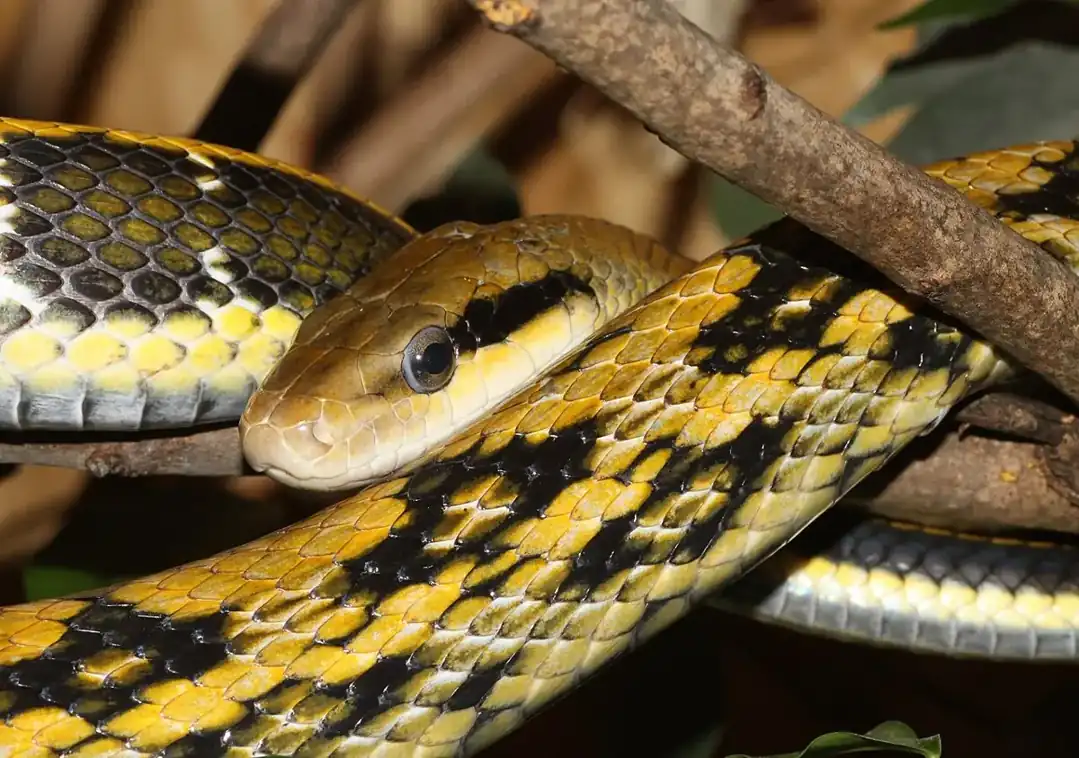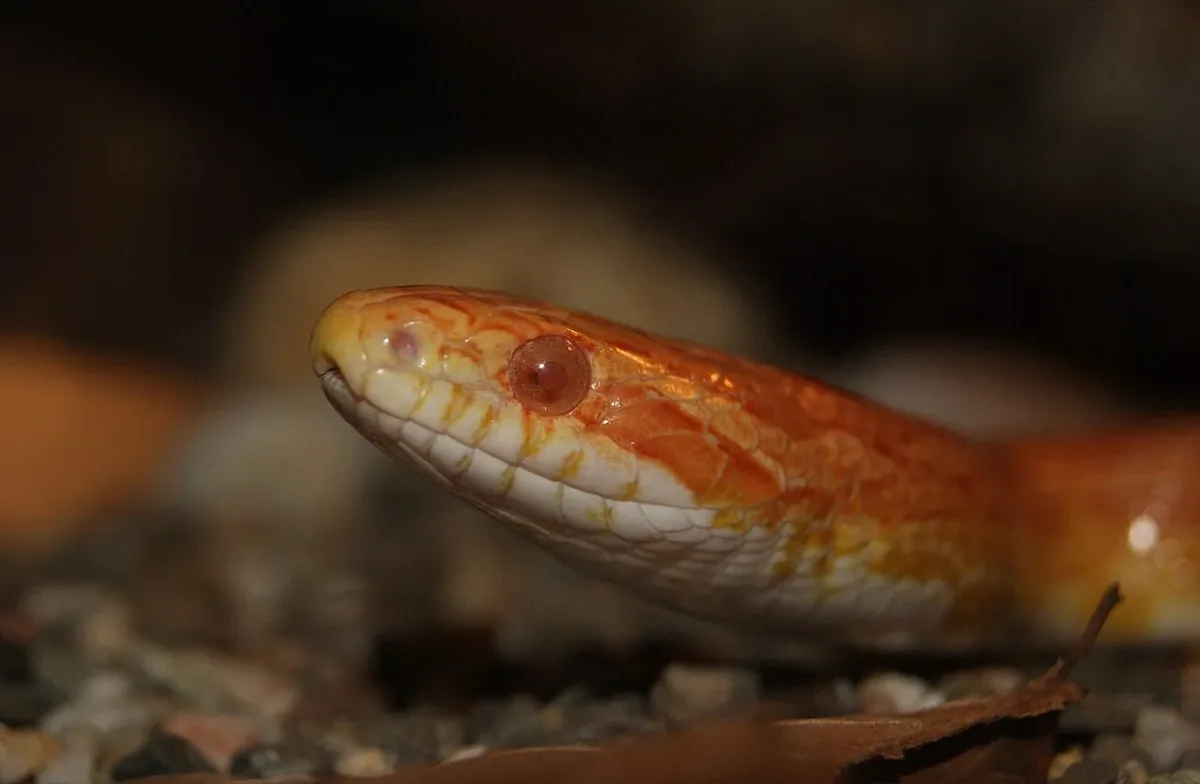
Use this guide as a starting point alongside the detailed sources below. Health concerns, unexplained changes in behavior, or feeding problems belong with a reptile veterinarian.
Adult enclosure recommendation
Our recommended minimum: 59.1″ × 29.6″ × 23.7″ (150 × 75 × 60 cm), length × depth × height.
Preferred target: 70.9″ × 35.5″ × 35.5″ (180 × 90 × 90 cm), length × depth × height.
Usable internal space for 1 adult animal. One Pantherophis guttatus adult up to ≈ 59.055″ (150 cm) total length, either sex. Longer adults need the conditional dimensions below; hatchling housing is temporary.
Height is the usable internal envelope, including the space reserved for substrate and water. Check the remaining movement space and lamp clearance after installation.
This editorial preferred target adds floor routes, more separated retreats and climbing opportunity for an adult up to ≈ 59.055″ (150 cm); it is not a scientifically tested optimum.
Our editorial minimum uses ReptiFiles' full-body-length floor, half-body-length depth and at least ≈ 23.7″ (60 cm) height, with a ≈ 59.055″ (150 cm) adult planning example. The controlled corn-snake study supports space for full elongation and greater activity, but did not validate this exact threshold or compare alternative depths/heights. We choose greater depth and height than the earlier RSPCA (Royal Society for the Prevention of Cruelty to Animals) one-third-body-length example to retain useful routes around furnishings.
Use total length from snout to tail tip, not snout-to-vent length: floor length at least the snake's total length, depth at least half that length, and height at least ≈ 23.7″ (60 cm). A ≈ 59.055″ (150 cm) adult needs at least ≈ 59.1″ × 29.6″ × 23.7″ (150 × 75 × 60 cm); a ≈ 70.866″ (180 cm) adult needs at least ≈ 70.9″ × 35.5″ × 23.7″ (180 × 90 × 60 cm). The larger preferred enclosure is still subject to this rule.
Adult longer than ≈ 59.055″ (150 cm), worked example at ≈ 70.866″ (180 cm) total length
Our recommended minimum: 70.9″ × 35.5″ × 23.7″ (180 × 90 × 60 cm), length × depth × height. Apply the same specialist length/depth rule. The larger preferred target is our editorial provision for routes and climbing, not a validated threshold.
Preferred target: 82.7″ × 41.4″ × 35.5″ (210 × 105 × 90 cm), length × depth × height.
- Floor space
- Keep a full-length straight route and room around warm/cool hides and the bowl. Shelves do not replace floor length.
- Climbing space
- Use secure branches and elevated shelter across the upper space. The ≈ 23.622″ (60 cm) internal envelope includes substrate; approximately ≈ 20.472″ (52 cm) remains above a ≈ 2.953″ (7.5 cm) layer, before required lamp clearances.
- Substrate
- Start with about 3″ (7.5 cm) of burrowable, humidity-compatible substrate. Support heavy furnishings on the base and retain dry resting surfaces.
- Water
- A stable cool-end bowl must fit the whole coiled snake for voluntary immersion, with easy entry and exit; no pool footprint is prescribed.
- Security and ventilation
- Lock openings, inspect hatchling-sized gaps, keep adhesives and hot fixtures inaccessible, and prove thermal and UV gradients through the furnished enclosure.
Meeting these dimensions alone does not establish suitability. Check the usable layout, environmental conditions, equipment clearance and the individual animal’s requirements before occupation.
An explorer you will care for over many years
A corn snake uses the enclosure as a network of routes: underneath cover, through loose material and up branches. Sheltering is part of that activity, not evidence that an animal needs only a hiding box. Give it ways to move while remaining concealed, and expect its use of the enclosure to change with feeding, shedding and time of day.
This guide is for Pantherophis guttatus, also called the eastern or red corn snake. Older books may call it Elaphe guttata; other species once included under that name do not automatically share this care plan. A corn snake can reach around ≈ 59.055″ (1.5 m), and some individuals grow longer. Size housing to the snake you have, allowing for growth.
Before bringing one home, be comfortable keeping and preparing whole rodents, checking equipment every day and arranging care with a reptile veterinarian. PetMD describes possible longevity beyond 20 years, so plan for decades rather than assuming care ends at a particular birthday. Include adult housing, electricity, replacement lamps, substrate, food and a veterinary reserve in the budget, and arrange another competent caretaker for absences. A corn snake can be manageable for a prepared first-time keeper, but its needs do not become optional because it is commonly sold as a beginner pet.
Plan the adult enclosure around usable length
Keep one corn snake in a secure, furnished enclosure. Our recommended minimum for an adult up to ≈ 59.055″ (150 cm) total length is ≈ 59.1″ × 29.6″ × 23.7″ (150 × 75 × 60 cm), measured as length × depth × height of usable internal space. We prefer ≈ 70.9″ × 35.5″ × 35.5″ (180 × 90 × 90 cm) for that adult because it gives more room for covered travel, separated retreats and climbing. These are our welfare recommendations, not experimentally validated cutoffs.
Measure total length from snout to tail tip, including the tail. Use at least the animal's full length for the enclosure length, half its length for depth and at least ≈ 23.7″ (60 cm) for height. A ≈ 70.866″ (180 cm) adult therefore needs at least ≈ 70.9″ × 35.5″ × 23.7″ (180 × 90 × 60 cm); our preferred target for that larger animal is ≈ 82.7″ × 41.4″ × 35.5″ (210 × 105 × 90 cm). Do not treat a typical adult size as a limit on an individual.
Keep a clear route long enough for full straightening around the bowl and retreats. Add warm, cool and moist hides, secure climbing branches and elevated cover. About 3″ (7.5 cm) of burrowable substrate is a practical starting layer. The stated height is the total internal envelope, including this layer: about ≈ 20.472″ (52 cm) remains above it in the minimum, or ≈ 32.283″ (82 cm) in the preferred enclosure, before lamp clearances. Support heavy furnishings on the base. A stable cool-end bowl should fit the whole coiled snake for voluntary immersion without blocking travel.
Choose secure mechanical closures and inspect sliding-door overlaps, lid edges, removable vents and cable ports. A hatchling can exploit openings an adult cannot. An adult enclosure with appropriately small hides and abundant cover can accommodate a youngster; a smaller grow-out enclosure is temporary and must expand with the animal. Recheck gaps, hide fit and full-length movement as it grows.
Dimensions alone do not make a suitable habitat. Test the furnished heat and UV gradients, safe clearance from fixtures, ventilation, dry resting places and cleaning access. A controlled study of 12 adult corn snakes found greater activity in larger enclosures and a preference for them while active; its two sizes and short study periods do not identify an exact minimum depth or height. No construction project has been assessed here as meeting this complete care plan.
Build routes between secure resting places
Place snug hides at the heated and cooler ends, each large enough for the whole coiled snake. Add a maintained moist hide and cover between resources. This lets the animal choose a temperature without being forced into the open. Include stable branches and an elevated retreat where the layout allows, while keeping a usable route for full straightening. Check that gaps cannot wedge the snake and that heavy furnishings stand securely on the enclosure base, so burrowing cannot undermine them.
Use clean, suitable burrowable substrate, such as an appropriate soil-based blend or moisture-retentive reptile bedding. ReptiFiles suggests about 3″ (7.5 cm) as a starting depth; that is a practical reference rather than a tested biological minimum. Add depth where it creates usable burrowing space without compromising doors, ventilation or lamp clearance. Choose material for the humidity plan and cleaning routine, avoiding contaminated or chemically treated material. Keep resting surfaces dry while maintaining the separate moist retreat.
Paper can be useful temporarily when observing a new arrival or collecting clean samples. Continue to provide hides and cover during that period. Brief research on hatchling background choices supports taking concealment and complexity seriously, but it does not establish an ideal commercial bedding or show that temporary paper is harmful. A planted enclosure also needs deliberate maintenance; plants and cleanup organisms do not remove that responsibility.
Measure daytime surfaces and plan the night separately
Provide about 90°F (32°C) on the accessible daytime basking surface and 75–82°F (24–27°C) on the cool-side substrate. These specialist operating targets describe surfaces, not an enclosure-wide air setting. Place independent digital probes at both locations and inspect accessible branches and raised surfaces as well. An infrared thermometer checks surfaces; use a probe shaded from direct heat to measure air.
Place controlled overhead heat toward one end, with covered routes to cooler shelter. Connect every heater to a compatible thermostat and secure its control probe according to the equipment instructions. Independently measure what the snake can reach. Prevent contact with lamps and hot fittings from every climbing route; select wattage by testing the actual finished setup.
Switch visible and UV lamps off at night. For youngsters under one year, or an animal whose established care requires overnight warmth, we recommend the warmer 75°F (24°C) cool-zone option described by ReptiFiles. Our implementation is a controlled non-light heater, an independent cool-side air probe at occupied height outside the direct beam, and surface checks. The source does not explicitly identify whether its night number is air or surface; this measurement arrangement is our editorial interpretation, not a proven biological minimum.
A healthy established adult may suit a separately planned cooler-night regime. RSPCA gives household nights around 61–68°F (16–20°C), alongside a different daytime plan. Review the animal's age, health and actual overnight readings before choosing that alternative. Do not deliberately cool or fast a pet for winter from a calendar alone.
Offer a measured patch of UV and places to avoid it
Provide a starting schedule of 12 hours of light and 12 hours of darkness. We recommend about UVI 1.0 at the basking opportunity, with zero-exposure shelter. For albinos, keep exposure no higher than UVI 0.7. These RSPCA targets are practical guidance, not doses proven optimal for every corn snake. Preserve covered warmth and get individual advice if unusual light sensitivity or illness complicates the setup.
Measure UV Index at the snake's back height with a suitable meter aimed toward the lamp, including its closest reachable climbing position. Check through the final mesh with the actual fixture installed. Lamp percentage alone does not specify exposure. Follow installation clearances and replacement instructions; remeasure after changing branches, lamps or screening.
UV can affect vitamin-D metabolism in this species. In a four-week study, UV-exposed adult males had increased circulating 25-hydroxyvitamin D3 compared with controls. That experiment used 12 snakes and did not establish an optimal UVI, a lifetime clinical requirement or an oral supplement dose. Give the snake a choice of measured exposure and shade.
Track moisture where the snake actually lives
Maintain an average relative humidity of 65–75% at a consistent monitoring point near the enclosure's middle, with a clean moist hide and dry resting surfaces. We use this specialist operating range to provide a moisture reserve in a ventilated habitat while preserving a drier retreat. It is an editorial choice under genuine uncertainty, not a proven captive optimum.
Record temperature and time with each humidity reading. Readings normally vary across the warm and cool sides and between day and night; a midpoint sensor is not a true enclosure-wide average. Check occupied refuges too. Adjust substrate moisture and ventilation from the recorded pattern rather than spraying on a fixed schedule, and distinguish brief peaks from persistently wet bedding.
Provide fresh water continuously in a stable, accessible bowl at the cool end, large enough for voluntary immersion. Replace it daily and whenever fouled. Routine forced baths are not needed. A fogger is not compulsory; if you use a moisture device, keep it clean and verify its effect.
Feed for steady condition, not maximum growth
Use suitable captive-produced whole prey, with fully thawed mice as the practical staple. Whole prey includes tissues and bones that a piece of meat does not supply. Start with the prey the snake is already eating successfully, then adjust size as it grows. Select one manageable item around the width of the snake’s widest body region, rather than its head. Published size rules differ, so do not force the largest item a chart permits.
Our starting framework follows RSPCA: a hatchling pinky meal about every five to six days, progressing to a suitable adult mouse about every seven to fourteen days for an adult. The meal must fit the individual; “adult mouse” is not a command to give the same prey to every snake. Growing juveniles need prey and interval reviewed together as they move between those stages. Ask the breeder or previous keeper for the established record and use it alongside growth and body condition.
ReptiFiles offers a different, community-derived progression, including fourteen to twenty-one days for established adults. No comparative evidence reviewed here identifies one universally optimal interval. Keep a dated meal log with prey size or weight, refusals, sheds and comparable monthly snake weights, and review condition with a reptile vet. A snake accepting another mouse does not by itself demonstrate a nutritional need. Do not accelerate growth or start a weight-loss feeding regime from an online chart.
Prepare prey safely and leave digestion undisturbed
Thaw frozen prey completely in a sealed container in the refrigerator, then warm the sealed item in water shortly before offering it. Use dedicated containers and utensils, and avoid overheating. Larger prey takes longer to thaw; an apparently warm exterior does not establish that the center is thawed. Do not microwave prey. Discard uneaten thawed food safely.
Offer with feeding tongs in the home enclosure. A clean feeding surface can help limit bedding contact; this is a practical precaution, not a reason to move every snake to a separate bin. Frozen-thawed prey avoids the bite injuries live rodents can inflict. Obtain help for a persistently refusing animal rather than automatically switching to live prey. Remove uneaten food promptly and leave the snake undisturbed after a meal, with access to its measured thermal choices.
Do not add powders by habit
Do not routinely add calcium, vitamin D3 or multivitamins to appropriate quality whole prey for a healthy corn snake. We follow the veterinary approach because intact prey supplies tissues and bones, and extra products can create an unbalanced intake. An unusual diet, suspected deficiency or medical condition needs a specific veterinary plan.
ReptiFiles suggests occasional powder supplementation, while VCA says extra vitamins and minerals are generally unnecessary with whole prey. The evidence reviewed does not establish an optimal powder schedule for every snake. UV provision also does not yield a universal oral D3 dose; record any prescribed product and amount so the whole diet can be assessed.
Let behavior guide everyday interaction
Learn where your snake rests, how it uses its routes and what changes around meals and sheds. Quiet observation gives more useful information than repeatedly lifting it out to see whether it is active. Offer sheltered exploration and stable climbing choices; add or rearrange a feature thoughtfully and recheck any changed heat or UV access.
Once settled and well, use brief handling sessions with the body supported through your hands close to a secure surface. Avoid gripping tightly or holding it by the tail. Stop if it persistently struggles or becomes defensive; stillness is not proof that it enjoys the interaction. There is no daily handling quota. Defer optional handling for at least 48 hours after feeding and during shedding. That interval is a practical precaution, not a guarantee that digestion is complete or a reason to delay necessary medical care.
Check the shed without pulling at the snake
The eyes may become cloudy before shedding, and growing snakes generally shed more often than established adults. Reduce disturbance and check water access and the moist hide. After the shed, inspect the discarded skin and look at the tail tip and eyes without picking at attached material. Record the event rather than expecting a fixed calendar.
Persistent skin retention can have causes beyond low humidity. Review the actual environmental readings, then seek veterinary advice for repeated incomplete sheds, retained eye coverings or an eye that remains abnormal after shedding. Do not peel eye caps or pull attached skin; the examining veterinarian can decide whether intervention is needed.
Keep routine care practical and food areas separate
During the daily check, remove waste and soiled material promptly, clean and refill the water bowl, confirm equipment readings and look for an unexpected change in the snake. For a conventional enclosure, RSPCA’s monthly full-clean routine is a starting point, with earlier cleaning when needed. Other guidance uses shorter intervals. The amount of soiling and the actual system matter more than a promise that one calendar keeps everything clean.
For a full clean, place the snake securely in suitable temporary accommodation. Remove dirt before using a reptile-appropriate disinfectant, and follow that product’s dilution, contact-time, rinsing and drying instructions. Keep chemicals away from the animal. A planted or bioactive system still needs prompt waste removal, dish cleaning and inspection; do not treat living substrate as something to disinfect on a routine calendar.
Healthy-looking reptiles and frozen feeder rodents can carry Salmonella. Freezing does not sterilize feeders. Wash hands after contact with the snake, enclosure or prey, keep equipment and thawing containers away from human food preparation, and use a separate cleaning area. Do not kiss the snake or let it roam in food areas. CDC (Centers for Disease Control and Prevention) does not recommend reptiles for households with young children, adults 65 or older, or people with weakened immunity. Children under five should not touch reptiles or their environments. Its separate feeder-rodent advice excludes handling by children under five, adults 65 or older, pregnant people and people with weakened immunity. Plan care around everyone sharing the home.
Have the habitat working before the first week
Before arrival, run the fully furnished enclosure through daytime and overnight cycles for at least a week, including the conditions your room is likely to reach. Record the selected surface, air, humidity and UV measurements, inspect escape points and make sure water and every retreat are accessible. Prepare the adult-space plan, secure hides and branches, suitable substrate, thermostatic heat control, independent thermometers, hygrometer, lighting timer, UV measurement access, water bowl, feeding tongs, dedicated cleaning supplies, transport container and a record sheet.
Obtain the animal’s identity, origin, feeding history, recent sheds and health information. During the first week, keep optional handling to a minimum and monitor discreetly. Continue an appropriate familiar prey and feeding plan rather than repeatedly experimenting. Arrange an early reptile-veterinary examination; weakness, injury or other concerning signs need attention immediately rather than waiting for the settling period to end.
If other reptiles are present, keep the newcomer separately with dedicated tools and care for established animals before it. Quarantine still requires suitable temperatures, shelter and water. Agree screening and release criteria with the veterinarian instead of treating a fixed number of days as proof of freedom from infection. Keep records together so changes in weight, appetite or behavior can be assessed against the arrival baseline.
Do not let a season explain away illness
Appetite and activity can change around shedding, seasons or reproduction, but those explanations do not rule out disease or a failing environment. This ordinary-pet guide does not prescribe intentional brumation, breeding induction or a winter fasting schedule. Keep the measurements and records consistent, and investigate a change rather than cooling or fasting an animal because a calendar says to.
A mature female can develop egg-related problems without a male currently present. If reproductive activity is suspected, seek advice about appropriate private laying access and monitoring. Persistent swelling, straining, weakness or protruding tissue needs veterinary attention. These signs do not identify the cause at home; do not massage eggs or attempt to extract them.
Know when observation is no longer enough
Contact a reptile veterinarian urgently for difficulty breathing, a substantial burn or wound, protruding tissue, marked weakness or inability to move normally. Repeated regurgitation, skin or mouth lesions, persistent swelling and unexplained weight loss also need prompt advice. Take the care record and actual enclosure readings to the appointment; a temperature setting on a controller does not show what the animal experienced.
For repeated unexplained food refusal, check prey preparation, security, recent sheds and the measured environment, then seek advice; earlier for a small growing or otherwise unwell animal. There is no universal safe number of fasting weeks. Stable weight alone cannot exclude illness, and persistent problems should not lead to home force-feeding, pesticide treatment or medication.
Use problems to check the whole setup
Repeated pressure at a door: first secure the opening, then inspect usable space, covered routes and both ends of the temperature gradient. Check for nose damage and seek help if rubbing persists. An escape attempt does not reliably mean the snake wants handling.
A correct basking reading but no cool retreat: inspect the room temperature, direct sunlight and the heater’s spread. Check occupied retreats and raised surfaces as well as the two routine probe sites. A thermostat can regulate its own location while another part of the enclosure becomes unsuitable.
Repeatedly broken sheds: compare humidity and temperature records at their documented sites, inspect the moist hide and confirm water access. Do not respond by soaking every surface or combining incompatible source ranges. Recurrent trouble calls for veterinary assessment as well as environmental correction.
Where recommendations differ
Enclosure proportions differ. RSPCA uses full snake length with depth and height each at least one-third of that length. ReptiFiles uses half-length depth and at least ≈ 23.7″ (60 cm) height. We choose the larger proportions so cover, a bowl and branches leave more useful movement space. The controlled space study compared ≈ 32.7″ × 13.8″ × 15.4″ (83 × 35 × 39 cm) with ≈ 70.5″ × 22.9″ × 22.9″ (179 × 58 × 58 cm) for adults ≈ 46.457″–61.811″ (118–157 cm) long. It supports full elongation and larger space, but did not test either formula as a minimum.
Temperature recommendations also measure different things. RSPCA gives a 82–86°F (28–30°C) basking zone and 68–75°F (20–24°C) cool end, with less explicit air/surface wording. Our 89.6 °F (32°C) surface and 75.2–80.6 °F (24–27°C) cool-substrate targets follow the more explicit ReptiFiles measurement plan. They should not be averaged or substituted for each other; the separate night section explains when the cooler adult alternative may apply.
Humidity is genuinely unsettled: RSPCA gives 40–50%, whereas ReptiFiles gives 65–75% based partly on regional climate averages. Outdoor climate averages do not establish the humidity a sheltered snake experiences or prove a captive optimum. We choose the higher range with ventilation, dry refuge and a moist hide. A healthy animal established in a lower-humidity plan may be better served by maintaining that measured plan while reviewing hydration, shedding and refuge conditions with a reptile vet, rather than making abrupt changes to match a percentage.
UV guidance ranges from RSPCA's UVI 1.0, or no higher than 0.7 for albinos, to ReptiFiles' UVI 2–3. We choose the lower starting exposure with complete shade; the available short adult-male study shows vitamin-D response but does not decide between these UVI targets. A different measured plan requires attention to pigmentation, refuge access and the individual, not a stronger bulb by default.
Sources & further reading
Read the full recommendations and check details for your animal, equipment, and local conditions.
- Pantherophis guttatus (Linnaeus, 1766)
- Natural history and meristics of an allopatric population of red cornsnakes in central Kentucky, USA (USA: United States of America)
- Does enclosure size influence the behaviour & welfare of captive snakes (Pantherophis guttatus)?
- How to care for a corn snake
- Corn Snake Care Sheet
- Corn Snake Terrarium Size Requirements
- Corn Snakes Can Behaviorally Enhance Crypsis by Choosing Complex Backgrounds and Substrate
- Corn Snake Substrate Options
- Corn Snake Temperatures & Humidity Requirements
- Effects of ultraviolet radiation on plasma 25-hydroxyvitamin D3 concentrations in corn snakes (Elaphe guttata)
- Snakes: Feeding
- Feeding Your Corn Snake
- Reptiles and Amphibians: Healthy Pets, Healthy People
- Common Problems in Pet Snakes
- Reptile quarantine
- Veterinary Care: The New Reptile Visit
- Reproductive Diseases of Reptiles
- Common Diseases of Pet Snakes
Original Creature Corner guide. Editorial fact and citation checks are recorded; independent veterinary review has not been performed.