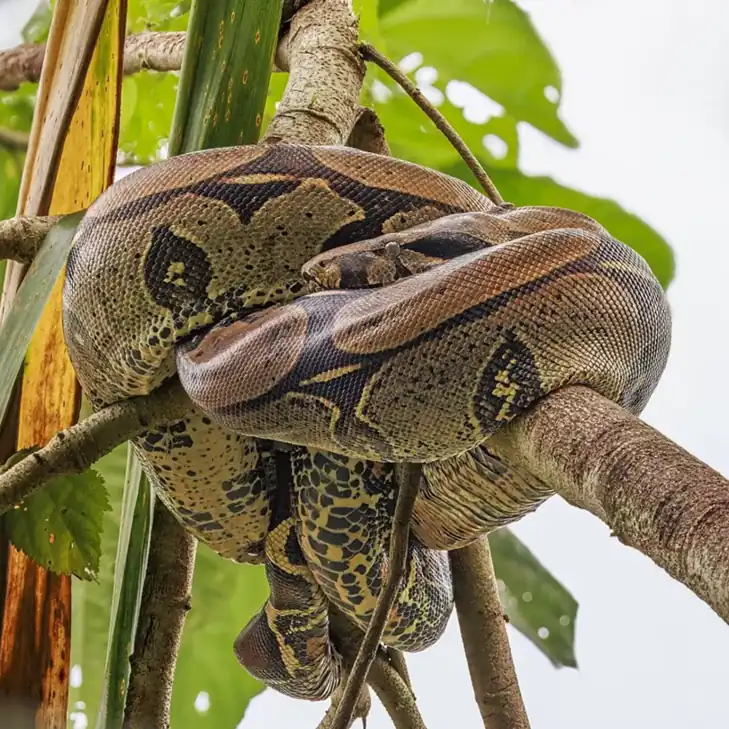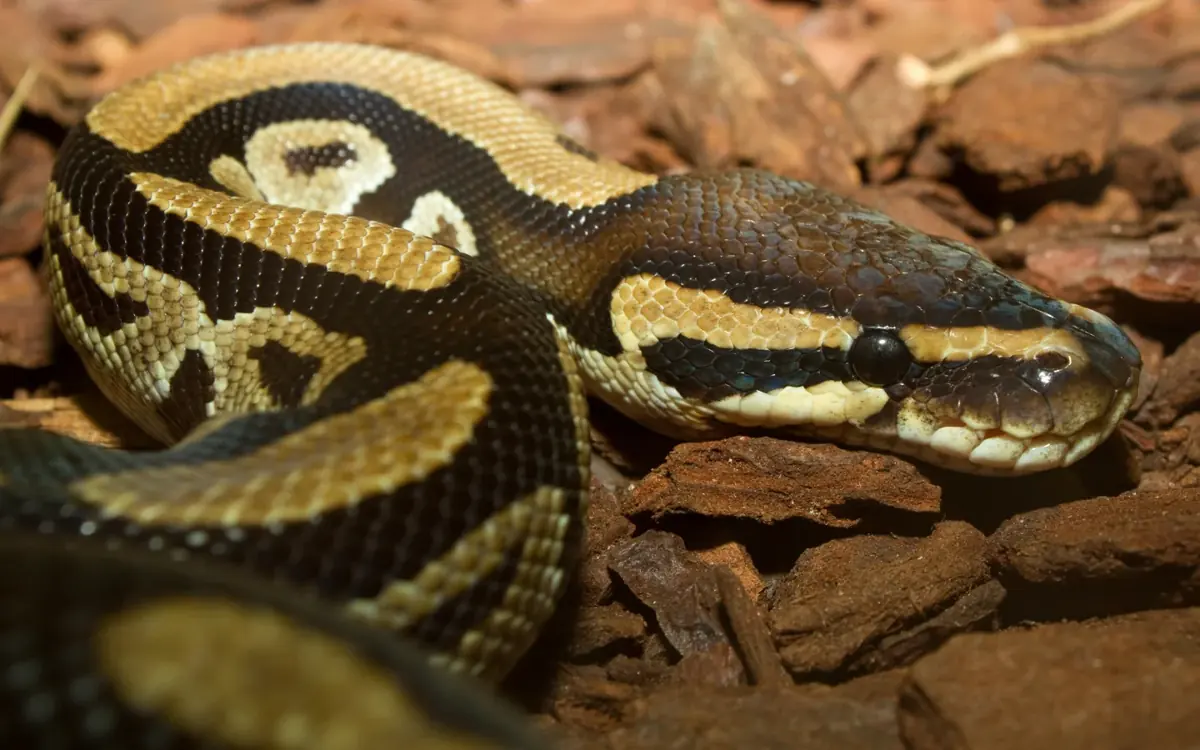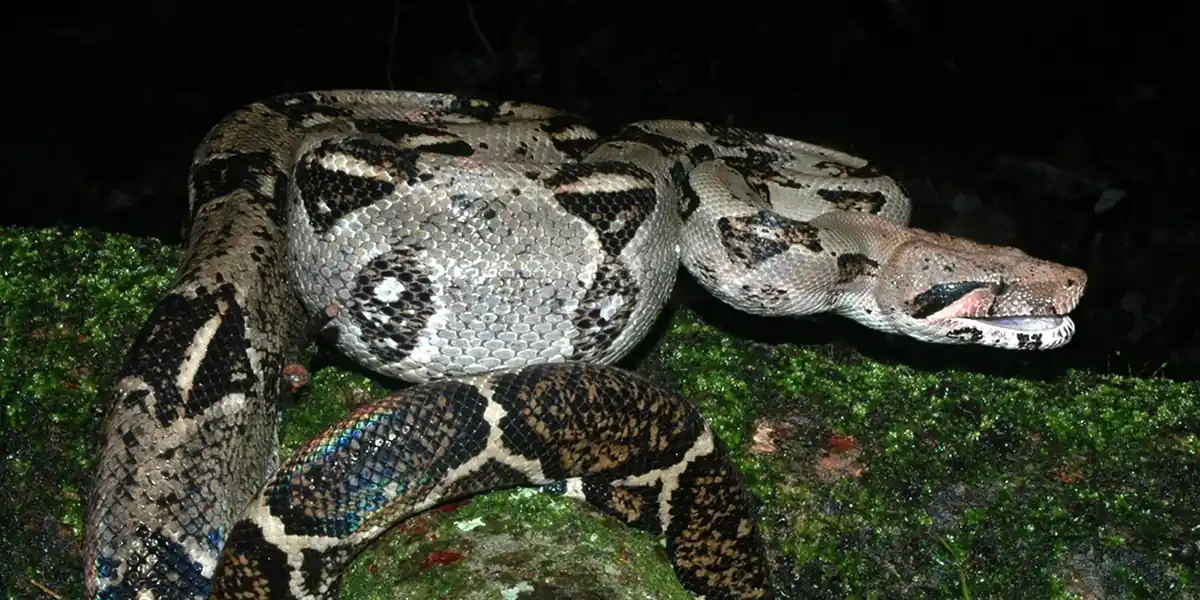
Use this guide as a starting point alongside the detailed sources below. Health concerns, unexplained changes in behavior, or feeding problems belong with a reptile veterinarian.
Adult enclosure recommendation
Our recommended minimum: 8′ × 4′ × 4′ (243.9 × 122 × 122 cm), length × depth × height.
Preferred target: 10′ × 5′ × 5′ (304.8 × 152.4 × 152.4 cm), length × depth × height.
Usable internal space for 1 adult animal. One adult Boa imperator up to 8′ (244 cm) total length. Confirmed smaller adults and animals longer than 8′ (243.84 cm) follow the explicit scaling rule; no juvenile or dwarf label substitutes for measured adult size.
Height is the usable internal envelope, including the space reserved for substrate and water. Check the remaining movement space and lamp clearance after installation.
Our preferred 10′ × 5′ × 5′ (304.8 × 152.4 × 152.4 cm) target for an 8′ (243.84 cm) adult adds longer connected climbing routes and more separation between refuges and water. This is an editorial expansion of the same spatial rule, not a second validated threshold.
Our recommended minimum applies the specialist's full snake length × half length × half length rule consistently, instead of using its smaller age-category examples. It supports straight extension, turning and substantial climbing. The rule is specialist guidance, not an experimentally validated welfare threshold.
Length at least total snake length; depth and height at least half total length. For a 6′ (183 cm) adult, minimum 6′ × 3′ × 3′ (183 × 91 × 91 cm). For a 10′ (305 cm) adult, minimum 10′ × 5′ × 5′ (305 × 152 × 152 cm). An unusually large 12′ (366 cm) individual needs 12′ × 6′ × 6′ (366 × 183 × 183 cm) under this rule.
Confirmed adult no longer than 6′ (183 cm)
Our recommended minimum: 6′ × 3′ × 3′ (182.9 × 91.5 × 91.5 cm), length × depth × height. Same total-length scaling rule, appropriate only to a known smaller adult, not an unverified locality label.
Preferred target: 8′ × 4′ × 4′ (243.9 × 122 × 122 cm), length × depth × height.
Adult 8′–10′ (244–305 cm)
Our recommended minimum: 10′ × 5′ × 5′ (304.8 × 152.4 × 152.4 cm), length × depth × height. The full-length rule scales every dimension; a longer animal needs further enlargement. No separately supported numerical preferred target is established for this larger size class; add useful space while maintaining the complete environment.
- Floor space
- For the 8′ (243.84 cm) example retain an 8′ × 4′ (244 × 122 cm) internal footprint, with dry routes around hides and the water basin.
- Climbing space
- Use weight-bearing branches and platforms through the 4′ (122 cm) internal height, including covered elevated retreats. Inspect anchors as mass and length increase.
- Substrate
- At least 3 in / 8 cm of suitable moisture-retaining bedding is our starting provision, adopting the specialist's preferred depth over its 2″ (5.08 cm) baseline. Internal height includes bedding, leaving about 45″ (114 cm) before fixtures.
- Water
- A stable clean basin that accommodates the whole coiled animal for voluntary soaking, with a safe exit. Retain dry floor space rather than using most of the enclosure as water.
- Security and ventilation
- One animal, guarded reachable fixtures, secure locks, effective ventilation and a practical large-snake service and transfer plan.
Meeting these dimensions alone does not establish suitability. Check the usable layout, environmental conditions, equipment clearance and the individual animal’s requirements before occupation.
Need a guide for this enclosure?
Include your boa’s measured total length and expected adult size, the usable internal dimensions and scaling rule above, supported climbing branches, full-body retreats, water and safe servicing access. Check these requirements before choosing a build.
Request review of a custom digital enclosure build guide.
Sending a request is free. This is a paid digital guide service; scope, price and timing are confirmed after review and before payment. Materials and construction are separate.
Confirm the animal before planning its adult home
Obtain locality, parent-size and feeding records for a captive-bred Boa imperator. The trade name “boa constrictor” also covers different species and mixed ancestry. The Hog-Islands subpopulation is often smaller, but a seller's dwarf label is not proof of a permanently small adult. Plan the enclosure and handling arrangement for the likely adult before acquiring a juvenile.
Housing
For one Boa imperator up to 8′ (244 cm) total length, our recommended minimum adult enclosure is 8′ × 4′ × 4′ (244 × 122 × 122 cm), length × depth × height of usable internal space. We prefer 10′ × 5′ × 5′ (305 × 152 × 152 cm) for an animal of that size, adding movement routes and separation between resources. The minimum follows specialist guidance; the preferred target is our editorial expansion, not a proven biological threshold.
Scale the minimum to at least the snake's total length, with depth and height each at least half that length. A confirmed 6′ (183 cm) adult needs at least 6′ × 3′ × 3′ (183 × 91 × 91 cm); a 10′ (305 cm) adult needs 10′ × 5′ × 5′ (305 × 152 × 152 cm). Unusually large animals need more: the zoo-reported 12′ (366 cm) case implies 12′ × 6′ × 6′ (366 × 183 × 183 cm). Sex and locality help estimate growth, but the actual adult length governs the result.
Provide whole-body retreats at different temperatures, connected branches and shelves strong enough for the moving animal, and a stable basin for voluntary whole-body soaking. Start with at least 3 in / 8 cm of moisture-retaining substrate. The quoted 4′ (121.92 cm) internal height includes this, leaving about 45″ (114 cm) before fixtures. House singly and retain accessible dry floor routes. Dimensions alone do not establish suitability: structure, climate, security and safe servicing must also work.
Warm the whole resting body
Create a broad basking area with air around 86–90°F (30–32°C) and a cool end around 75–79°F (24–26°C). Measure air beside the occupied resting places with probes and contact surfaces separately with an infrared thermometer. A surface reading is not a substitute for either air measurement. Guard heat sources and use compatible thermostatic control.
For ordinary nonbreeding care, allow dark nights around 68–75°F (20–24°C). This is our practical night operating range drawn from the specialist's 68 °F (20°C) lower reference and daytime cool range; it is not a locality-specific experimental optimum. Use controlled non-light heat when the room falls below the plan. Do not copy seasonal cooling advice for another boa species.
References: [2]
Keep humid air and dry resting choices
Maintain roughly 55–75% relative humidity, allowing fluctuations while providing a clean humid refuge. Measure near occupied resting areas with the local temperature recorded, and inspect bedding rather than misting to chase one number. Retain moisture below the surface while keeping dry resting options and ventilation.
Use suitable coconut fibre, soil-based reptile substrate or another maintainable moisture-retaining material without hazardous additives. Provide at least 3 in / 8 cm as a starting layer and more where digging and structural clearance permit. Refresh drinking water daily and immediately after fouling; the basin must be stable, removable and easy to leave.
Build a whole-prey routine
Offer appropriately sized thawed whole prey and record prey mass, date and condition. Quality whole rodents provide a balanced practical staple. Use a clean feeding surface and long feeding tools, with the boa left undisturbed afterward. Refresh water and remove soiled substrate as part of daily care.
We do not recommend automatic calcium, vitamin D3 or multivitamin additions to good-quality whole prey. Veterinary guidance generally finds these unnecessary; the specialist's occasional-supplement approach is discussed below. An unusual diet, poor growth or suspected deficiency needs an individual nutritional review.
Avoid
Avoid power-feeding for rapid growth, unstable branches, live rodents and casual handling of a large snake alone. Seek experienced handling support and reptile-vet advice when appetite, breathing or movement changes.
Plan adult housing while the boa is young
A well-furnished large enclosure can house a young boa if suitably sized retreats, safe water and food are readily accessible and observation remains practical. A temporary juvenile enclosure does not replace the adult dimensions above. Avoid deep adult water vessels that a small youngster cannot safely leave.
As the animal grows, check doors, water-bowl stability and every branch and shelf anchor for the load of the whole moving boa. Measure total length without stretching or forcing the animal. Keep a secure temporary holding and transfer arrangement ready for maintenance.
References: [1]
Lengthen feeding intervals through maturity
For an established growing boa, begin around every 10–12 days in the first year, 12–14 days at 12–18 months and every 2–3 weeks from about 18 months to two and a half years. Around two and a half to three years, the specialist framework extends to 3–4 weeks; at three to four years, 4–6 weeks; and for mature adults, often 4–8 weeks. These are starting intervals for monitoring, not a requirement to fast a thin or ill animal.
Keep individual meals no wider than the snake's broadest region and treat the specialist's approximately 10% body-mass limit as a ceiling, not a target to reach. Adjust portion and interval together with condition, activity and locality. Do not accelerate growth for breeding or offer another meal simply because the boa accepts it. Allow at least 48 hours without optional handling after feeding.
Handling, shedding and useful activity
Develop handling skills while the boa is manageable, with an experienced keeper showing you how to support its body and read defensive behaviour. Arrange another capable adult for handling a large individual. Keep the snake away from faces and necks, other pets and unsecured furniture; return it before either keeper or animal becomes difficult to manage.
Enrichment should support climbing, concealed resting and movement between temperatures. Add broad branches and stable shelves rather than dangling lightweight ornaments. Around a shed, reduce optional handling and offer a clean humid hide. Inspect the discarded skin, particularly the tail tip and eye coverings. Retained eye caps, wounds or abnormal breathing need veterinary assessment, not home removal or treatment.
Three common setup problems to investigate
The heater creates a tiny hot spot: compare the warmed area with the boa’s whole coiled body and measure surrounding air as well as the surface. ReptiFiles recommends a broad heating zone. Review fixture layout and thermostat placement rather than increasing one bulb until the centre becomes excessive.
The floor stays wet: inspect water-bowl spills, substrate depth and misting quantity. Check whether ventilation and drying time are adequate. Humid air and permanently saturated resting surfaces are different conditions; keep clean dry options available.
Branches shift or the door bows: stop using the unsafe feature and arrange secure temporary containment while fittings are corrected. Recheck all supports, locks and reachable fixtures after growth or rearrangement. This is a structural problem to solve before the next climbing or feeding session.
Lifetime commitment and costs
Minnesota Zoo lists 20 years for its Hog-Islands subpopulation; Belize Zoo lists over 40 years for Boa imperator. These are different source summaries, not a statistical 20–40 year average. Plan for the longer possibility.
Get a quote for the adult enclosure, its supporting structure, secure access and durable furnishings; locality and individual size matter.
Larger whole prey, heating a large enclosure, transport and access to a suitable reptile veterinarian continue long after a juvenile outgrows its first home.
Measure light at the animal
Provide a clear day/night cycle, with about 12 hours of daylight as our ordinary maintenance starting point and no visible light overnight. Offer UVB (ultraviolet B) over part of the enclosure with complete shade and covered warm retreats. A specialist starting reference is UVI (ultraviolet index) 2–3 at the boa's back in the accessible basking position.
This is guidance applied to the boa group, not proof of an optimal dose for every Boa imperator locality. Use a suitable UVI meter and account for mesh, lamp distance and raised perches. Follow the actual fixture's instructions and remeasure after rearranging supports; lamp percentage alone cannot validate exposure.
Arrival and quarantine planning
Keep acquisition and locality records with feeding history. Discuss separation and screening with a reptile veterinarian before any contact with an established collection.
Prepare a separate species-appropriate arrival enclosure and dedicated equipment. Agree observation, screening and release criteria with a reptile veterinarian. Keep the animal’s identity, origin, baseline condition and care history together.
Where recommendations differ
The specialist enclosure page gives a 6′ × 3′ × 3′ (182.88 × 91.44 × 91.44 cm) adult category for snakes up to 8′ (243.84 cm), yet separately recommends enclosure length equal to the snake's full length. We adopt the full-length rule consistently because an adult should be able to extend along one side while retaining turning and climbing room. The smaller numerical example applies only to a genuinely smaller adult. Retail availability is not a reason to shorten the rule.
Supplement advice is also inconsistent. ReptiFiles suggests occasional powder on prey; VCA's veterinary guidance generally does not require vitamins when healthy whole prey are fed. We choose no routine supplement additions because the reviewed sources do not establish a Boa imperator dose that improves a complete whole-prey diet. Veterinary-directed supplementation may be appropriate for a documented dietary or medical need.
Sources & further reading
Read the full recommendations and check details for your animal, equipment, and local conditions.
- ReptiFiles: boa enclosure dimensions
- ReptiFiles: boa temperature measurements
- ReptiFiles: boa humidity
- ReptiFiles: boa feeding
- ReptiFiles: boa handling
- VCA: common problems in pet snakes
- Minnesota Zoo; Hog-Islands boa
- Belize Zoo; Central American boa
- Arcadia: light and shade implementation
- The Unusual Pet Vets: reptile quarantine
- VCA: the new reptile visit
- The Reptile Database: Boa imperator
- ReptiFiles: boa substrate
- VCA: whole-prey snake nutrition
- ReptiFiles: boa UVB and lighting
- VCA: common diseases of pet snakes
Original Creature Corner guide. Editorial fact and citation checks are recorded; independent veterinary review has not been performed.