Use this guide as a starting point alongside the detailed sources below. Health concerns, unexplained changes in behavior, or feeding problems belong with an amphibian veterinarian.
Adult enclosure recommendation
Our recommended minimum: 3′ × 18″ × 18″ (91.5 × 45.8 × 45.8 cm), length × depth × height.
Preferred target: 3′ × 2′ × 18″ (91.5 × 61 × 45.8 cm), length × depth × height.
Usable internal space for 1 adult animal. One adult Ceratophrys cranwelli, approximately 3.1–5.1″ (8–13 cm) body length. Excludes other Pacman species and hybrids.
Height is the usable internal envelope, including the space reserved for substrate and water. Check the remaining movement space and lamp clearance after installation.
The extra depth keeps a whole-body bath and clean feeding area from crowding the burial sites. It also allows sheltered movement between warmer and cooler soil positions; the exact layout is an editorial preference.
The exact dimensions are our editorial expansion of an older small-adult reference to make deep burial, separated sheltered thermal positions, a clean feeding surface and shallow water coexist. No species-specific enclosure trial validates a precise threshold.
- Floor space
- At least 3′ × 18″ (92 × 46 cm) of usable internal floor after planning the bath, feeding surface and multiple burial positions.
- Climbing space
- No elevated climbing requirement. Stable low cover and routes must not create falls, traps or access to hot fixtures.
- Substrate
- About 4–6″ (10–15 cm) soft moist soil or coconut fiber for whole-body burial, within the 18″ (46 cm) internal envelope; this is an editorial adult allowance.
- Water
- Continuously available shallow easy-exit whole-body bath with chlorine/chloramine-free water, changed daily and whenever fouled.
- Security and ventilation
- Solitary housing, secure ventilated lid and gaps, stable digging-proof supports and controlled guarded heat where needed.
Meeting these dimensions alone does not establish suitability. Check the usable layout, environmental conditions, equipment clearance and the individual animal’s requirements before occupation.
Know which Pacman frog is coming home
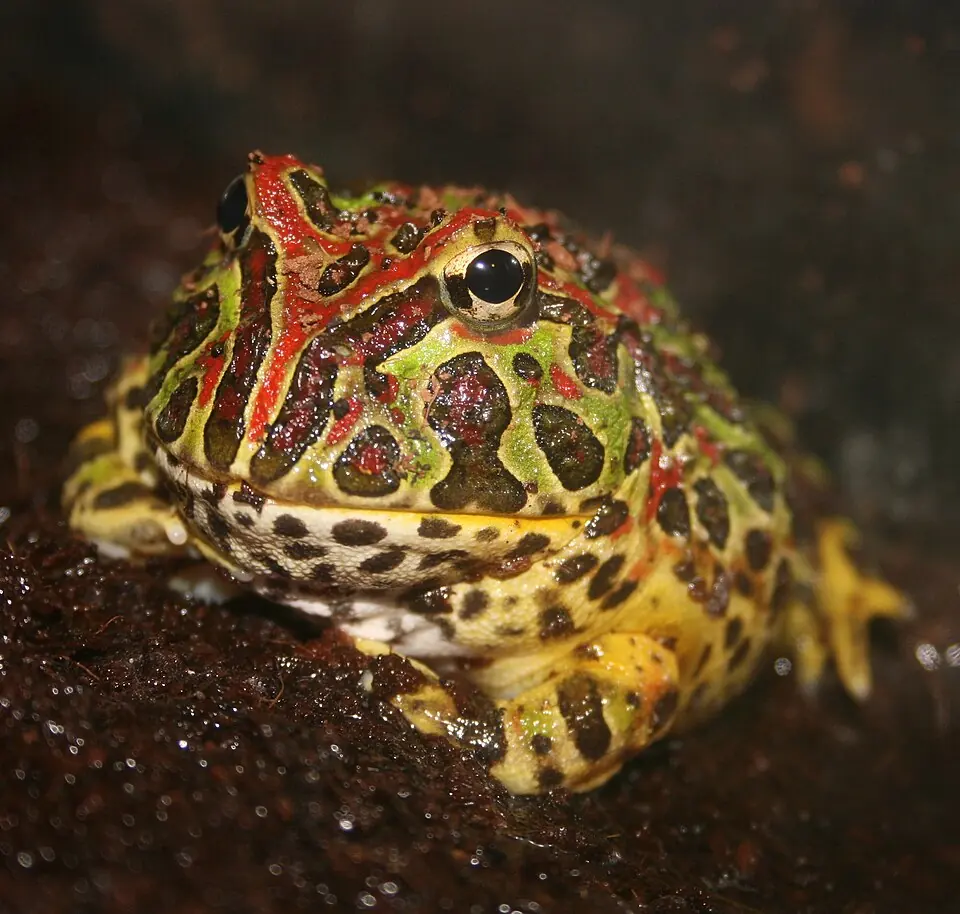
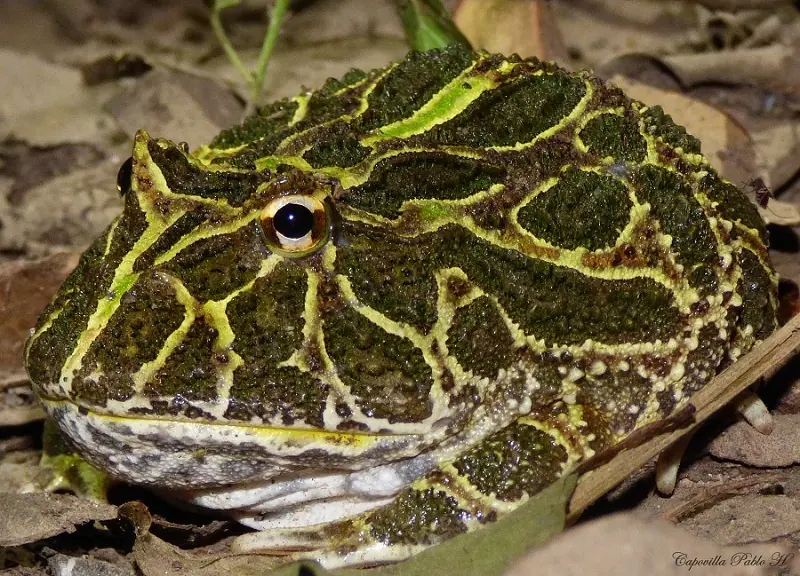
A Pacman label does not identify a species. This guide covers Ceratophrys cranwelli, Cranwell’s or the Chacoan horned frog. Ornate horned frogs, Surinam horned frogs and the hybrids sold as fantasy frogs need their own identity and care assessment. Obtain breeder records and the scientific name before buying, and preserve that provenance with the animal’s record.
Cranwell’s horned frogs are rounded, powerful ambush predators from South America’s seasonal Gran Chaco. They spend long periods concealed rather than walking around on display. The Smithsonian describes body lengths around 3.1–5.1″ (8–13 cm). An appetite, a large mouth and quiet behavior do not make one a pet for handling or justify a tiny enclosure.
Plan for years of clean-water work, cultured live food and close observation of an animal that can be partly buried most of the time. Reliable captive lifespan data are limited. The Smithsonian’s shorter estimate describes wild frogs and should not be used as a pet lifespan. Include adult housing, environmental control and amphibian-veterinary access in the purchase decision.
Build a floor that holds a real burrow
For one adult, we recommend at least 3′ × 18″ × 18″ (92 × 46 × 46 cm) usable internal length × depth × height, with 3′ × 2′ × 18″ (92 × 61 × 46 cm) preferred. These are our functional editorial choices: enough floor to separate sheltered thermal positions, a large shallow bath and a clean feeding area after deep substrate is installed. The older specialist sheet permits much smaller tanks for small adults, but it does not experimentally validate a welfare minimum.
Provide roughly 4–6″ (10–15 cm) of soft fertilizer- and pesticide-free soil or coconut fiber that allows complete burial. This depth is our adult-size allowance, rather than a proven biological minimum. It occupies part of the stated enclosure height, leaving approximately 12–14″ (30–36 cm) before fixtures. Increase the internal envelope if the actual bath, bedding and equipment crowd those functions.
Use stable low cover over more than one burial position, with a route between them. Support heavy furnishings independently of loose soil so the frog cannot undermine them. Keep the lid secure and ventilated, and close openings at the current frog’s scale. Height is useful for safe equipment separation, not an invitation to add precarious climbing structures.
House one animal. Cannibalism and feeding strikes are reasons to exclude tank mates, including other horned frogs. Check ventilation, water safety and the finished thermal and moisture conditions as well as floor dimensions before the frog arrives.
Warm the active frog without heating away its refuge
For a healthy nonbreeding frog, start with daytime air around 75–82°F (24–28°C), measured about 1″ (2.5 cm) above the bedding, with sheltered choices toward the low and high ends. At night, about 70–75°F (21–24°C) is our conservative selected reduction. The mixed-species specialist reference gives a broader 75–84°F (24–29°C) active envelope and permits a night drop. Our narrower operating plan is an editorial choice, not a measured species optimum.
Measure warm-side and cool-side air independently, and check reachable soil surfaces and a representative burrow separately. An infrared thermometer reads a surface rather than the air above it. Secure thermostat control and follow the actual heater’s mounting instructions; a thermostat setting cannot certify the burrow or frog’s body temperature.
Avoid a fiercely heated patch, an exposed hot fitting or a heater under the deep burrow that removes the frog’s cooler escape. Use controlled external heat only when the completed setup actually needs it, and retain a moist shaded retreat. Keep lights off at night, using suitable non-light heat if the room would fall outside the selected maintenance range. Recheck the layout when the room, heater or substrate changes.
Offer a low light gradient with complete shelter
A consistent 12-hour day and 12 hours of darkness is our practical maintenance cycle. This nocturnal frog needs covered places that remain usable throughout the day. Plant lighting should not turn every burial position into a bright exposed patch.
The exact benefit and ideal dose of ultraviolet B (UVB) have not been established for this species in the evidence. If providing it, we favor a small voluntary exposure opportunity around ultraviolet index (UVI) 0.3–0.7, falling to 0 beneath cover. This is an editorial low-exposure inference from the frog’s ecology and the general shade-dweller framework in the ultraviolet lighting guide (UV-Tool (an ultraviolet lighting reference)). The tool’s species appendix does not list Ceratophrys cranwelli, so this is not a published species assignment or proven requirement.
Use an appropriate low-output installation, measure toward the lamp at the frog’s back height and closest reachable position, and maintain full shade. Do not infer UVI from a bulb’s percentage, wattage or a photograph. Distance, reflector and mesh matter. Sensitive or albino animals need particular care and individual advice; do not force them to accept exposure to obtain warmth. Coordinate dietary vitamin D3 with the chosen exposure and supplement plan.
Judge moisture where the frog sits
Keep the burrowing layer moist but not muddy. A frog must not be sitting in free water throughout the substrate or in soil that has dried completely. Inspect below the surface when servicing, away from the occupied burrow; the top’s appearance alone can hide a dry or saturated lower layer.
Provide a shallow stable bath that fits the frog, lets it stand with its head above water and has an effortless exit. Horned frogs are poor swimmers, so a deep aquarium is inappropriate. Change the bath at least daily and after every contamination, with clean water close to the enclosure’s ordinary temperature.
Use water treated for chlorine and chloramine according to the actual supply and conditioner instructions, including for misting and moistening soil. Water left standing may still contain chloramine. Keep fertilizers, pesticides, aromatic bedding and cleaning residues out of contact with permeable skin.
A dependable species-specific air-humidity target is not established. Log air humidity beside its local temperature near bedding height, and use it to understand the setup’s drying pattern alongside soil moisture and the animal’s condition. Preserve ventilation rather than sealing the lid to chase a percentage. A persistent sour odor, pools in the bedding or dry burial sites call for correction.
Use the mouth’s power as a reason for restraint
Offer a varied supply of cultured invertebrates, including suitable earthworms or nightcrawlers, gut-loaded roaches, crickets and other appropriate larvae. Field diet studies document a wide range of animal prey, including frogs, but do not show that a pet needs feeder frogs or rodents as staples. The review also warns that large conspicuous vertebrate meals can distort impressions of the natural diet.
Choose prey the frog can swallow comfortably, rather than anything it can seize. Keep bulky food smaller than the mouth’s apparent capacity; a broad mouth is not a portion guide. Use a clean feeding surface, a suitable dish or soft-tipped tongs so a strike does not take in loose bark, gravel or a wad of moss. Never tap the snout to provoke a feeding response or use fingers as targets.
For a settled growing froglet, start with small meals every one or two days. For a mature active adult, start around every five to seven days and review the amount and interval against actual intake, weight trend and body condition. These are practical editorial intervals within variable keeper guidance, not measured calorie requirements. Older guidance permits very large weekly or fortnightly meals; we prefer smaller observable meals without trying to fill the frog to capacity.
Remove leftovers promptly, and do not leave biting feeder insects around a buried resting frog. A frog that is eager every time the enclosure opens may still be overfed. Continued refusal, lost weight, abnormal swelling or difficulty swallowing needs environmental review and veterinary help, not progressively larger prey or force feeding.
Record the whole nutritional plan
Gut loading and appropriate calcium plus vitamins are part of feeding an insect-eating amphibian. Use one amphibian-suitable supplement plan that includes vitamin A and coordinates dietary vitamin D3 with any measured ultraviolet provision. Apply the selected products at their actual stage-appropriate label directions; record names, concentrations and frequency with the meals.
The guidance does not establish one universally correct powder dose or frequency for this species. A calcium-only jar leaves other nutrients unresolved, while combining several complete formulas can duplicate them. Choose a clear label-based plan before acquisition, and have the veterinarian review it against the real diet and lighting. Do not administer concentrated vitamins as a home treatment for weakness or poor appetite.
Read stillness and skin in context
Remaining partly buried with the eyes visible is ordinary ambush behavior. It is not proof that the frog has no use for alternative refuges or more floor space. Observe its normal night pattern, feeding response, position and waste. Keep a record of weight using a safe container and minimal disturbance, with more frequent review if it is growing or the veterinarian has concerns.
Skin turnover can be brief and the frog may consume the shed. Do not pull skin, scrape a coating or bathe it routinely to make it shed. A prolonged crust or cocoon-like covering can accompany unfavorable seasonal conditions but can also conceal a care or health problem. Check the environment and obtain advice before assuming it should simply be left indefinitely.
Move the frog only when needed, preferably with a clean damp container. Use wet powder-free gloves if physical support is necessary, keep it low and avoid squeezing. Its teeth and strong strike can injure a hand; its skin can be damaged by oils, salts and residues. This is a frog for observation rather than regular handling.
Clean around a burrow rather than repeatedly destroying it
Inspect the bath, feeding area and visible bedding every day. Remove feces, dead food and contaminated soil promptly, replacing it with prepared moist material. Avoid repeatedly digging the animal up merely to make the enclosure look uniform. Renew the conventional substrate before waste or deterioration accumulates; the correct interval depends on loading, substrate and cleaning access.
A planted system can still be excavated by the frog and still needs inspection. Secure roots and heavy décor, retain a feeding area and do not treat a clean-up crew as a substitute for cleaning. Use dedicated amphibian tools. Remove dirt from equipment before using a disinfectant documented for amphibian equipment at its specified dilution and contact time; rinse thoroughly and clear residues before reuse. Wash hands after contact and keep maintenance out of food preparation areas.
Separate normal growth from deliberate dormancy
Young frogs need smaller prey, more frequent offers, shallower water and closer checks that every resource remains accessible. A simple temporary observation enclosure can be useful when it has adequate shelter and climate control, but it is not the permanent adult space. Plan the transition before the bath and burrow crowd the floor.
The species survives cold and dry seasons by becoming inactive underground. That adaptation does not establish that pet maintenance should force the same challenge. Keep clean water available and do not deliberately dry, chill or starve a frog to induce estivation. When an animal becomes unusually inactive or stops feeding, review measured conditions and health first.
This guide begins after metamorphosis. The species’ carnivorous tadpoles, breeding pools and rain-associated reproduction require a separate specialist plan, including protection against cannibalism. Adult feeding and shallow bath advice cannot simply be applied to aquatic larvae.
Prepare before the first meal
Have the finished enclosure operating through complete day and night cycles before collection, with a record of air and soil temperatures, moisture, water access, light and shade. Ask for recent meals, the last weight, provenance and any treatments. Begin separate arrival observation with dedicated tools and an amphibian-veterinary examination; a commonly used six-to-eight-week quarantine reference must be adjusted to the actual risk. Before buying, check local ownership and property restrictions. Never release the animal outdoors.
In the first week, keep disturbance low, offer the established cultured prey, record acceptance and waste, and check the bath and climate daily. Seek prompt veterinary assessment for raw or discolored skin, persistent bloating, prolapse, weakness, tremor, abnormal breathing, inability to right itself or refusal accompanied by weight loss. A quiet buried animal can still be ill, and a hungry animal can still have nutritional disease.
Prepare the enclosure, soft burrowing substrate, stable low cover, shallow bath, suitable water treatment, independent air probes and surface thermometer, hygrometer, heater control where needed and a day/night timer. Add a measured low-ultraviolet installation if chosen, feeder-insect supplies, the documented supplement plan, a transfer container and records.
Sources & further reading
Read the full recommendations and check details for your animal, equipment, and local conditions.
- Ceratophrys cranwelli Barrio, 1980 | Amphibian Species of the World
- Environment and Husbandry for Amphibians
- Reptiles and Amphibians: Healthy Pets, Healthy People
- How much UV-B does my reptile need? The UV-Tool, a guide to the selection of UV lighting for reptiles and amphibians in captivity (UV: ultraviolet)
- Feeding Pet Frogs and Toads
- Short Tongue Syndrome or Hypovitaminosis A in Frogs and Toads
- Horned (Pacman) Frog Care: Ceratophrys cranwelli and C. ornata
- On the Diet of the Frogs of the Ceratophryidae: Synopsis and New Contributions
- Cranwell's horned frog
Original Creature Corner guide. Editorial fact and citation checks are recorded; independent veterinary review has not been performed.