Use this guide as a starting point alongside the detailed sources below. Health concerns, unexplained changes in behavior, or feeding problems belong with an amphibian veterinarian.
Adult enclosure recommendation
Our recommended minimum: 4′ × 2′ × 2′ (122 × 61 × 61 cm), length × depth × height.
Preferred target: 5′ × 30″ × 2′ (152.4 × 76.2 × 61 cm), length × depth × height.
Usable internal space for 1 adult animal. One adult male or unsexed Pyxicephalus adspersus up to about 10″ (25 cm) body length. A smaller numerical case is limited to a confirmed adult female no longer than 5.5″ (14 cm).
Height is the usable internal envelope, including the space reserved for substrate and water. Check the remaining movement space and lamp clearance after installation.
The longer, deeper layout leaves a substantial digging area beside a large removable bath and allows daily servicing without dismantling the habitat. It is preferred for the male or unsexed large-adult scope; the separate female alternative retains its own limits.
Species-specific veterinary guidance supports solitary housing, burrowing soil, a large shallow bath and controlled substrate-level climate. Exact larger dimensions and digging allowances are our editorial layout choices; legacy small volumes are not accepted as empirically validated welfare minima.
Confirmed adult female Pyxicephalus adspersus no longer than 5.5″ (14 cm) body length
Our recommended minimum: 3′ × 18″ × 18″ (91.5 × 45.8 × 45.8 cm), length × depth × height. Our smaller editorial female layout retains roughly 6–8″ (15–20 cm) of burrowing soil, a whole-body easy-exit bath and sheltered routes. It does not apply merely because an animal is currently small or is called a dwarf pixie.
Preferred target: 4′ × 2′ × 2′ (122 × 61 × 61 cm), length × depth × height.
- Floor space
- At least 4′ × 2′ (122 × 61 cm) usable internal floor for the primary large-adult case, retaining a sizeable burial area and an unblocked route around a whole-body bath.
- Climbing space
- Stable low hide and sheltered floor movement, without a tall climbing requirement. Support heavy furnishings independently of digging soil.
- Substrate
- Large male: about 8–12″ (20–30 cm) of soft moist soil or coconut fiber inside the 2′ (61 cm) internal envelope. Scoped female: about 6–8″ (15–20 cm). These are editorial body-scale allowances.
- Water
- Continuously available shallow whole-body bath with easy exit; use chlorine/chloramine-free water and empty/clean at least daily and after fouling.
- Security and ventilation
- One animal only, secured lid and gaps, effective ventilation with moist but not waterlogged soil, protected controlled heat and access for heavy-bowl servicing.
Meeting these dimensions alone does not establish suitability. Check the usable layout, environmental conditions, equipment clearance and the individual animal’s requirements before occupation.
Plan for the adult behind the tiny pixie label
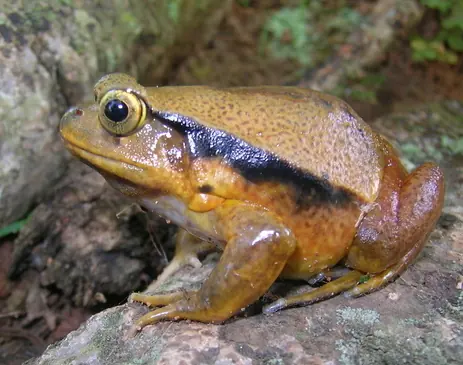
An African bullfrog sold as a pixie can become a substantial, long-lived animal. This guide covers Pyxicephalus adspersus, the giant southern-African bullfrog. Pyxicephalus edulis and other relatives are separate species, and an American bullfrog is entirely different. Historical sources confused some of their ranges; retain a reliable captive-bred identity and provenance rather than accepting the common name alone.
Males can reach roughly 6–10″ (15–25 cm) in body length, while females are often around 3.5–5.5″ (9–14 cm). Small size does not establish that a frog is an adult female; it could be young, a different species or affected by health and growth history. Use the large-adult housing plan while sex or identity remains uncertain.
Veterinary practice guidance describes a potential 15–25-year commitment. Budget for adult floor space, heavy wet substrate, repeated large-bowl cleaning, cultured prey and amphibian-veterinary care over that period. A powerful feeding strike and bony mouth projections mean this is a frog to observe rather than handle. Quiet burrowing behavior does not make the daily hygiene work optional.
Give a large male space for both soil and water
For one male or unsexed adult up to about 10″ (25 cm) body length, our recommended minimum is 4′ × 2′ × 2′ (122 × 61 × 61 cm) of usable internal length × depth × height. Our preferred target is 5′ × 30″ × 2′ (153 × 77 × 61 cm). A confirmed adult female no longer than about 5.5″ (14 cm) has a smaller conditional minimum of 3′ × 18″ × 18″ (92 × 46 × 46 cm). These scopes must remain visible when using the finder or planning housing.
The dimensions are our functional editorial judgment, substantially larger than the small aquarium volumes in older veterinary and keeper sheets. They provide room for a whole-body shallow bath, a substantial burial area and sheltered routes between resources. No controlled study validates these exact minimum or preferred thresholds.
For a large male, allow roughly 8–12″ (20–30 cm) of soft, moisture-holding soil or coconut fiber without added fertilizer or pesticides; for the scoped female plan, about 6–8″ (15–20 cm). These are editorial body-scale digging allowances, not measured physiological minima. Bedding occupies part of the internal height. In the large-adult minimum, 12–16″ (30–41 cm) remain above it before fixtures; choose more height if the real layout needs it.
Support the bath and heavy décor so digging cannot undermine them. Add a stable low hide and unobstructed movement between moist covered positions. There is no requirement for tall climbing furniture. Secure the lid and ventilation, and ensure the enclosure, supporting furniture and access arrangement can handle wet substrate and daily servicing.
Design the bath around daily removal of waste
Provide clean water at all times in a stable bowl large enough for voluntary whole-body soaking. It must be shallow enough for the frog to stand and breathe comfortably, with a secure easy exit. These animals can drag large amounts of soil into the bowl and may defecate in it; design the enclosure so the full bowl can be emptied and cleaned without lifting the frog or dismantling the habitat.
Change water at least daily and immediately after fouling. Use water treated for the actual supply’s chlorine and chloramine, and use the same appropriate water for misting and moistening the bedding. Water standing overnight is not a reliable chloramine treatment. Do not assume distilled or ultra-purified water is suitable as the sole long-term source without a mineral and veterinary plan.
A deep permanent aquatic section introduces filtration, chemistry and safe access work that is unnecessary for this maintenance layout. A clean removable bath is a practical choice. If a different aquatic design is proposed, assess its entire system separately rather than declaring it suitable because the overall enclosure has enough volume.
Keep the active frog warm with moist refuges
Our selected active daytime air reference is 77–82°F (25–28°C) at substrate level, with sheltered cooler and warmer positions within that range. At night, allow about 68–75°F (20–24°C). These are practical veterinary-based operating targets for a healthy nonbreeding animal, not measured critical limits or a deliberate dormancy plan.
Place independent probes at the warm and cool occupied locations. Check exposed surfaces with an infrared thermometer and investigate conditions in a representative burrow separately. Control any heat source with a compatible thermostat and secure its probe as directed. Do not warm the bottom of a deep burrow so that digging removes the frog’s cooler escape. Avoid exposed heaters and a compulsory hot basking patch.
For moisture, we select the veterinary-practice reference of around 80–90% relative humidity near bedding height during active maintenance, measured with its local temperature. Keep ventilation working and the lower soil moist without free water or sludge. Relative humidity is an air measurement; it cannot prove that the buried frog has safe soil conditions.
Published care routines differ: an older keeper sheet uses 60–70% relative humidity and somewhat warmer daytime temperatures. This guide follows the veterinary-practice range above. Keep the whole plan consistent, with moist soil, ventilation and a thermal choice; averaging the humidity figures or combining sealed wet air with the hottest temperature advice produces a different setup.
Run the fully furnished setup through complete day and night cycles before arrival. Log room conditions, occupied air, soil, humidity and the bath; recheck after changes. If high humidity requires an airtight enclosure, or the soil smells sour, correct drainage, ventilation and waste loading rather than adding more mist.
Keep dark refuges and avoid forced exposure
Use the selected veterinary maintenance cycle of 10 hours of light and 14 hours of darkness. Provide low shaded cover and a burrow that remain useful throughout the day. Plant lights must not remove every shaded resting option, and night heat, if needed, should not illuminate the enclosure.
The veterinary practice source recommends ultraviolet B (UVB) without establishing a measured species dose. We favor a low voluntary opportunity around ultraviolet index (UVI) 0.3–0.7 on a small exposed patch, declining to 0 in the burrow or hide. This is an editorial low-exposure inference using the general ultraviolet lighting guide (UV-Tool (an ultraviolet lighting reference)) framework; its appendix does not list Pyxicephalus adspersus. It is not evidence that a particular dose is required or optimal.
Measure at the animal’s back height and nearest reachable point, accounting for distance, reflector, screening and lamp age. Choose a suitable fixture and follow actual mounting and replacement instructions. Lamp percentage is not delivered UVI. Coordinate dietary vitamin D3 with the real exposure plan, and never force a frog into intense ultraviolet or remove its shelter to make the lamp reach it.
Keep large appetite separate from appropriate intake
Use a varied diet built around safe cultured earthworms and appropriately sized gut-loaded insects such as crickets and roaches. Large frogs can seize vertebrates, but frequent rodents are unnecessary for this routine and can encourage excessive energy intake. Do not offer wild frogs or reptiles to reproduce a dramatic natural-history record.
Growing frogs under about 3″ (7.6 cm) body length can begin with modest daily meals. Subadults and settled adults can start with two or three modest feeding sessions a week, using the species-specific veterinary guidance as a framework. The amount needs individual review: offer food the frog can swallow comfortably, record actual intake and adjust as growth slows or excess condition develops.
The source describes a feeding window, but we do not use the frog’s willingness to keep eating as an unlimited ration. Prey varies greatly in mass and energy. Record prey type and approximate amount, weight trend and activity, and let an amphibian veterinarian help judge condition. An apparently hungry adult does not automatically need a larger meal.
Feed on a clean surface or using suitable soft-tipped tools, away from loose bark or moss. Never hand feed or provoke the snout with a feeder. Remove uneaten insects promptly. If an animal stops eating with weight loss, swelling or other changes, check the environment and seek help rather than force feeding.
Document calcium, vitamins and light together
Gut loading and supplementation are necessary considerations for an insect-based diet. The veterinary page gives weekly calcium and a multivitamin every two weeks as one practical example, but this is not a universal dose independent of food, product strength, age and ultraviolet provision. Select a coherent amphibian-appropriate product plan that includes vitamin A, applying the actual label directions and reviewing it with the veterinarian.
Record product names, vitamin D3 content, application frequency and storage/opening dates with the feeding record. Do not layer separate vitamin A or vitamin D3 onto a complete product without a specific reason. Whole vertebrate prey, if occasionally used under the animal’s plan, are nutritionally different from insects and should not automatically receive the same powders. Do not use concentrated vitamins to treat weakness or poor appetite at home.
Maintain a digging animal without creating a wet waste reservoir
Use soft soil or coconut fiber without fertilizers, pesticides, sharp particles or aromatic wood oils. Preserve moisture below the surface while avoiding free water throughout the bedding. Keep the strike area clear of swallowable bark and loose moss, and anchor any planted roots or low cover so excavation does not cause collapse.
Check daily for waste, dead food, soiled water and unstable furnishings. Remove contaminated substrate promptly instead of mixing feces into a deep bed. Renew the conventional bedding as its actual loading and condition require. A bioactive system remains subject to the same inspections and may not keep pace with a large frog’s waste.
Use dedicated tools and remove visible dirt from equipment before disinfection. Choose a product documented for amphibian equipment and follow its dilution and contact time, then rinse thoroughly and clear residues before reuse. Wash hands afterward and keep cleaning away from human food areas. Clean mister and water-storage equipment too, because clear-looking water and hidden biofilm can still carry problems.
Do not turn survival adaptations into a compulsory challenge
A bullfrog can spend long periods buried or still. Note its regular positions, feeding response, waste and weight rather than repeatedly digging it out for attention. Essential moves are safest with a clean damp container; if support is required, use moistened powder-free gloves, keep the body supported low and keep fingers away from the mouth.
These frogs can form protective skin layers and become dormant during unfavorable seasons. Experiments document major metabolic and gut changes during fasting and induced estivation; they do not show that deliberate dormancy benefits a pet. We do not prescribe drying, chilling, starving or withdrawing water for ordinary maintenance.
When inactivity or appetite changes unexpectedly, compare the actual records and obtain veterinary advice. Do not peel a cocoon, forcibly soak an unresponsive frog or assume a long fast is safe because a wild animal can survive one. Breeding, rain chambers and larvae require separate planning; the father’s remarkable natural behavior does not make shared pet housing safe.
Make care easy enough to keep doing for decades
Arrange an amphibian-veterinary examination and source-risk quarantine with dedicated tools and an easy-to-inspect arrival layout. Veterinary guidance commonly describes six to eight weeks, but the source, testing and other animals in the home determine the actual plan. Preserve breeder identity, sex evidence, recent meals, weights and treatments. Before buying, check local ownership and property restrictions. Never release the animal outdoors.
During the first week, keep disturbance low, inspect climate and bath access daily, offer established prey and record the results. Seek prompt help for persistent bloating, prolapse, raw or red skin, wounds, weakness, tremors, inability to right itself, labored breathing or refusal with weight loss. Do not diagnose these signs from a care-sheet label or improvise medication.
Have the adult enclosure and support, deep substrate, low refuge, serviceable bath, water conditioner, secure ventilation and dedicated cleaning containers ready. Add independent air probes, surface thermometer, hygrometer, timer, appropriate guarded heat control, and measured ultraviolet equipment if that option is selected. Prepare cultured prey, gut-loading supplies, the supplement labels, a safe transfer container and weight/condition records.
Sources & further reading
Read the full recommendations and check details for your animal, equipment, and local conditions.
- Pyxicephalus adspersus Tschudi, 1838 | Amphibian Species of the World
- Environment and Husbandry for Amphibians
- Reptiles and Amphibians: Healthy Pets, Healthy People
- How much UV-B does my reptile need? The UV-Tool, a guide to the selection of UV lighting for reptiles and amphibians in captivity (UV: ultraviolet)
- Feeding Pet Frogs and Toads
- Short Tongue Syndrome or Hypovitaminosis A in Frogs and Toads
- Pixie Frog Care / African Giant Bullfrog (Pyxicephalus adspersus)
- Giant Pixie [African Bullfrog] Frog: Concise & Precise Care Sheet
- Physiological responses to feeding, fasting and estivation for anurans
Original Creature Corner guide. Editorial fact and citation checks are recorded; independent veterinary review has not been performed.