Use this guide as a starting point alongside the detailed sources below. Health concerns, unexplained changes in behavior, or feeding problems belong with an amphibian veterinarian.
Adult enclosure recommendation
Our recommended minimum: 30″ × 18″ × 18″ (76.2 × 45.8 × 45.8 cm), length × depth × height.
Preferred target: 3′ × 18″ × 18″ (91.5 × 45.8 × 45.8 cm), length × depth × height.
Usable internal space for 1 adult animal. One adult Dyscophus guineti, including a female approaching 4″ (10 cm) snout-to-vent length, meaning body length from nose to rear opening. Excludes other tomato-frog species.
Height is the usable internal envelope, including the space reserved for substrate and water. Check the remaining movement space and lamp clearance after installation.
The extra length separates moist burial sites, a shallow bath and a clear feeding area, so servicing does not require disturbing the resting frog. It is a functional preference rather than a tested optimum.
The species specialist supports moist terrestrial burrowing and shallow water but gives a small shared-aquarium example without a welfare trial. Our larger one-animal footprint is editorial functional judgment, reserving separated burial, bath and feeding areas.
- Floor space
- At least 30″ × 18″ (77 × 46 cm) usable internal floor for one adult, with unblocked burial, bath and feeding access.
- Climbing space
- Low stable cover rather than tall climbing structures; protect roots and support heavy items against excavation.
- Substrate
- About 4″ (10 cm) of soft moist fertilizer- and pesticide-free soil or coconut fiber within the 18″ (46 cm) internal envelope. This editorial allowance permits full-body burial.
- Water
- Continuously available shallow whole-body bath with easy exit; chlorine/chloramine-free water changed daily and immediately after fouling.
- Security and ventilation
- One animal, secure lid and openings, effective ventilation, moist but not waterlogged burial soil and protected controlled heat where needed.
Meeting these dimensions alone does not establish suitability. Check the usable layout, environmental conditions, equipment clearance and the individual animal’s requirements before occupation.
Make the scientific identity part of the purchase
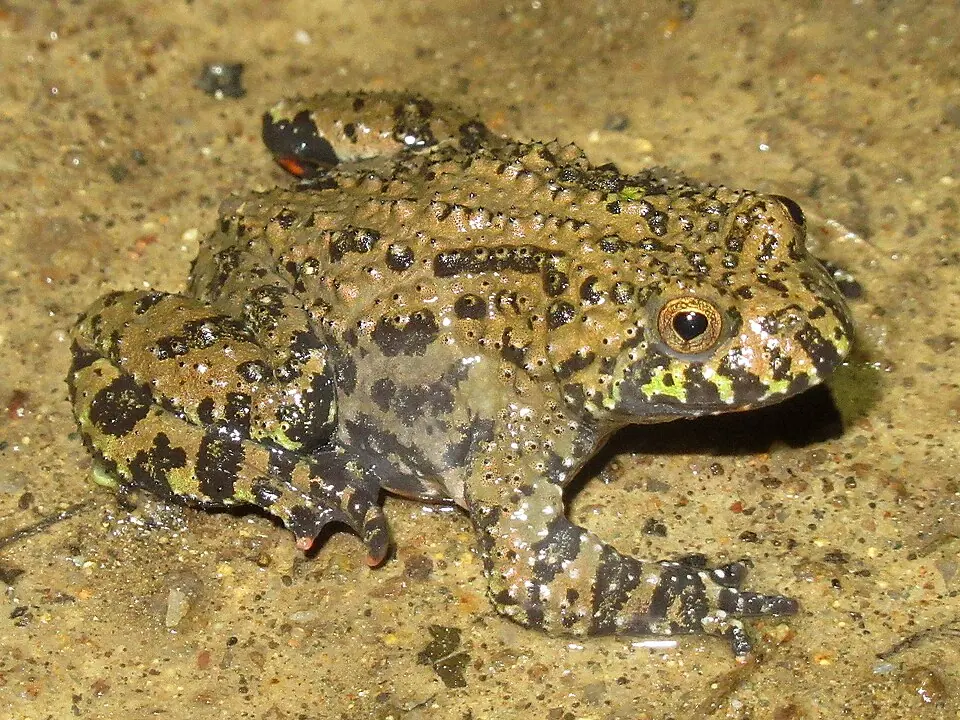
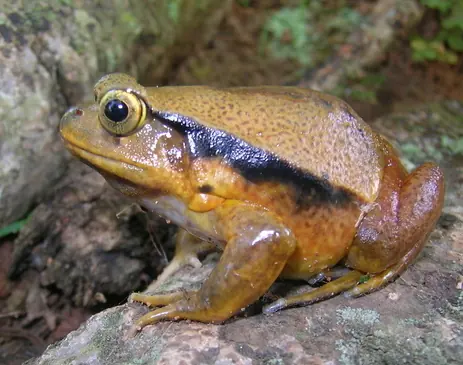
This guide covers Dyscophus guineti, the Sambava or false tomato frog. Tomato frog is also used for D. antongilii and D. insularis. Color alone cannot reliably settle that distinction, and older sources have confused the species. Obtain captive-bred provenance and an explicit scientific identification rather than choosing a care plan from a red photograph.
D. guineti comes from eastern Madagascar and spends much of its time on or in the forest floor. It is mainly active after dark, with a body built for concealment and burrowing rather than display on branches. Females can approach 4″ (10 cm) in snout-to-vent length, excluding the tail (SVL), the body length from the nose to the rear opening; males are often nearer 2.5″ (6.4 cm).
Plan for roughly six to ten years using experienced captive guidance, allowing for individual variation rather than treating the range as a guarantee. You need dependable cultured live food, clean treated water, moisture control and an amphibian veterinarian. These frogs may inflate and release a sticky irritating secretion when threatened, so handling is a necessary-care task rather than a benefit of ownership.
Give a burrowing adult more than a bowl-sized patch
For one adult, our recommended minimum is 30″ × 18″ × 18″ (77 × 46 × 46 cm) of usable internal length × depth × height. We prefer 3′ × 18″ × 18″ (92 × 46 × 46 cm). These are our editorial functional layouts for separated burial, bath and feeding areas. Older species guidance permits small shared aquaria while advising more room; the cited sources do not validate one precise welfare minimum.
Provide about 4″ (10 cm) of soft fertilizer- and pesticide-free soil or coconut fiber, enough for the frog to bury its body. This is our allowance above the expert’s shallower starting layer, not a proven biological threshold. The bedding occupies part of the internal height, leaving about 14″ (36 cm) before any drainage layer and equipment. Preserve lamp clearance and useful floor routes after furnishing.
Use stable low cork cover or similar shaded refuges, a shallow removable bath and a clean feeding position. Protect planted roots from excavation and support heavy objects independently of loose soil. An adult does not need a tall climbing arrangement. Secure the lid and cable gaps and provide ventilation rather than a sealed wet box.
Our numerical plan covers one animal. Similar-sized conspecifics are sometimes kept together, but group housing adds feeding observation, predation and disease considerations that a larger volume alone does not resolve. Solitary housing is the default for this maintenance plan.
Keep a margin against overheating
For active nonbreeding maintenance, start with daytime air around 72–78°F (22–26°C) near bedding height, with cooler and warmer sheltered positions. At night, about 68–72°F (20–22°C) is our selected reference. Measure both ends independently and check soil surfaces and a representative burrow separately. These are practical operating choices, not experimentally established limits.
The species specialist gives a broad 65–80°F (18–27°C) maintenance envelope and warns against excessive heat. The ultraviolet lighting guide (UV-Tool (an ultraviolet lighting reference)) lists a warmer protocol. We select the lower part of the specialist envelope with no required hot basking patch; the higher source values are not mixed into this plan. The published heat caution does not establish exactly 80°F (27°C) as a universal lethal boundary.
An already suitable room may need no added heat. If the actual setup needs a heater, use compatible thermostatic control and protect the frog from hot equipment. Avoid heating beneath the deep burrow or drying every sheltered position. Independent thermometers check the result, while the control probe manages the heater. Recheck during seasonal room changes and after moving décor or changing substrate.
Run the final empty enclosure through complete day and night cycles before arrival. Log probe positions, room conditions, air and soil temperatures, water, moisture and light. A single central reading or a thermostat display is not evidence that the frog has safe choices throughout the enclosure.
Offer shade before deciding how much ultraviolet to provide
Use a stable 12-hour light and 12-hour dark cycle for this maintenance plan. Keep low covered refuges and burial positions shaded during the day. The UV-Tool’s 13:11 reference is another practical photoperiod, not a reason to lengthen days automatically or force a seasonal breeding program.
Experienced guidance says ultraviolet lighting is not essential, while the UV-Tool places D. guineti in its low-exposure group. We favor an optional modest ultraviolet B (UVB) opportunity around ultraviolet index (UVI) 0.3–0.7 on a small exposed patch, with UVI 0 under cover. This is a low-exposure practice choice; the cited sources do not establish the species’ ideal lifelong dose or prove a universal requirement.
Measure toward the lamp at the frog’s back height and closest reachable point, accounting for mesh, reflector, lamp age and distance. A percentage printed on the bulb cannot establish the animal’s exposure. Retain sheltered warmth and complete shade, follow the actual fixture’s safety instructions and coordinate dietary vitamin D3 with the lighting and supplements. Do not apply strong periodic ultraviolet boosts or use colored lamps through the night.
Keep the burrow moist and the bath clean
The frog’s skin needs clean moisture even when it is hidden. Keep the lower soil or coconut fiber damp enough for burial without free water or a muddy slurry. Inspect below the surface while servicing away from the animal’s occupied site; the top may look acceptable while the lower layer is dry or saturated.
Provide a shallow stable dish that fits the frog and allows it to rest with its head above water and leave easily. Clean and refill it at least daily, and immediately after fouling. Use chlorine/chloramine-free water for the bath, misting and substrate preparation. Treat the actual tap supply with a suitable conditioner as directed; standing water is not a reliable chloramine treatment.
A dependable species-specific air-humidity target is not established. Record near-bedding air humidity beside its local temperature to understand the habitat’s drying cycle, then inspect soil and water availability separately. Do not borrow a percentage from another frog or from a laboratory nutrition study’s apparatus.
Ventilation must clear stagnant air without drying all burial sites. The surface can lose visible free water between mistings while deeper soil remains moist. Constant heavy condensation, sour bedding or an enclosure that requires an airtight lid calls for review of drainage, waste and air exchange. Misting the environment according to those observations is more useful than repeatedly spraying the frog.
Supply a modest rotation of live prey
Use cultured live crickets, appropriate roaches, suitable earthworms and other appropriately sized invertebrate prey. Feed insect cultures a proper gut-loading diet before offering them. Wild-caught prey adds uncertain parasites and pesticide exposure; dried bloodworms are not a substitute for a complete live-prey feeding routine.
For an established adult, three modest meals a week is our starting framework, adjusted to condition and actual intake. A nine-week species nutrition trial also fed three times weekly, but that experiment tested carotenoid treatments, not the ideal lifetime feeding interval or portion. Growing froglets usually need small daily offers and closer checks that food is found and swallowed.
Choose prey comfortably smaller than the frog’s apparent maximum swallowing capacity. Offer it where you can observe the strike without taking in loose bark or moss, using a clean feeding area, suitable dish or soft-tipped tools. Record prey type and amount, remove leftovers and review weight trend. A frog that is always willing to eat can still be overfed.
Do not use rodents or feeder frogs as required staples. Persistent missed strikes, refusal with weight loss, difficulty swallowing or new swelling needs assessment of conditions and health rather than larger food or force feeding.
Provide calcium and a balanced vitamin plan
A varied insect diet still needs calcium and appropriate vitamins, including vitamin A. Choose one amphibian-suitable product plan, using the actual age-appropriate label directions and accounting for any ultraviolet provision and dietary vitamin D3. Lightly coat feeders as directed just before offering them. Keep the product names, concentrations, opening dates and use frequency with the meal record.
A small D. guineti trial found increased plasma vitamin A and growth with a mixed-carotenoid treatment in injected crickets. That species-specific result means it is too broad to claim that amphibians cannot use any carotenoid precursors. It does not establish that ordinary vegetables in a feeder bin supply enough vitamin A, or that a pet should receive injected feeders, concentrated color boosters or a carotenoid-only supplement.
Retain a balanced vitamin/mineral plan and obtain veterinary advice when choosing between products. Do not stack a complete formula with extra vitamin A or vitamin D3 simply because separate sources mention them. Abnormal prey capture, weakness or swelling needs examination, not an improvised therapeutic dose.
Clean a hidden animal’s home deliberately
Daytime burial and movement after dark are normal. Learn the animal’s preferred sites, night activity, appetite and waste pattern without digging it up repeatedly. Robust plants may survive if their roots are protected, but this frog can excavate decorative arrangements. Keep essential bath and feeding access independent of fragile plant growth.
Remove feces, dead food and soiled bedding daily, replacing contaminated material rather than mixing it deeper into the floor. Conventional substrate needs periodic renewal according to waste and condition. A planted or bioactive setup still needs daily inspection; adding decomposers does not make it self-cleaning.
Use dedicated tools and keep water-storage and misting equipment clean. Remove visible dirt from items before disinfection, follow the dilution and contact time of a product documented for amphibian equipment, and rinse thoroughly before reuse. Keep cleaning separate from food preparation. Frogs and apparently clean enclosures can carry Salmonella; handwashing remains necessary after servicing.
Avoid provoking the defensive secretion
Use a clean damp container for necessary moves. If support is unavoidable, use moistened powder-free gloves, stay low over a safe surface and avoid squeezing. Oils, soap, lotions and salts on human skin are unsuitable for the frog’s skin. If secretion contacts you, avoid touching the eyes or mouth and wash thoroughly.
Inflating or releasing sticky mucus is a defensive response, not a behavior to elicit for a photograph. A young yellow-brown frog may change color with maturity; neither redness nor a dark stripe alone proves species identity or health. Normal skin turnover may include eating shed skin. Do not peel it, scrape mucus or force a bath to remove a coating.
Keep young frogs observable without treating them as small adults
Young frogs need smaller prey, more frequent opportunities to feed, a suitably shallower bath and closer checks on moisture and body condition. Temporary simple arrival housing may make those observations easier, but it still needs cover, safe soft footing and measured climate choices. Move to the adult layout before water and refuges crowd the available floor.
Seasonal rainfall influences reproduction in nature, but this guide does not prescribe a forced dry spell or cooling period for nonbreeding pets. Unexpected inactivity or reduced appetite is a reason to check measured conditions and health first. Eggs and filter-feeding tadpoles need a separate aquatic plan; the adult’s invertebrate diet and shallow bath cannot support them.
Make the quiet first week a useful record
Before collection, obtain provenance, the scientific identity, recent food, weight history and any treatments. Arrange an amphibian-veterinary examination and separate arrival observation with dedicated tools. Quarantine length depends on source risk and the other animals present; six to eight weeks is a common veterinary reference rather than a guarantee. Before buying, check local ownership and property restrictions. Never release the animal outdoors.
In the first week, minimize disturbance, check the water and environment each day, offer the established cultured prey and record intake and feces. Seek prompt help for raw skin, swelling, cloudy eyes, weakness, tremor, abnormal breathing, inability to right or refusal with weight loss. No single sign establishes a diagnosis such as vitamin deficiency or infection.
Prepare the measured adult enclosure, soft burrowing bedding, stable low cover, removable shallow bath, suitable water conditioner, ventilation and secure lid. Add independent air probes, a surface thermometer, hygrometer, timer and controlled guarded heat only where needed. For any ultraviolet option, arrange a suitable fixture and exposure measurement. Keep cultured-food supplies, the chosen supplement labels, a transfer container, cleaning equipment and a weight/condition record ready.
Sources & further reading
Read the full recommendations and check details for your animal, equipment, and local conditions.
- Dyscophus guineti (Grandidier, 1875) | Amphibian Species of the World
- Environment and Husbandry for Amphibians
- Reptiles and Amphibians: Healthy Pets, Healthy People
- How much UV-B does my reptile need? The UV-Tool, a guide to the selection of UV lighting for reptiles and amphibians in captivity (UV: ultraviolet)
- Feeding Pet Frogs and Toads
- Short Tongue Syndrome or Hypovitaminosis A in Frogs and Toads
- Tomato Frog Care Sheet
- Tomato frog
- Dietary carotenoids on fat-soluble vitamin status and growth in tomato frogs, Dyscophus guineti
Original Creature Corner guide. Editorial fact and citation checks are recorded; independent veterinary review has not been performed.