Use this guide as a starting point alongside the detailed sources below. Health concerns, unexplained changes in behavior, or feeding problems belong with an amphibian veterinarian.
Adult enclosure recommendation
Our recommended minimum: 30″ × 18″ × 18″ (76.2 × 45.8 × 45.8 cm), length × depth × height.
Preferred target: 3′ × 18″ × 18″ (91.5 × 45.8 × 45.8 cm), length × depth × height.
Usable internal space for 1 adult animal. One adult Bombina orientalis, about 1–2″ (2.5–5 cm) body length. A conditional three-adult similar-size conspecific alternative requires multiple resources and separation capacity; other Bombina, newts and mixed aquaria are excluded.
Height is the usable internal envelope, including the space reserved for substrate and water. Check the remaining movement space and lamp clearance after installation.
The extra length allows more usable shoreline and land shelter while preserving shallow water, gentle exits and feeding access. Keep roughly half the usable floor as land; the larger single-animal layout is not an automatic group allowance.
Opened practice references differ between one-third and one-half water and use small volume examples. Our larger editorial half-land/half-water layout makes usable land, water, shelter and service access explicit; no exact welfare dimension, ratio or density is proven.
Conditional group of three similar-size adult Bombina orientalis with multiple resources and ready separation housing
Our recommended minimum: 3′ × 2′ × 18″ (91.5 × 61 × 45.8 cm), length × depth × height. Veterinary and specialist accounts support possible conspecific groups but do not prove a density threshold. Our larger editorial half-land/half-water layout requires separate feeding access, retreats, gradual exits and individual monitoring; no other species are included.
- Floor space
- At least 30″ × 18″ (77 × 46 cm) usable internal floor, with approximately half land/half water and at least 15″ × 18″ (39 × 46 cm) accessible land in the one-adult minimum.
- Climbing space
- Low stable cover, gentle shores and resting points support safe travel; ramps and inaccessible voids do not replace usable land or count as housing area.
- Substrate
- About 2–3″ (5–8 cm) fertilizer- and pesticide-free soil or coconut fiber on land with leaf cover and hides, inside the 18″ (46 cm) internal envelope; damp refuges without contaminated mud.
- Water
- Selected shallow water about 2″ (5 cm), gradual easy exits and resting points. Clean a removable tray daily and after fouling; a permanent filtered section needs prior cycling, testing and test-based partial changes.
- Security and ventilation
- Secure fine gaps/lid, effective air exchange with moist refuges, protected fixtures and daily land/water service access. Groups require individual monitoring, multiple resources and separation capacity.
Meeting these dimensions alone does not establish suitability. Check the usable layout, environmental conditions, equipment clearance and the individual animal’s requirements before occupation.
Keep an East Asian land-and-water amphibian
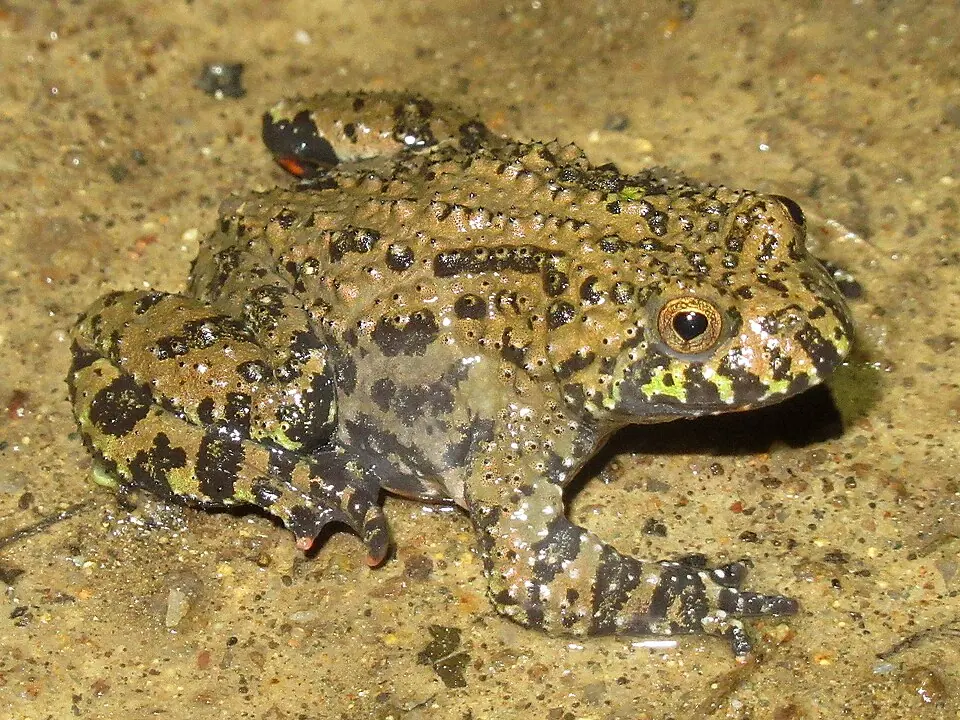
The Oriental fire-bellied toad, Bombina orientalis, is a small diurnal amphibian that uses both land and shallow water. It is a good observation animal for someone prepared to service water every day, feed cultured invertebrates and monitor access to both parts of the habitat.
Confirm the scientific identity and captive-bred provenance. “Fire-bellied” also describes other Bombina species and several newts; shared color is not shared care. The current taxonomic reference places B. orientalis in East Asia. A seller’s mixed product list or an overbroad old range does not widen this guide to other species.
Adults are roughly 1–2″ (2.5–5 cm) in body length. Plan around ten to fifteen years using practice accounts, with variation rather than a promised lifespan. Include safe land-and-water housing, water changes, live food, lamp checks and amphibian-veterinary care.
Handle only for necessary care, even with captive-bred animals. Keep skin secretions away from your eyes and mouth and keep the species out of mixed aquaria. Colorful warning displays are behavior to observe without deliberately disturbing the animal.
Measure usable land as well as the whole enclosure
For one adult, our recommended minimum is 30″ × 18″ × 18″ (77 × 46 × 46 cm) usable internal length × depth × height. We prefer 3′ × 18″ × 18″ (92 × 46 × 46 cm). This is our editorial functional layout beyond small-volume examples, not a proven welfare threshold.
Choose approximately half usable land and half water. In the minimum layout, retain at least 15″ × 18″ (39 × 46 cm) of accessible land and a comparable water area. A steep ramp or hidden cavity does not count as usable land. Position shelter, feeding access and gradual shores so neither resource blocks the other.
Land can use about 2–3″ (5–8 cm) of fertilizer- and pesticide-free moisture-holding soil or coconut fiber with leaf cover and stable hides. This is a practical furnishing allowance, not a measured biological requirement. Keep the land damp in refuges without turning it into contaminated mud, and keep loose ingestible material away from feeding.
A conditional group of three similar-size adults uses at least 3′ × 2′ × 18″ (92 × 61 × 46 cm) usable internal space, with multiple feeding points, retreats and exits and ready separation capacity. This larger editorial layout does not guarantee compatibility or approve additional animals by volume.
Make shallow water easy to leave and easy to clean
Our selected simple water depth is about 2″ (5 cm), with gently sloped shores, secure resting points and exits the animal can use without swimming continuously. This lies within shallow-water practice examples; it is a layout choice, not a universal depth limit. Check exits at the smallest animal’s size.
A removable shallow tray provides a straightforward maintenance option. Clean and refill it daily and immediately after fouling, using appropriately treated compatible water. Anchor it so it cannot tip, leak under the land bedding or leave a trapping gap at the shore.
A permanent filtered water section needs a biological filter established before arrival, protected intakes and gentle current. Test water rather than assuming a filter makes it safe: ammonia and nitrite should be 0 parts per million (ppm), with appropriate test-based partial changes and stable source-water chemistry. An exact species-specific nitrate or pH (a measure of acidity or alkalinity) optimum is not established; monitor these readings for changes and review persistent water-quality problems with an amphibian veterinarian.
Treat chlorine and chloramine in the actual supply before use. Keep water-storage containers and tools clean, remove waste promptly and verify the water temperature separately from land air. Standing tap water is not a dependable chloramine treatment, and a clean-looking pool can still be unsuitable.
Use a coherent active maintenance plan
Select occupied land air around 70–75°F (21–24°C) by day and 68–72°F (20–22°C) at night. This follows the cooler specialist maintenance approach. Another veterinary sheet uses warmer air, while a lighting table includes cold seasonal treatment; they are different protocols rather than numbers to combine.
Check occupied land air, the water and reachable warm surfaces separately. Use independent probes and inspect lamp-exposed points, including the room’s warmest period. No required hot basking patch or routine water heater is part of this plan. Any necessary heat needs compatible thermostatic control, secured probes and protection from hot equipment.
Use about 50–70% relative humidity as a working land-air reference at a recorded temperature and position. Water access and moist land refuges remain separate resources. Mist according to the actual drying pattern and preserve effective air exchange, rather than sealing the lid to force a reading.
Run the furnished setup before arrival, with the final water section, lamps and lid in place. Watch for soggy land, stagnant corners, wet feeding areas and warming water. Reassess after changing the water layout, ventilation or lighting.
Recommend low exposure with complete shelter
Use a 12-hour light period and 12 hours of darkness. We recommend a voluntary ultraviolet B (UVB) land option around ultraviolet index (UVI) 0.5–1.0 at an accessible exposed position, falling to 0 in substantial shelter. Keep suitable shaded land available so the animal does not need to choose between excessive exposure and water.
The published summary of a species-specific experiment reports improved vitamin D status and skeletal outcomes with ultraviolet B and calcium provision, even though the diet contained vitamin D3. This supports considering light and nutrition together, but the summary does not establish a household lamp setting or a supplement recipe.
Our selected number is a conservative practice target informed by the ultraviolet lighting guide (UV-Tool (an ultraviolet lighting reference)), not the experiment’s demonstrated optimum or a validated lifelong dose. Measure toward the lamp at the animal’s back height and closest reachable position with the actual mesh and furnishings. A bulb percentage is not an exposure measurement.
Preserve shade as plants grow, follow fixture installation and replacement directions and recheck after layout changes. Coordinate the measured light option with one actual calcium, vitamin A and vitamin D3 formulation plan; dietary vitamin D3 does not by itself prove light is unnecessary, and ultraviolet does not replace calcium or a balanced diet.
Feed modest meals where each animal can reach them
Offer varied cultured small insects, appropriately sized worm pieces and suitable soft-bodied larvae. Prepare insect prey nutritionally and choose sizes the individual can swallow comfortably. Avoid pesticide-exposed garden prey and feeder vertebrates as routine food.
Start settled adults with modest meals every two or three days. Growing young need smaller, more frequent offers, with interval and amount adjusted to growth and condition. Practice sheets use different feeding schedules; no universal prey count or unlimited feeding window is established.
Use a clean feeding location that keeps strikes clear of loose gravel and soiled bedding. In a group, provide more than one feeding point and record each animal’s intake and condition. A vigorous frog taking every meal does not show the whole group is adequately fed. Remove leftovers and check the shallow water after feeding.
Use one amphibian-appropriate supplement plan that includes calcium and vitamin A and coordinates vitamin D3 with the actual light option. Follow the product’s life-stage directions and storage, keeping labels and dates. Do not mix complete products, add color powders or copy the experiment’s calcium treatment into a home formula.
Persistent missed strikes, swelling, weakness or weight loss need a review of environment, diet and health. They do not diagnose one deficiency or authorize concentrated home vitamin treatment.
Keep groups conditional and contact brief
One adult is the primary case. A similar-size conspecific group can work, but observe individuals and keep separation housing ready. Size differences, pursuit, biting, blocked exits or loss of access to food require intervention. More water or another hide does not guarantee that an incompatible group becomes stable.
The three-adult alternative applies only to Bombina orientalis with multiple resources and individual monitoring. It is not permission to mix fire-bellied species, fish, newts or other frogs. Disease transfer, ingestion, injury and skin secretions make a mixed display a different and unsupported proposal.
For essential moves, use a clean damp container. If direct support is unavoidable, use wet powder-free gloves, hold the animal low and avoid squeezing. Keep hands away from eyes and mouth and wash thoroughly after animal or habitat contact. Use dedicated tools and keep maintenance out of food preparation areas.
Brief skin turnover can be normal and shed may be eaten. Do not peel the skin or routinely soak the animal as a shed treatment. Prolonged changes, sores or altered movement call for environmental checks and veterinary advice.
Inspect both sides of the shoreline
Every day check animals, land, water, exits and equipment. Remove feces, dead food and contaminated leaf cover. Service the tray daily or use the documented testing and partial-change routine for a cycled permanent section. A planted land area or filter does not remove the need for inspection.
Prevent water migrating beneath the land into an inaccessible stagnant pocket. Replace contaminated bedding according to its condition and preserve stable hides. Remove dirt from equipment before disinfection. Follow the dilution and contact time of a product documented for amphibian equipment, then rinse thoroughly and keep residues out of both land and water.
Froglets need small food, tight containment and land/water access that works at their size. A shallow pool suitable for an adult may still need extra safe shores and resting access for young animals. Eggs and tadpoles require separate aquatic rearing, food and separation planning outside this guide.
Do not deliberately chill, fast or dry a pet to imitate seasonal dormancy or trigger breeding. The cold seasonal values in institutional tables are not ordinary active maintenance temperatures. Unexplained inactivity or food refusal should prompt current-condition and health review before a seasonal explanation is assumed.
Check the individual before building a group
Obtain exact identity, provenance, recent meals and treatments. Arrange source-risk quarantine and an amphibian-veterinary examination with dedicated tools. General veterinary guidance often uses six to eight weeks, but testing, source and other animals affect the actual plan. Before buying, check local ownership and property restrictions. Never release the animal outdoors.
During the first week minimize disturbance and record each animal’s intake, waste, position and behavior. Confirm comfortable land access, easy water exits and measured conditions on both sides. A quiet frog should still be checked for access to food and changing condition.
Seek prompt help for skin lesions, marked weakness, impaired righting, weight loss, swelling or persistent buoyancy or breathing changes. Review water and land conditions immediately and bring the record to the veterinarian. Do not self-diagnose from belly color or use fish medications in a shared pool.
Prepare the measured adult enclosure, usable land, shallow cleanable water, gradual exits, moist hides, independent land/water temperature monitoring and hygrometer. Add water treatment and dedicated containers, a timer and measured low-ultraviolet plan, cultured food, documented supplements and separation housing for any group.
Sources & further reading
Read the full recommendations and check details for your animal, equipment, and local conditions.
- Bombina orientalis (Boulenger, 1890) | Amphibian Species of the World
- Environment and Husbandry for Amphibians
- Reptiles and Amphibians: Healthy Pets, Healthy People
- How much UV-B does my reptile need? The UV-Tool, a guide to the selection of UV lighting for reptiles and amphibians in captivity (UV: ultraviolet)
- Feeding Pet Frogs and Toads
- Short Tongue Syndrome or Hypovitaminosis A in Frogs and Toads
- Fire Bellied Toad Care (Bombina orientalis)
- Fire-Bellied Toad Care Sheet
- Impacts of UVB provision and dietary calcium content on serum vitamin D3, growth rates, skeletal structure and coloration in captive oriental fire-bellied toads (Bombina orientalis)
Original Creature Corner guide. Editorial fact and citation checks are recorded; independent veterinary review has not been performed.