Use this guide as a starting point alongside the detailed sources below. Health concerns, unexplained changes in behavior, or feeding problems belong with an amphibian veterinarian.
Adult enclosure recommendation
Our recommended minimum: 3′ × 18″ × 18″ (91.5 × 45.8 × 45.8 cm), length × depth × height.
Preferred target: 3′ × 2′ × 18″ (91.5 × 61 × 45.8 cm), length × depth × height.
Usable internal space for 1 adult animal. One adult Ceratophrys ornata, including a large female up to approximately 7″ (18 cm) body length. Excludes C. cranwelli and hybrids.
Height is the usable internal envelope, including the space reserved for substrate and water. Check the remaining movement space and lamp clearance after installation.
The extra depth gives a large female more room to bury while keeping the bath, feeding area and sheltered thermal choices separate. This is a functional preference, not an experimentally established optimum.
Species-specific veterinary sources supply functional care but give smaller volume-based or square examples and variable female size. Our larger internal layout is editorial judgment to preserve full burial, sheltered thermal choices, shallow water and a clean feeding surface for a large female.
- Floor space
- At least 3′ × 18″ (92 × 46 cm) usable internal floor with unblocked routes between burial, water and feeding areas.
- Climbing space
- Low secure cover only; do not substitute height or tall climbing structures for useful burrowing floor.
- Substrate
- About 4–6″ (10–15 cm) of soft moist soil or coconut fiber within the 18″ (46 cm) internal height, allowing full-body burial and stable covered choices.
- Water
- Daily clean shallow chlorine/chloramine-free bath, large enough to sit in with head above water and easy exit; not a deep swimming pool.
- Security and ventilation
- One frog, secured ventilated lid, stable digging-proof supports, clean feeding station and protected thermostatically controlled heat if required.
Meeting these dimensions alone does not establish suitability. Check the usable layout, environmental conditions, equipment clearance and the individual animal’s requirements before occupation.
Start with an ornate, rather than an ambiguous trade name
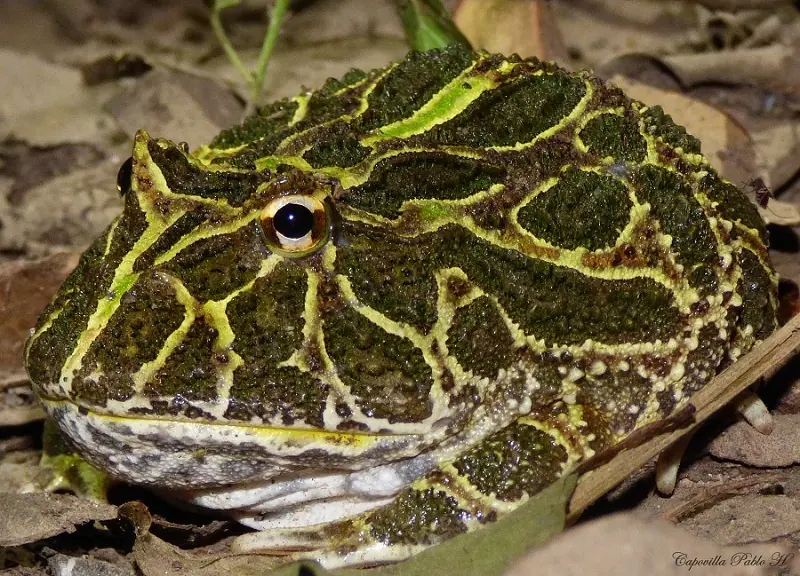
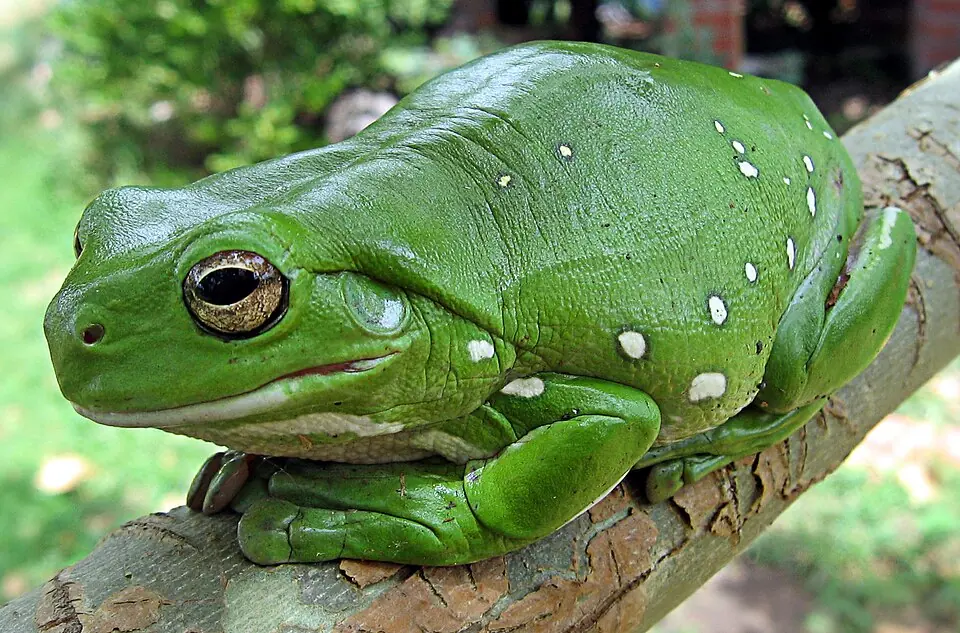
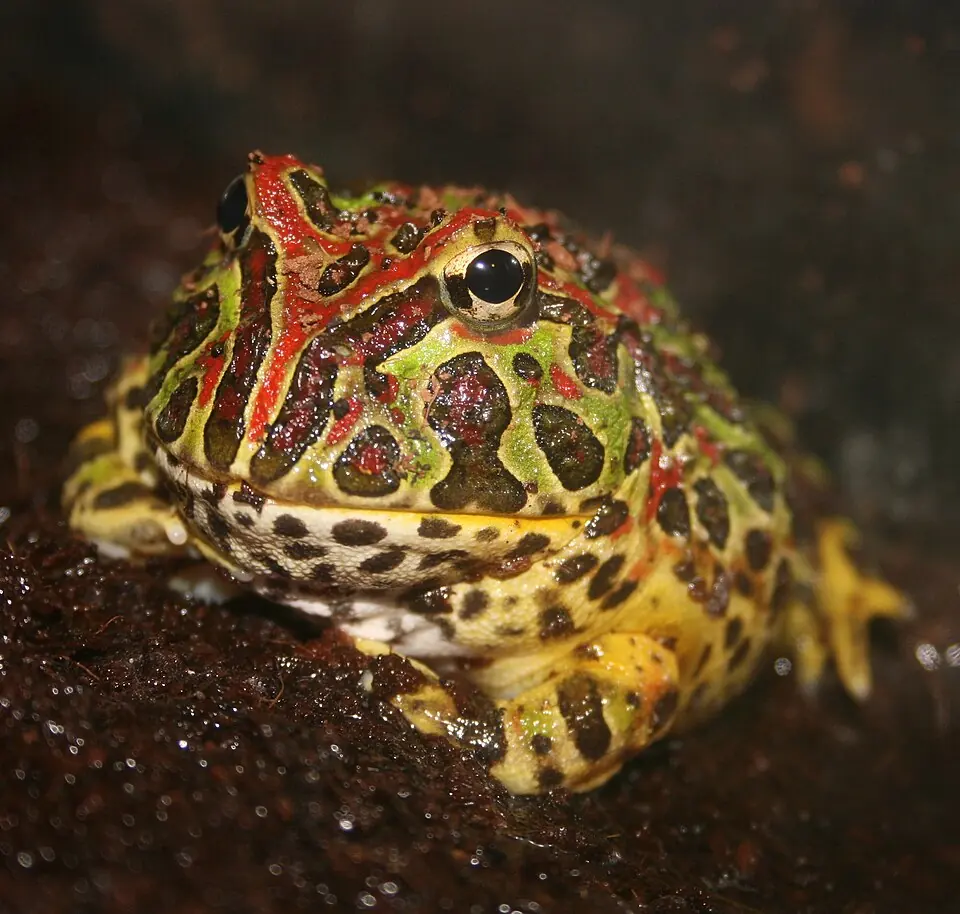
Ceratophrys ornata is the ornate or Argentine horned frog, a terrestrial ambush predator from the Pampean region of Argentina, Uruguay and southern Brazil. “Argentine horned frog” and “Pacman frog” are also used loosely for other species in shops. Ask for the breeder’s scientific identification and parentage, keeping hybrids and Ceratophrys cranwelli outside this guide’s scope.
This distinction affects the research. The museum taxonomic record specifically warns that some Paraguayan reports assigned to C. ornata were probably C. cranwelli. We therefore do not use a Gran Chaco care story as evidence for this animal. A similar round body does not make the two species interchangeable.
Veterinary care accounts give adult body lengths around 4–6″ (10–15 cm), with another describing females as large as about 7″ (18 cm). Plan for the large female your juvenile might become and roughly a decade of care; reported lifespans and size ranges are practical planning information, not a guaranteed result. This is a display animal with sensitive skin and a strong bite.
Allow a large female to bury and choose conditions
Our recommended minimum for one adult up to about 7″ (18 cm) body length is 3′ × 18″ × 18″ (92 × 46 × 46 cm) of usable internal length × depth × height. We prefer 3′ × 2′ × 18″ (92 × 61 × 46 cm) for more separation between burial, bath and feeding areas. These are our editorial functional layouts, larger than the small-terrarium or volume-based references. No trial establishes the exact dimensions as universal thresholds.
Use a roughly 4–6″ (10–15 cm) layer of soft, moist soil or coconut fiber without added fertilizer or pesticides that lets the entire frog bury. The layer is included in the internal height, leaving about 12–14″ (30–36 cm) before equipment. An unusually large animal or bulky furnishings needs an individual layout review; do not keep the number on paper by crowding the bath against the only refuge.
Add stable low cover in more than one part of the enclosure and a route between sheltered thermal choices. Furnishings must remain secure when the frog excavates below them. A heavy water bowl needs firm support and an easy exit. Provide effective ventilation and a secured lid. Do not add a large aquatic section: a source may call the enclosure semi-aquatic while also explicitly warning that the frog swims poorly.
Keep one frog per enclosure. Feeding strikes and cannibalism make another frog a risk even when both appear well fed.
Use a measured ambient plan
Maintain daytime air around 76–82°F (24–28°C) across sheltered floor positions, with the cool end toward the low part and warm end toward the high part. Measure air about 1″ (2.5 cm) above bedding and check burrow and exposed soil surfaces separately. At night, our selected reference is about 72–75°F (22–24°C). These are practical maintenance targets rather than critical limits.
The Chicago veterinary page also lists an 84–88°F (29–31°C) hot spot, while the other veterinary sheet uses day air of 75–82°F (24–28°C) and warns against drying basking lamps. We choose the ambient plan with a cooler moist refuge and no required hot spot. Combining the hottest surface reference with an enclosed uniformly humid tank would be a different system.
Use compatible thermostatic control on any heater, secure its probe according to the equipment instructions and verify with independent instruments. Prevent contact with hot fittings and avoid a heater under the deep burrow. A frog must be able to burrow into shelter without entering the warmest part of the system. Dark nights remain dark; add suitable controlled non-light warmth only when room conditions require it.
Offer low ultraviolet exposure with full shade
Provide a 12-hour light period and 12 hours of darkness, with covered areas that remain dark enough for daytime rest. Bright plant lamps and heat must not occupy every possible retreat.
The veterinary pages disagree about ultraviolet B (UVB): Chicago recommends it, while Royal Veterinary Center calls it unnecessary but permits low output. Neither page establishes a measured ideal species dose. We choose a voluntary low-exposure option around ultraviolet index (UVI) 0.3–0.7 in a small exposed patch, declining to 0 under cover. That number is an editorial application of the general low-exposure framework, not a claim that the ultraviolet lighting guide (UV-Tool (an ultraviolet lighting reference)) assigns C. ornata a zone or that experiments prove a requirement.
Measure toward the lamp at the frog’s back height and closest reachable point. Follow the fixture’s safe mounting and replacement instructions, accounting for mesh and reflector effects. A bulb percentage is not an animal-level measurement. Keep a fully shaded, suitably warm refuge, and review dietary vitamin D3 with the actual light and supplement plan. Avoid intense ultraviolet “boosts” and never use exposure as a substitute for calcium or a complete diet.
Give skin clean moisture and air exchange
Use approximately 60–80% relative humidity near bedding height as the veterinary-practice reference, recording local air temperature and probe position. It is a working husbandry range rather than a demonstrated physiological optimum. Keep the soil moist enough to bury in without turning it into mud, and maintain ventilation so humid air does not become stagnant.
Provide a shallow bath large enough for the frog to sit in with its head above water. It must not need to swim to use it, and the exit must be easy. Clean and refill it daily and immediately after feces or other fouling. A water feature with standing water introduces filtration and chemistry work; a removable dish is usually easier to keep under control.
Use water free of chlorine and chloramine for bathing, misting and substrate preparation. Treat the actual supply with an appropriate conditioner according to its label; simply aging water is unreliable for chloramine. Never let fertilizers, pesticides, perfume, soap or disinfectant residue touch the frog or its water.
If the air stays wet all day or the substrate smells sour, inspect drainage, ventilation and waste loading rather than applying more mist. If burial soil dries or the frog repeatedly struggles with skin turnover, inspect the entire moisture and temperature pattern and seek advice. A meter reading cannot diagnose hydration by itself.
Make earthworms part of a varied meal plan
An earthworm-rich rotation with suitable cultured crickets, roaches and other appropriate insect prey follows the species-specific veterinary guidance. Gut-load insect feeders before offering them and obtain worms from a safe cultured source. Field records include vertebrates and cannibalism, but the diet review documents diverse invertebrates too and warns that conspicuous large prey can bias observations.
A pet does not need wild frogs, feeder fish or frequent mice to imitate that ecology. Choose prey the animal can swallow comfortably, offer food clear of loose bark or moss and keep fingers away from the strike. Soft-tipped feeding tools or a clean feeding station allow observation without repeatedly relocating the frog.
Start a mature active adult with a modest meal every four to seven days. Growing young frogs generally need smaller meals every one or two days. Those intervals come from practical veterinary guidance, not an energy-budget study, so adjust portion and interval as growth, weight and condition change. The number of prey items depends on their type and size; a single large worm is not nutritionally equivalent to a tiny cricket.
Remove uneaten feeders and record appetite and waste. An adult that accepts everything can still become obese. Persistent bloating, difficult swallowing, weight loss or refusal paired with other changes needs assessment before changing food quantity or attempting to force feed.
Include vitamin A as well as calcium
Use calcium with insect meals and an amphibian-appropriate vitamin/mineral plan that includes vitamin A. Royal’s practice sheet describes calcium on most insect meals, while the Chicago page emphasizes vitamin A and calcium without a universal dose. Apply one selected stage-appropriate product plan according to the actual label and have it reviewed alongside the diet and any measured ultraviolet exposure.
Keep a record of product names, vitamin D3 content, storage, opening date and feeding frequency. Do not stack a complete supplement with additional vitamin A or vitamin D3 simply because different care sheets mention them. A veterinarian should assess poor prey capture, weakness, swelling or abnormal posture; these signs do not authorize concentrated home vitamin treatments.
Keep the soil soft, the strike area clear and the refuges stable
Choose soft fertilizer- and pesticide-free soil or coconut fiber rather than gravel, sharp particles or aromatic bedding. Keep loose moss and large bark pieces out of the feeding area. Small amounts of suitable leaf cover can provide concealment, but no piece should routinely enter the mouth with prey. Protect plant roots and heavy decorations from excavation.
Inspect daily for feces, dead insects, soiled water and contaminated bedding. Remove waste with the affected substrate and replace it with prepared material. Do not churn the occupied burrow daily: useful cleaning should not repeatedly expose the frog or destroy every refuge. Conventional bedding needs periodic full renewal according to its actual condition and loading, while planted systems still need servicing.
Remove dirt from equipment before disinfection. Follow the dilution and contact time for a product documented for amphibian equipment, then rinse thoroughly and clear residues before the item touches the frog again. Keep tools dedicated to the enclosure, wash hands afterward and avoid cleaning food or frog equipment together. A planted terrarium does not eliminate pathogen or Salmonella precautions.
Treat burial as behavior, not an invitation to poke
A frog half-buried with only the eyes visible is using a normal hunting strategy. It may move between burial sites at night. Record changes in its normal pattern, but do not repeatedly dig it out to check whether it is “friendly” or provoke a strike to test health.
Use a clean damp container for necessary moves. If support is unavoidable, moisten powder-free gloves with appropriate water and keep the frog low above a safe surface. Protect its sensitive skin from residues and protect your fingers from its mouth. Normal shedding may be followed by eating the skin. Do not peel retained skin or assume a prolonged coating is harmless without checking conditions and health.
Maintain young frogs without forcing a seasonal fast
Juveniles need smaller prey, more frequent feeding, appropriately shallow water and closer hydration checks. Temporary simple housing can make intake observable if it still provides soft shelter and a measured thermal choice. It must be replaced before the adult layout becomes necessary; a small grow-out tub is not the adult reference in the finder.
Older horned-frog guidance discusses inducing dormancy by reducing moisture, temperatures and feeding. We do not prescribe that as ordinary pet care. Keep water available and assess unexplained inactivity or appetite loss before calling it estivation. Breeding, seasonal cycling and carnivorous tadpole rearing require a separate plan and facilities.
Make the first week quiet and measurable
Before arrival, test the fully furnished enclosure through complete day and night cycles, documenting occupied-height air, soil, humidity, water and any ultraviolet measurement. Obtain the seller’s identity, last meals, weight history and treatments. Use separate tools during arrival observation and arrange an amphibian-veterinary exam and a quarantine duration based on the animal’s origin and other animals present. Before buying, check local ownership and property restrictions. Never release the animal outdoors.
In the first week, check the bath and environment daily, offer the established food and record intake and feces with minimal handling. Seek prompt help for raw or red skin, swelling, tremors, soft or abnormal jaws, weakness, prolapse, inability to right, breathing difficulty or appetite loss with weight loss. These observations need diagnosis; they are not instructions to treat at home.
Prepare the adult enclosure, deep soft bedding, low hides, easy-clean shallow bath, water conditioner, ventilation and secure lid, independent air probes, an infrared surface thermometer, hygrometer, timer and heat control where required. Add access to a suitable meter for any ultraviolet plan, cultured prey and gut-loading supplies, the documented supplement plan, feeding tools, a transfer container and an animal record.
Sources & further reading
Read the full recommendations and check details for your animal, equipment, and local conditions.
- Ceratophrys ornata (Bell, 1843) | Amphibian Species of the World
- Environment and Husbandry for Amphibians
- Reptiles and Amphibians: Healthy Pets, Healthy People
- How much UV-B does my reptile need? The UV-Tool, a guide to the selection of UV lighting for reptiles and amphibians in captivity (UV: ultraviolet)
- Feeding Pet Frogs and Toads
- Short Tongue Syndrome or Hypovitaminosis A in Frogs and Toads
- Horned (Pacman) Frog Care: Ceratophrys cranwelli and C. ornata
- On the Diet of the Frogs of the Ceratophryidae: Synopsis and New Contributions
- Argentine Horned Frog (Ceratophrys ornata)
- Pacman Frog (Ornate Horned Frog) Care Sheet
Original Creature Corner guide. Editorial fact and citation checks are recorded; independent veterinary review has not been performed.