Use this guide as a starting point alongside the detailed sources below. Health concerns, unexplained changes in behavior, or feeding problems belong with an amphibian veterinarian.
Adult enclosure recommendation
Our recommended minimum: 2′ × 18″ × 3′ (61 × 45.8 × 91.5 cm), length × depth × height.
Preferred target: 2′ × 2′ × 3′ (61 × 61 × 91.5 cm), length × depth × height.
Usable internal space for 1 adult animal. One adult Agalychnis callidryas, about 2–3″ (5–8 cm) body length; excludes other red-eyed/leaf-frog species and unresolved identity.
Height is the usable internal envelope, including the space reserved for substrate and water. Check the remaining movement space and lamp clearance after installation.
The extra depth makes room for more sheltered leaf and branch routes at the same height, while preserving a clear path to the bath and access for cleaning. This is a functional preference, not a proven optimum.
Veterinary guidance supplies a single-frog vertical baseline and functional climbing, water and cover requirements. Our larger dimensions are an editorial layout choice for connected sheltered movement and climate separation, not a trial-validated threshold.
- Floor space
- At least 2′ × 18″ (61 × 46 cm) usable internal floor with accessible shallow water and a route below furnishings.
- Climbing space
- Anchored branches/vines, broad leaves with covered undersides and more than one sheltered perch at different heights; measured lamp clearance.
- Substrate
- A planted option uses about 3″ (8 cm) moisture-holding soil or coconut fiber plus drainage and leaf cover within the 3′ (92 cm) internal envelope.
- Water
- Continuously available shallow easy-exit bath, cleaned daily and after fouling with chlorine/chloramine-free water.
- Security and ventilation
- One-animal reference, secure fine gaps/lid, effective air exchange with moist refuges, protected fixtures and compatible thermostatic heat control where needed.
Meeting these dimensions alone does not establish suitability. Check the usable layout, environmental conditions, equipment clearance and the individual animal’s requirements before occupation.
Choose a nocturnal leaf frog with a documented identity
Red-eyed tree frogs spend much of the day folded into shelter and become active after dark. They are a good fit for someone who enjoys observing a planted habitat in the evening, accepts live-insect feeding and can check water and climate every day. They are not pets for daytime handling sessions or repeatedly waking for photographs.
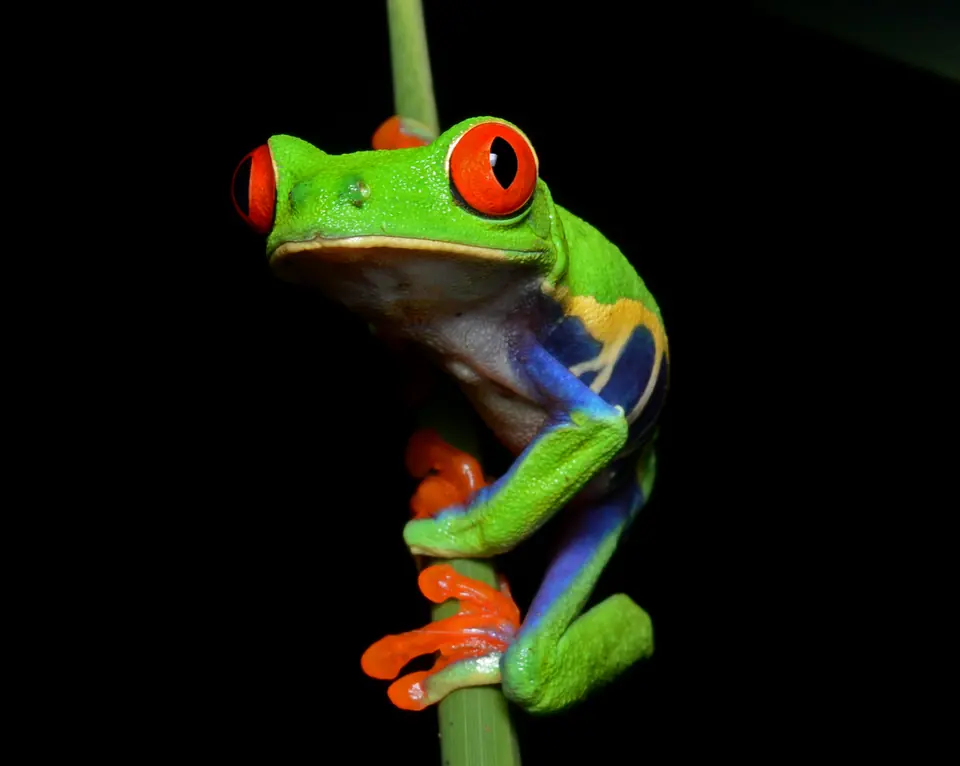
This guide covers Agalychnis callidryas, the red-eyed leaf or tree frog. The current taxonomic record separates animals formerly included under that name, especially A. taylori. Ask for scientific identification, captive-bred origin and lineage information. An old care article’s map or a color resemblance cannot establish a frog’s identity.
Adults are roughly 2–3″ (5–8 cm) in body length, with females usually larger. Plan for five to ten years or longer using veterinary practice estimates, rather than a guaranteed lifespan. Include secure vertical housing, plant and lamp maintenance, live-food cultures and an amphibian-veterinary reserve in the decision.
Make height into connected covered routes
For one adult, our recommended minimum is 2′ × 18″ × 3′ (61 × 46 × 92 cm) usable internal length × depth × height; we prefer 2′ × 2′ × 3′ (61 × 61 × 92 cm). This expands a veterinary 18″ × 18″ × 2′ (46 × 46 × 61 cm) single-frog example so climbing, sheltered rest, water access and distinct conditions coexist. It is our functional editorial recommendation, not an experimentally proven minimum.
Arrange branches and vines between broad leaves and cork retreats at several heights. Let the frog travel between sheltered positions without crossing an exposed empty tower. Broad leaves with protected undersides provide daytime resting choices; robust furnishings must stay anchored when the frog jumps. Keep openings secure at the smallest frog’s size.
A planted option can use about 3″ (8 cm) of fertilizer- and pesticide-free moisture-holding soil or coconut fiber above a drainage layer, with suitable leaf cover. This is a practical layout allowance rather than a biological depth requirement. Bedding and drainage are inside the stated height, so subtract them when judging clear climbing space and lamp clearance.
The dimensions cover one frog. Conspecific pairs or groups are possible in experienced care, but require a separate resource, size, feeding and disease assessment rather than multiplying gallons.
Measure the places where the frog actually rests
For healthy nonbreeding maintenance, start with daytime air around 76–80°F (24–27°C) across occupied perch locations, and night air around 70–74°F (21–23°C). Provide a cooler shaded route and a warmer choice. These are selected operating targets within published veterinary protocols; they are not experimentally measured optimum or critical limits.
Use independent digital probes at upper and lower occupied heights and on the warm and cool sides. Check reachable surfaces separately with an infrared thermometer. Control any heater with a compatible thermostat, secure its control probe as directed and prevent contact with hot fittings or guards. An air reading near the floor cannot tell you whether a lamp-side upper leaf is overheating.
One veterinary protocol gives warmer air and an optional basking site, while another discourages basking lamps. We choose the milder air-based plan without a required hot spot. Do not combine every source’s upper number in a humid enclosure. Plant lighting and room heat can add significant warmth even when there is no dedicated heater.
Run the final furnished habitat through complete day/night cycles before arrival, including the room’s warmest expected conditions. Recheck after pruning plants, moving perches or replacing equipment. Use controlled non-light warmth if necessary at night and preserve darkness.
Provide a measured choice, without intense ultraviolet boosts
Set a consistent 12-hour light period and 12 hours of darkness. Offer modest ultraviolet B (UVB), measured as ultraviolet index (UVI), around 0.5–1.0 at an exposed perch, declining to 0 beneath shelter. This is our selected low-exposure practice target, not a dose proven ideal throughout life.
Measure toward the lamp at the frog’s back height and nearest reachable point, with the actual mesh, reflector and branches in place. A bulb’s percentage does not report the exposure reaching the animal. Preserve a shaded, appropriately warm resting choice and follow the fixture’s installation and replacement instructions.
A controlled study of nominal red-eyed tree frogs compared background ultraviolet with an additional boost and two calcium-feeder treatments. The extra boost showed no demonstrated growth or breeding advantage and was associated with greater fungal load. Every group received background ultraviolet, so the study does not answer ultraviolet versus none. Its captive lineage also predates a later taxonomic split. We do not recommend intense periodic boosts or claim the experiment proves this exact maintenance dose.
Dietary vitamin D3, calcium, vitamins and light must be planned together. Adding an ultraviolet lamp does not remove the need for calcium and a complete diet, and it does not justify combining multiple vitamin powders.
Maintain moist refuges and clear stagnant air
Our selected air reference is about 60–80% relative humidity at a documented occupied location, recorded with local temperature. Another veterinary sheet uses 70–90%; neither establishes an exact optimum or makes air humidity a direct measure of skin hydration. Moist substrate, covered resting places and fresh bath access remain important.
Mist the habitat according to its measured drying pattern so exposed leaves lose free surface water between wettings while lower soil remains moist. Retain effective ventilation. Persistent condensation everywhere, sour bedding or a need to seal the lid suggests drainage, waste or air-exchange trouble. Do not repeatedly spray a sleeping frog to make a meter reading rise.
Provide a shallow stable bath that fits the frog, with a secure easy exit and water shallow enough to rest with the head above it. Clean and refill it at least daily and immediately after contamination. Treat the actual supply for chlorine and chloramine before water is used in the bath, mister or soil. Simply leaving water to stand is unreliable for chloramine.
Keep pesticides, fertilizers, perfumes and cleaning residues away from the habitat and prepare plants safely before installation. Clean water storage and misting equipment as well as the visible bowl; a planted tank is not protected from contaminated equipment.
Feed during activity and observe actual intake
Use varied cultured gut-loaded insects, such as suitable crickets and roaches, with appropriately sized earthworms or soft-bodied larvae as additional foods. Offer food around dusk so a sleeping frog is not expected to find and eat insects throughout the day. Prey should be comfortable to swallow; do not use the mouth’s apparent capacity as a portion target.
Start a settled adult with three modest meals weekly and growing young with smaller daily offers. Adjust for the individual’s life stage; body length alone does not establish adulthood. Review growth, weight trend and condition with the veterinarian, adjusting the actual amount and interval as the animal changes.
Use a clean feeding area or suitable soft-tipped tools to keep the strike clear of loose bark or moss. Record what was eaten and remove leftovers. A long daytime fast followed by feeding enthusiasm does not show that every additional insect is needed.
Use one amphibian-appropriate calcium and vitamin plan that includes vitamin A and coordinates dietary vitamin D3 with the measured ultraviolet option. Apply the actual stage-appropriate product directions, recording labels and use dates. Do not stack complete formulas or administer concentrated vitamins for a missed meal or poor strike without assessment.
Keep the planted structure accessible for cleaning
Inspect the water, animal, perches and feeding area daily, removing feces, dead insects and contaminated material. Keep plants trimmed enough for servicing and observation without stripping away daytime cover. Drain collected water before it reaches the soil layer, and refresh deteriorated leaf cover or soiled bedding.
Short separate arrival observation can use simple moist paper with proper perches and cover, replaced whenever soiled. It remains a temporary assessment arrangement rather than an excuse to omit adult space or humidity control. A mature bioactive system still needs waste inspection and clean water; a clean-up crew does not certify hygiene.
Remove visible dirt from equipment first, then use a disinfectant documented for amphibian equipment at its specified dilution and contact time. Rinse thoroughly and prevent residues returning to the animal. Use dedicated tools, wash hands afterward and keep servicing away from food preparation surfaces. Apparently healthy amphibians can carry Salmonella.
Protect the folded daytime frog
Observe the frog’s evening route and daytime resting pattern without repeatedly touching or uncovering it. Essential moves are best made with a clean damp container. If support is unavoidable, use wet powder-free gloves, hold the animal low and avoid squeezing. Bare-hand oils, salts and soap traces are unsuitable for its skin.
Skin turnover may be brief and the frog may eat the shed. Do not peel skin or routinely bathe a frog to make it shed. Prolonged coatings, new raw patches, repeated difficulty gripping or changed appetite call for environmental checks and veterinary advice rather than a visual diagnosis.
Keep breeding methods out of ordinary maintenance
Small froglets need smaller prey, tighter escape security, appropriately shallow water and closer hydration checks. Temporary grow-out housing may make intake easier to observe, but the adult layout must be ready before it becomes crowded. Keep shelter and measured exposure choices at every stage.
Seasonal cooling, rain chambers, egg clutches and tadpoles require separate planning. They are not necessary additions to a nonbreeding pet routine. Do not force a dry spell, prolonged fast or winter chill because an institutional table describes seasonal treatment; unexplained inactivity or refusal should first prompt review of the current conditions and health.
Let the first week establish a useful baseline
Obtain identity, provenance, recent meals, weight history and any treatments before arrival. Arrange a source-risk quarantine and amphibian-veterinary examination with dedicated tools. Veterinary guidance often uses six to eight weeks, but origin, tests and other animals can change the appropriate duration. Before buying, check local ownership and property restrictions. Never release the animal outdoors.
During the first week, keep disturbance low, inspect climate and bath access daily, offer established prey and record intake and waste. Seek prompt help for raw or red skin, swelling, weakness, abnormal breathing, weight loss, impaired righting or inability to grip and perch. These signs do not identify one disease or authorize home antibiotics or vitamin doses.
Prepare the measured adult enclosure, anchored climbing cover, drainage and substrate, shallow removable bath, suitable water conditioner and cleaning containers. Add independent air probes, a surface thermometer, hygrometer, timer, appropriate heat control where required and access to UVI measurement for the selected light plan. Keep cultured food, gut-load, documented supplements, a transfer container and records ready.
Sources & further reading
Read the full recommendations and check details for your animal, equipment, and local conditions.
- Agalychnis callidryas (Cope, 1862) | Amphibian Species of the World
- Environment and Husbandry for Amphibians
- Reptiles and Amphibians: Healthy Pets, Healthy People
- How much UV-B does my reptile need? The UV-Tool, a guide to the selection of UV lighting for reptiles and amphibians in captivity (UV-Tool: an ultraviolet lighting reference; UV: ultraviolet)
- Feeding Pet Frogs and Toads
- Short Tongue Syndrome or Hypovitaminosis A in Frogs and Toads
- Red Eyed Tree Frog Care (Agalychnis callidryas)
- Red-Eyed Tree Frog (Agalychnis callidryas) Care
- Effects of different UV and calcium provisioning on health and fitness traits of red-eyed tree frogs (Agalychnis callidryas)
Original Creature Corner guide. Editorial fact and citation checks are recorded; independent veterinary review has not been performed.