

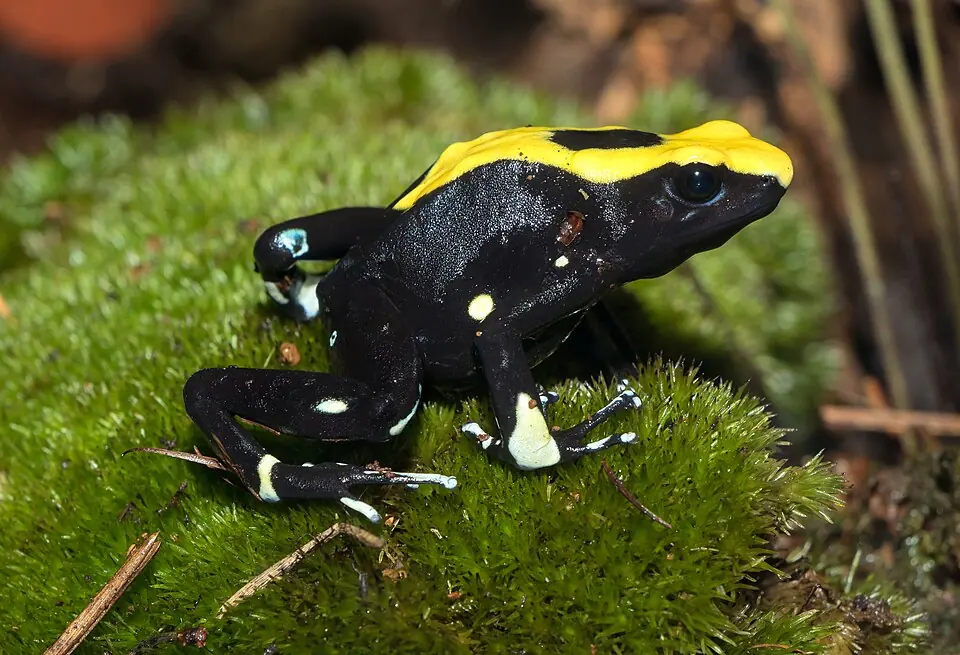
Use this guide as a starting point alongside the detailed sources below. Health concerns, unexplained changes in behavior, or feeding problems belong with an amphibian veterinarian.
Adult enclosure recommendation
Our recommended minimum: 2′ × 18″ × 2′ (61 × 45.8 × 61 cm), length × depth × height.
Preferred target: 3′ × 18″ × 2′ (91.5 × 45.8 × 61 cm), length × depth × height.
Usable internal space for 1 adult animal. One adult Dendrobates tinctorius up to 3″ (7.6 cm) body length, including azureus as a form/alias; no automatic pair or group suitability.
Height is the usable internal envelope, including the space reserved for substrate and water. Check the remaining movement space and lamp clearance after installation.
The extra length provides more leaf-litter foraging area and low covered routes between feeding, water and moist retreats. Keep that floor accessible beneath planting; the preference is not a tested welfare threshold.
Specialist examples establish leaf-litter use, small-prey feeding and female aggression, with no experimentally validated space threshold. Our larger editorial layout separates covered movement, feeding, clean shallow water and measured climate.
- Floor space
- At least 2′ × 18″ (61 × 46 cm) usable floor with connected leaf-litter routes, more than one shelter and a visible feeding station.
- Climbing space
- Low stable cork, roots and plants provide accessible covered routes; height cannot compensate for unavailable floor.
- Substrate
- A practical planted example uses about 2″ (5 cm) drainage plus 2″ (5 cm) soil and generous leaf cover inside the 2′ (61 cm) internal height; inspect and drain below-soil water.
- Water
- A continuously available very shallow easy-exit dish, cleaned daily and after fouling with chlorine/chloramine-free water; no required pond.
- Security and ventilation
- Secure fine gaps for the smallest stage, effective air exchange with moist refuges, safe protected fixtures and access for daily servicing.
Meeting these dimensions alone does not establish suitability. Check the usable layout, environmental conditions, equipment clearance and the individual animal’s requirements before occupation.
Keep the species and its form attached to the record
Dyeing poison dart frogs reward patient daytime observation. A settled frog searches leaf litter for tiny prey, investigates low cover and may become familiar with a feeding station. The commitment includes reliable small-food production, daily moisture and temperature checks and essential handling only. A planted display still needs an accessible service routine.
This guide covers Dendrobates tinctorius, including the blue form often sold as azureus. The current taxonomic reference places azureus within this species; it is an alias or form identity here, not a separate species guide. Preserve the breeder’s locality or form label and parentage information. A blue frog without provenance does not establish a particular lineage.
The species occurs in the lowland forests of the Guianas and adjoining Brazil. Captive forms vary substantially: adults are approximately 1.25–2.5″ (3–6.4 cm) in body length in the specialist accounts, with females generally larger. Our space recommendation covers one adult up to 3″ (7.6 cm), not every unresolved animal sold under a color name.
Experienced producer estimates range around ten to twenty years, with longer-lived individuals reported. Treat twenty years as a potential care commitment rather than a promised lifespan. Budget for food-culture failures, summer room cooling, plant and lamp maintenance, and amphibian-veterinary care as well as the frog.
Leave a useful forest floor beneath the planting
For one adult, our recommended minimum is 2′ × 18″ × 2′ (61 × 46 × 61 cm) usable internal length × depth × height. We prefer 3′ × 18″ × 2′ (92 × 46 × 61 cm). These dimensions are our editorial functional choice beyond small cube and gallon examples. They make room for separate feeding, moist shelter and exploratory routes; the cited sources do not establish an exact welfare threshold.
Prioritize reachable floor and low routes rather than a tall bare tower. Arrange leaf litter, stable cork, roots and broad plants so the frog can move between cover, a feeding area and water without entering a single exposed bottleneck. Low climbs add choice, but foliage should not make most of the nominal floor inaccessible.
A practical planted layout uses about 2″ (5 cm) of expanded-clay drainage balls beneath 2″ (5 cm) of a well-draining soil mix made for planted amphibian enclosures, topped with clean leaf litter. Place a fine mesh barrier between drainage and soil so particles cannot wash into the lower layer. Provide access to remove collected water before it floods the soil. These layers occupy part of the stated internal height; their depths are a practical starting allowance, not a tested biological minimum.
Use a secure fine-gap lid, safe screened ventilation and robustly anchored furnishings. Prepare plants without pesticides, fertilizers or cleaning residues. Leave enough access to reach the bath, inspect waste and remove the frog by container when necessary. A dense planting should offer shelter without making essential care impossible.
Plan for a warm room before it becomes a crisis
Start healthy nonbreeding adults with occupied-floor daytime air around 72–76°F (22–24°C), falling to about 68–72°F (20–22°C) at night. Provide shaded variation within that plan. These selected targets sit within specialist practice ranges and favor the low-to-mid seventies; they are not experimentally proven optimum temperatures or exact danger boundaries.
Measure air at frog height near the feeding and sheltered areas with independent probes. Also check the warmer upper points created by plant lights. A thermometer high on the front glass can miss a warm pocket or the conditions under a wet leaf. Record where each reading was taken.
Run the furnished habitat through day and night before arrival and assess the warmest room conditions expected during summer. A cool room or controlled room cooling may matter more than a heater. Do not add a basking patch merely because another animal uses one. If heat is necessary, control it with a compatible thermostat and prevent direct access to hot equipment.
Light changes, blocked ventilation and a new lid can change heat accumulation. Recheck after those changes and have a plan to maintain appropriate conditions during equipment failure. Spraying extra water is not a reliable substitute for controlling excessive heat.
Make low ultraviolet exposure optional and measurable
Use a consistent 12-hour day and 12-hour dark period. A selected low ultraviolet B (UVB) option is ultraviolet index (UVI) 0.3–0.7 at an accessible exposed position, falling to 0 under substantial cover. The frog must be able to remain sheltered at a suitable temperature without receiving the exposure.
The published ultraviolet lighting guide (UV-Tool (an ultraviolet lighting reference)) assigns generic tinctorius to a broader category than its separate azureus row. We choose a conservative low option across this species guide. The framework is an evidence-informed practice tool, not proof that our exact target is necessary or optimal for every form throughout life.
Measure toward the lamp at the animal’s back height and nearest reachable surface with the actual mesh and foliage installed. Lamp percentage, fixture distance alone and visible brightness do not establish the UVI reaching the frog. Preserve clearance as plants grow and review the installation when equipment is changed.
Coordinate light with one documented calcium, vitamin A and dietary vitamin D3 plan for the actual amphibian product and life stage. Record the labels, storage directions and use pattern rather than combining several complete powders. Ultraviolet does not replace calcium, and a missed meal does not justify a concentrated vitamin correction.
Keep moist refuges while exchanging air
Use about 70–90% relative humidity as a working near-floor air reference, with temperature and measurement location recorded. It is our selected operating range, not a direct measurement of skin hydration. Specialist accounts differ: one gives 70–100%, while a second favors 70–80% and warns about stagnation.
Maintain moist lower soil and shaded refuges, while exposed leaves and surfaces lose free water between misting events. Adjust misting to the actual drainage, room air and drying pattern. Do not seal the enclosure to hold a constant 100% reading or copy a universal percentage of covered mesh. Persistent sour substrate, pooled drainage or condensation everywhere needs investigation.
Offer a very shallow stable water dish with a gradual easy exit, rather than a pond that consumes the small frog’s floor. The animal should be able to stand comfortably without being forced to swim. Clean and refill it daily and after fouling. Water availability does not make chronically dry refuges acceptable.
Treat water for the actual supply’s chlorine and chloramine before it is used for the dish, misting or substrate. Standing tap water is not a dependable chloramine treatment. Keep storage containers and mister tubing clean, and keep soaps, fragrances and household chemicals away from the habitat.
Make food continuity part of the setup
Flightless fruit flies are a practical staple-sized prey for captive dart frogs. Cultured small crickets and other suitable tiny invertebrates can broaden the diet. Small frogs need prey they can capture and swallow easily; springtails in the habitat can supplement feeding but do not establish a complete ration.
Maintain more than one food culture at different ages, with a backup supply that will still be available if a culture crashes. Practice producing and dispensing prey before bringing the frog home. A single flourishing culture today does not guarantee food through its next production gap.
Start a settled adult with three modest meals each week, then adjust the amount and interval to actual intake, body condition and waste. Growing froglets need smaller daily offers and closer observation. Another keeper protocol feeds adults on alternate days; neither schedule supports an exact universal fly count.
Feed at a visible clean station so the frog can forage while you check intake. Use nutritionally prepared prey and the selected product-specific supplement plan. Remove spoiled material and obvious leftovers, and avoid allowing large residual prey populations to substitute for knowing whether the frog ate.
Repeated failed strikes, weight loss or a frog becoming thin while flies remain available warrant environmental review and veterinary assessment. Those signs alone do not diagnose vitamin A deficiency or authorize adding high-dose vitamins. Dietary variety and careful records are more useful than assuming appetite guarantees nutritional balance.
Keep the floor clean without erasing its cover
Inspect the frog, dish, feeding area and drainage every day. Remove feces, dead prey and spoiled organic material, replenish deteriorating leaf cover and remove water collected below the soil before it rises into the bedding. A clean-up crew can assist decomposition; it does not replace inspection or prove that an enclosure is hygienic.
Prune plants to preserve low connected routes, visible feeding access and ventilation. Replace contaminated or failing substrate according to its condition rather than a promised multi-year interval. Use dedicated maintenance tools. Remove dirt from equipment before using a disinfectant documented for amphibian equipment at its specified dilution and contact time, then rinse thoroughly and keep residues away from the frog.
Do not force a seasonal dry period, winter cooling or fasting to trigger breeding under this maintenance guide. Eggs, transporting behavior and tadpole rearing need a separate plan, including the correct aquatic food and safe rearing conditions. Froglets need escape-proof gaps, small food and shallower water access; they do not inherit an adult meal interval automatically.
Skin turnover can be brief and the shed may be eaten. Do not peel skin or repeatedly mist the animal directly to make it shed. New raw areas, prolonged skin changes or altered movement call for a review of water, moisture and health.
Use the first week to learn the individual
Before arrival, obtain exact identity, captive-bred provenance, form, recent diet and any treatment history. Arrange an amphibian-veterinary examination and source-risk quarantine with dedicated equipment. General veterinary guidance often uses six to eight weeks, but testing, origin and other animals can change that plan. Before buying, check local ownership and property restrictions. Never release the animal outdoors.
Keep disturbance low while checking the frog’s route, cover use, meals and waste. Confirm that it actually reaches food and water, rather than assuming a planted tank supplies everything. Record a baseline weight using a suitable container when it can be obtained without repeated disruptive catching.
Seek prompt help for weakness, impaired righting, raw skin, swelling, persistent feeding difficulty or weight loss. Review the recorded environmental conditions and actual intake with the veterinarian; photographs alone cannot distinguish the possible causes.
Have the measured adult habitat, moist refuges, drainage access, daily-service bath, conditioned water, independent probes, hygrometer, light timer and measured ultraviolet plan ready. Add food cultures of different ages, backup food, the documented nutrition products, a transfer container and written daily records before the animal arrives.
Sources & further reading
Read the full recommendations and check details for your animal, equipment, and local conditions.
- Dendrobates tinctorius (Cuvier, 1797) | Amphibian Species of the World
- Environment and Husbandry for Amphibians
- Reptiles and Amphibians: Healthy Pets, Healthy People
- How much UV-B does my reptile need? The UV-Tool, a guide to the selection of UV lighting for reptiles and amphibians in captivity (UV: ultraviolet)
- Feeding Pet Frogs and Toads
- Short Tongue Syndrome or Hypovitaminosis A in Frogs and Toads
- Dendrobates tinctorius 'Powder Blue'
- Hopping into the Hobby: Three Great Starter Frogs
- Feeding Dart Frogs: What, How Often, and How Much?
- Dendrobates tinctorius 'Azureus' | Blue Poison Dart Frog
- Dendrobates tinctorius care sheet
Original Creature Corner guide. Editorial fact and citation checks are recorded; independent veterinary review has not been performed.
Treat adult female aggression as a real housing limit
One adult is the primary numerical case in this guide. Young frogs that appear peaceful together may develop different relationships as they mature, and specialist accounts particularly warn about adult female fighting. Successful groups described for one form cannot establish that every pair or group will work.
A proposed pair requires its own identity, size, resource and behavior assessment, with ready separation housing. Watch individual intake and condition, persistent pursuit, pinning and exclusion from feeding or shelter. A frog that stays hidden after a social change may need more than another plant.
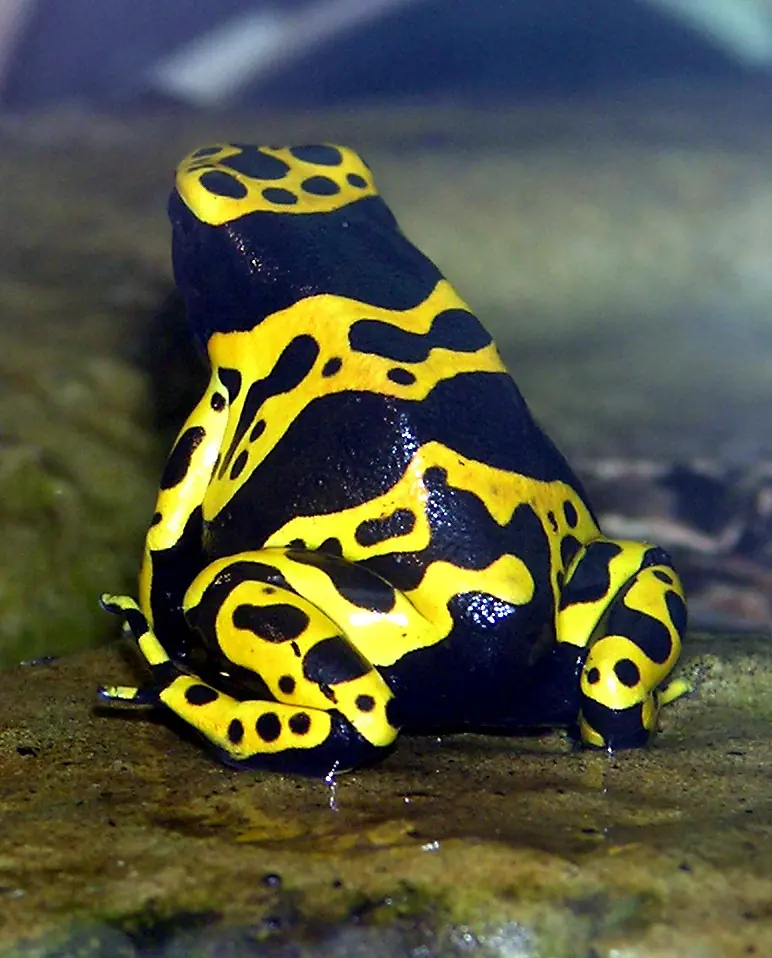
Do not mix dart-frog species or locality forms. Keep provenance and breeding history with the individual record. There is no group-size alternative in this guide that turns a dimension match into social approval.
Use a clean damp container for essential moves. If support is unavoidable, use wet powder-free gloves and keep the frog low without squeezing. Captive feeding often changes the chemical defenses associated with wild dart frogs, but this does not make every animal or its environment harmless. Avoid eye and mouth contact and wash hands after servicing.
References: [2] [3] [7] [8] [10]