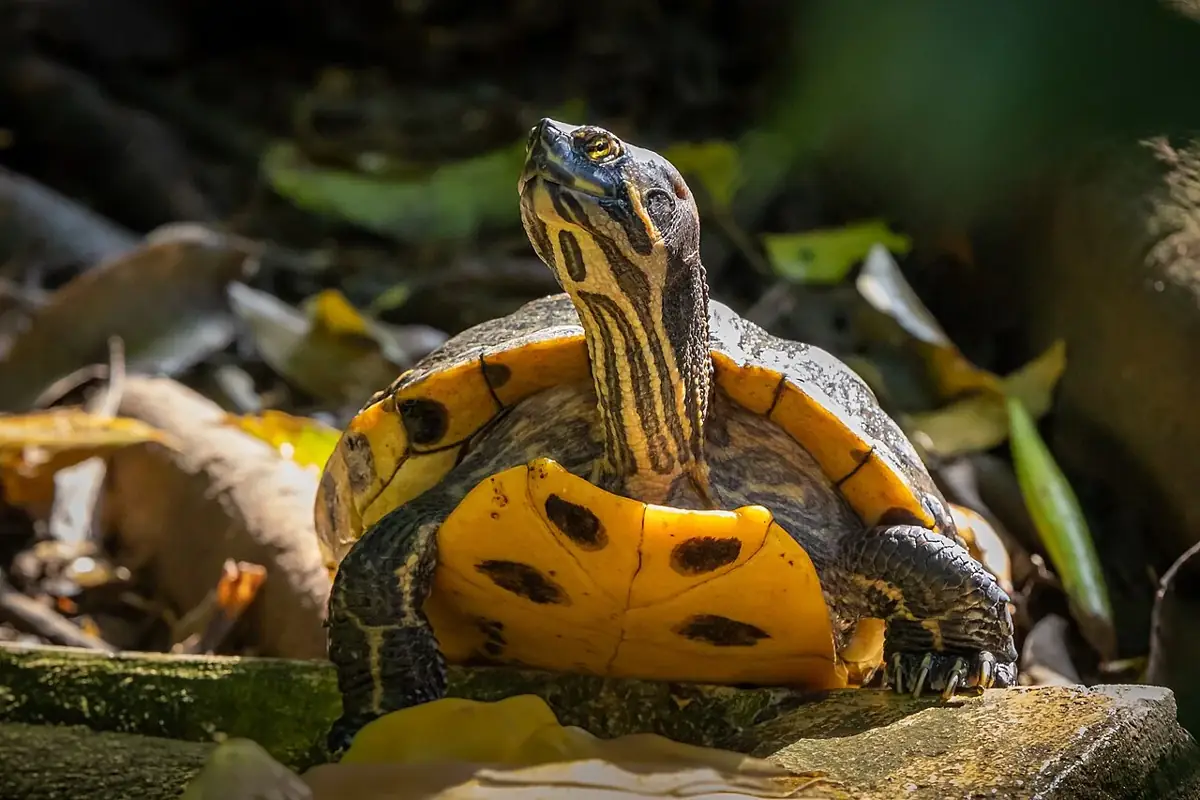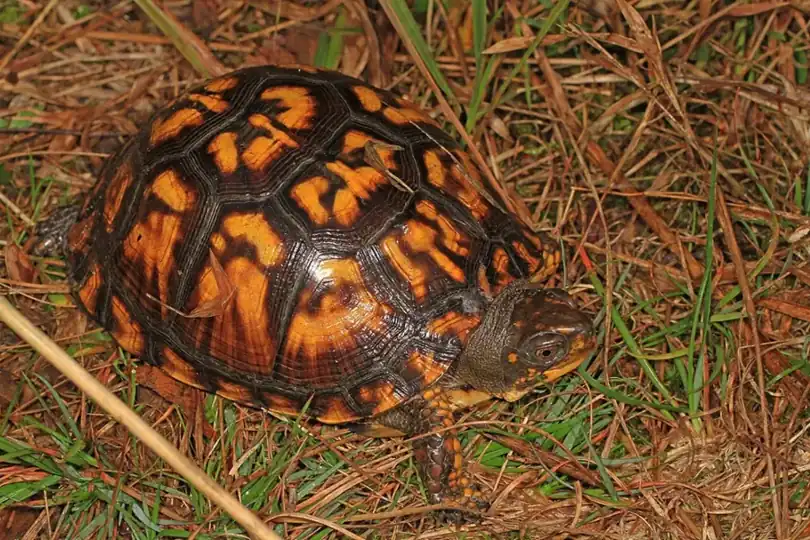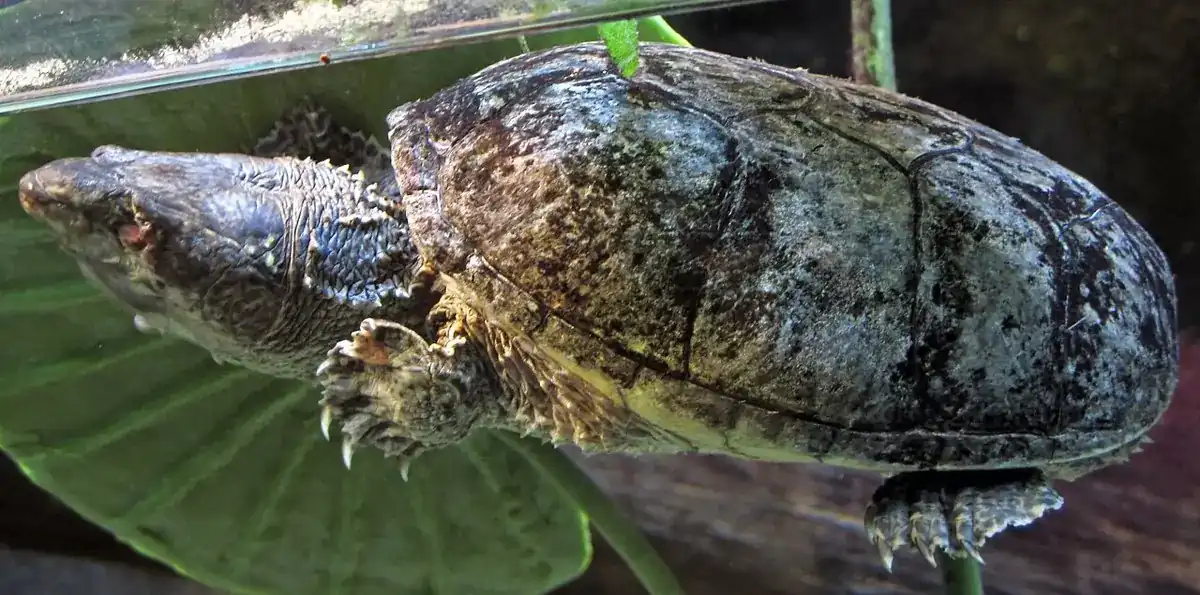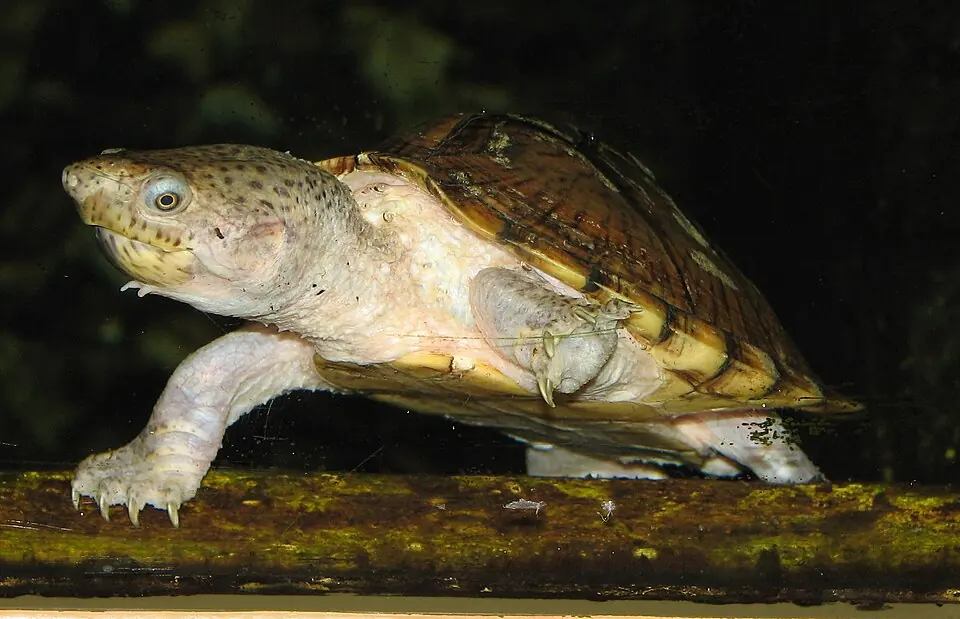
Use this guide as a starting point alongside the detailed sources below. Health concerns, unexplained changes in behavior, or feeding problems belong with a reptile veterinarian.
Adult enclosure recommendation
Our recommended minimum: 4′ × 2′ × 2′ (122 × 61 × 61 cm), length × depth × height.
Preferred target: 6′ × 3′ × 3′ (182.9 × 91.5 × 91.5 cm), length × depth × height.
Usable internal space for 1 adult animal. One confirmed adult Sternotherus carinatus through 7″ (18 cm) straight carapace length, alone. Exceptional larger individuals need an enlarged individually assessed layout.
Height is the usable internal envelope, including the space reserved for substrate and water. Check the remaining movement space and lamp clearance after installation.
The preferred layout adds bottom routes, structured swimming and room for a separate accessible land/dock system.
Our minimum replaces a volume-only keeper example with usable adult water geometry, resting structure and a dry dock. Complete dimensions and selected depth are editorial judgments, not trial-derived optima.
Reassess a larger animal beyond 7″ (18 cm) shell length; primary evidence includes an exceptional 8.2″ (20.9 cm) specimen, which is outside this standard fit.
- Floor space
- Preserve 4′ × 2′ (122 × 61 cm) usable water footprint beneath a raised dry dock; do not consume half that footprint with a solid land partition.
- Climbing space
- Anchor underwater rests and multiple easy routes to the surface and dry dock; avoid traps and unstable stacked rocks.
- Substrate
- Bare bottom or a thin cleanable fine-sand layer; account for displacement and keep swallowed gravel out.
- Water
- An established competent adult can use an editorial 12–16″ (30.5–40.5 cm) depth with abundant surface rests. This is about 60–80 US gal (227–303 L) before displacement; start young/weak/new animals shallower.
- Security and ventilation
- At that depth the stated minimum height leaves 8–12″ (20–30.5 cm) above water before dock/headroom. An external secured dry dock or greater height may be needed; protect heater/intakes, lock climbing escape routes and ventilate.
Evidence gaps requiring review:
- Verify actual water depth, ability-led surfacing routes, fully dry dock, escape margin and shell-height lamp clearance in the finished layout.
Meeting these dimensions alone does not establish suitability. Check the usable layout, environmental conditions, equipment clearance and the individual animal’s requirements before occupation.
Measure the shell and confirm the musk turtle
This guide covers Sternotherus carinatus, the razor-backed musk turtle, rather than the common musk or loggerhead musk turtle. Confirm legal captive-bred origin and identity. Adult size here is straight carapace length, measured along the shell, excluding the head, neck and tail.
The standard example covers one animal through 7″ (18 cm) shell length. A specialist account also records an exceptional 8.2″ (20.9 cm) specimen; that larger case requires an enlarged individual layout. A small hatchling and a thirty-gallon keeper example should not be mistaken for a permanent adult plan.
Plan for a turtle that may need care for decades. Its continuing requirements include filter upkeep, replacement lamps, water testing and veterinary care, even while the shell still looks relatively small.
Structure the whole route from bottom to air
Use the adult panel’s internal water footprint and choose the preferred layout where possible. Healthy established adults can use deeper water than many mud turtles, but that does not make featureless deep water suitable. Provide covered bottom routes, secured wood and broad resting positions at several heights, including rests close enough to the surface for easy breathing.
Our 12–16″ (30.5–40.5 cm) adult water depth is an editorial implementation, not a minimum for every stage. Start hatchlings, weak animals and new arrivals shallower, with close resting support. Increase depth only after observing controlled swimming, turning, resting and surfacing. Protect heater and filter intakes, retain a gentle-flow destination and eliminate entrapment gaps.
A fully dry accessible dock remains essential even if basking seems infrequent. Its ramps, escape margin and lamp clearance must actually fit above the water. An external secured dock or taller enclosure may be necessary. Bare bottom or a thin cleanable fine-sand layer makes waste inspection practical; avoid swallowed gravel and unstable stacked stone.
Make basking a voluntary measured choice
The selected adult strategy uses water 75–78°F (23.9–25.6°C), air where the animal rests or moves 75–83°F (23.9–28.3°C), and a dry basking surface 88–92°F (31.1–33.3°C). The surface interpretation narrows an older keeper reference; night air 70–75°F (21.1–23.9°C) is an editorial choice near the zoo table’s night range. Water, air and dock surface are different measurements.
Control heat, protect equipment and retain a cooler destination. Provide a 12-hour starting day and dark night. Ultraviolet B (UVB) is implemented as a restricted basking patch at ultraviolet index (UVI) 2–3 at shell height, with low background exposure and fully shaded shelter. This numerical patch is an editorial use of the zoo zone 2–3 classification, not a dose proven by the zone label alone. Meter the actual fixture, mesh and nearest shell position.
A clear-looking tank still needs water tests
Mature biological filtration before arrival, with protected intakes and a manageable flow. Test ammonia and nitrite: both should remain at zero in milligrams per liter (mg/L). Test at least weekly and more often during startup, equipment problems or changes in condition, recording nitrate and source-water readings too. A clear-looking tank is not a substitute for tests, and a larger filter does not remove the need for water changes.
Remove food residue and visible waste promptly. A general Ornamental Aquatic Trade Association (OATA) starting reference is a partial change of about half the water weekly, using treated, temperature-matched replacement water; adjust frequency and volume to actual readings and waste load. If ammonia or nitrite is detected, make a prompt suitable partial change, retest more often and investigate the biofilter, feeding and source water. Do not wait for the next routine cleaning.
For nitrate, the same general freshwater guidance gives an action reference of no more than 40 mg/L above the measured normal tap-water level. Check the baseline and increase maintenance before a continuing rise reaches it; this is not a species-specific toxicity threshold or a promise that every lower reading is harmless. If source water is already high, plan a suitable alternative with qualified aquatic advice. Preserve biological filter media, rinsing it gently in removed aquarium water when needed, and avoid routine sterilization or an automatic full-system reset. Use dedicated buckets and a safe siphon that never needs mouth-priming.
References: [5]
Combine a complete base with safe invertebrate variety
Use an appropriate complete aquatic-turtle pellet as a nutritional base alongside safe cultured invertebrate variety, including suitably sized mollusks where available. Natural-history evidence records aquatic insects, snails, clams and crayfish; their importance changes with size. Avoid polluted wild prey and dried shrimp or raw muscle meat as the entire menu.
Daily offers for growing young and roughly three meals weekly for adults are editorial starting rhythms, adjusted to actual intake, weight and condition. Coordinate calcium and vitamin provision with the fortified food and measured UV (ultraviolet) plan rather than adding vitamin D3 to everything. Remove residue promptly and assess persistent refusal with decline rather than switching endlessly between treats.
Offer meals in the water, where this aquatic turtle can swallow them normally. Suitable variety includes cultured earthworms and aquatic snails of a manageable size. Start with the complete pellet’s feeding directions for the animal’s size, record the amount offered and remove leftovers promptly; adjust portions if weight or body condition changes.
Observe closely and transfer only when needed
House singly. An older community account does not establish safety with sliders, fish or another musk turtle; competition and bites can develop after apparently peaceful periods. Keep routine interaction to observation and calm feeding. For necessary transfers, support the shell and limbs low over a secure container, keeping clear of the extending neck and jaws.
A mature female needs accessible suitable laying land even without planned mating. Nest searching, straining or swelling needs attention rather than a deeper water change. Seasonal behavior is not permission for automatic winter cooling: review identity, health and husbandry before any planned brumation. This guide does not prescribe breeding or incubation.
Validate the dock as carefully as the filter
Prepare a watertight adult enclosure, anchored surface routes, secure dry dock, protected heating, measured heat and UV, timer, water and air probes, surface thermometer, test kits, conditioner, siphon and dedicated cleaning tools. Validate the finished layout and cycled water before arrival, including safe electrical installation around water.
Quarantine new arrivals and record weight, food, buoyancy, basking and shell condition. Breathing effort, tilted floating, inability to surface, eye swelling, a soft or malodorous pitted shell, or unexplained weight loss needs a reptile veterinarian. Do not peel scutes or medicate vitamins at home. Wash hands after contact and keep equipment away from food preparation.
Sources & further reading
Read the full recommendations and check details for your animal, equipment, and local conditions.
- The Reptile Database: Sternotherus carinatus
- Sternotherus carinatus species account
- Care Sheet: Razorback Musk
- A UV-B lighting guide for reptiles and amphibians
- How to look after terrapins / freshwater turtles
- Management and Husbandry of Reptiles
- Feeding Aquatic Turtles: feeding in water
Original Creature Corner guide. Editorial fact and citation checks are recorded; independent veterinary review has not been performed.