Use this guide as a starting point alongside the detailed sources below. Health concerns, unexplained changes in behavior, or feeding problems belong with a reptile veterinarian.
Adult enclosure recommendation
Our recommended minimum: 3′ × 18″ × 18″ (91.5 × 45.8 × 45.8 cm), length × depth × height.
Preferred target: 4′ × 2′ × 2′ (122 × 61 × 61 cm), length × depth × height.
Usable internal space for 1 adult animal. One healthy adult Sternotherus odoratus up to 5″ (12.7 cm) straight shell length; hatchlings and impaired swimmers need shallower individualized water.
Height is the usable internal envelope, including the space reserved for substrate and water. Check the remaining movement space and lamp clearance after installation.
Our editorial larger layout expands bottom exploration and supports more actual water at a similar accessible depth. It follows the sources' preference for larger housing, not a separately validated numerical threshold.
Our 3′ × 18″ × 18″ (91.44 × 45.72 × 45.72 cm) minimum and 4′ × 2′ × 2′ (121.92 × 60.96 × 60.96 cm) preferred layouts use the veterinary shell-length framework and published 29-gallon and 30-plus-gallon housing examples. The actual water and usable routes must be measured; nominal volume alone is not approval.
- Floor space
- At least 3′ × 18″ (91.44 × 45.72 cm) of internal footprint with usable bottom routes around fixtures.
- Climbing space
- Submerged branches and rests leading to the surface, plus a fully dry stable basking area.
- Substrate
- Bare bottom or cleanable large non-swallowable stones; no required aquatic substrate depth.
- Water
- Aim for at least 30 US gal (114 L) of actual water in our adult layout, usually 10″–1′ (25–30 cm) deep, with easy climbing and breathing routes. Increase the footprint if shallower water is needed.
- Security and ventilation
- Provide a secure lid and freeboard, guarded heater and filter intakes, mild flow and maintenance access. Internal height includes water; clearance for external lamps must be checked separately.
Meeting these dimensions alone does not establish suitability. Check the usable layout, environmental conditions, equipment clearance and the individual animal’s requirements before occupation.
References: [1]
Small turtle, substantial aquatic care
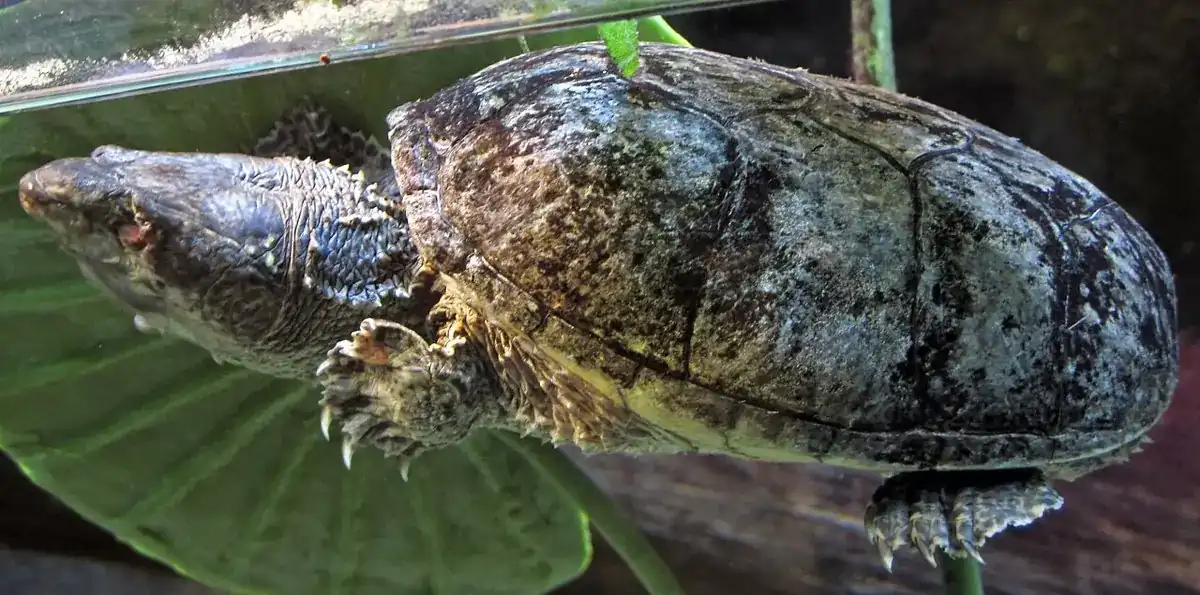
This guide covers Sternotherus odoratus, the common musk turtle. Adults usually have a straight shell length around 4″–5″ (10–13 cm), yet still need substantial bottom space, clean water and a dry basking area.
Plan for 30–50 years of care. This is an observation animal with a strong bite; minimize unnecessary handling and keep a secure transfer container for servicing.
Our adult enclosure recommendation
Our recommended minimum for one healthy adult is 3′ × 18″ × 18″ (91.4 × 45.7 × 45.7 cm), length × depth × height of usable internal space. Our preferred target is 4′ × 2′ × 2′ (121.9 × 61.0 × 61.0 cm). Height includes the water and space above it; external lamps need additional safe clearance. The minimum footprint is 4.5 ft² (0.42 m²), increasing to 8 ft² (0.74 m²) in the preferred habitat.
This is our design judgment using the veterinary length rule of about six times shell length, published 29-gallon tank guidance and the preference for more bottom area and water. A 5″ (12.7 cm) adult gives at least 30″ (76.2 cm) of length by that rule; our 3′ (91.44 cm) length and 18″ (45.72 cm) depth allow a less crowded furnished layout. The dimensions are not scientific consensus or a validated welfare threshold.
For the minimum adult design, provide about 10″–1′ (25–30 cm) water depth and at least 30 US gallons (114 L) actual water after displacement. At 1′ (30.48 cm) depth, the unfurnished 3′ × 18″ (91.44 × 45.72 cm) footprint holds 33.7 US gallons (127 L). If furnishings or shallower water reduce this below the target, enlarge the footprint. Neither volume nor dimensions alone establish suitability.
Basking, UVB (ultraviolet B) and resting routes
Provide stable submerged branches and near-surface resting places so the turtle can climb up to breathe. Include a ramp to a dry platform that supports the whole body without sinking.
Provide a basking area around 90–92°F (32–33°C), with cooler choices, and suitable reptile UVB for about 12 hours daily. Check exposure at the shell and all reachable fixtures using lamp-specific installation guidance. Keep lamps protected from splashes and retain shade.
Water temperature and life stage
Our adult water routine is 72–76°F (22–24°C), with hatchlings warmer at 78–80°F (26–27°C). Measure water near and away from the heater, and use a protective guard and thermostat as appropriate.
Start tiny hatchlings in around 3–4 in (8–10 cm) water with abundant support, increasing depth gradually as they grow and demonstrate confident access to air. An impaired or newly acquired turtle may need shallower water and individual assessment. Do not put it into a bare deep tank.
A varied measured diet
Feed in water. Use a suitable complete aquatic-turtle food with varied invertebrates such as earthworms and captive-source snails. Offer some suitable leafy plants, while recognizing that this species commonly favors animal food.
Feed growing youngsters daily and adults about every other day, adjusting portions to condition. Remove leftovers promptly. Coordinate additional calcium and vitamins with the complete food and UVB rather than automatically adding multiple powders.
Water maintenance and clean substrate
Establish biological filtration before relying on the aquarium for permanent care. Use a bare bottom or cleanable, non-swallowable large stones, leaving unobstructed walking routes. Keep intakes guarded and flow gentle enough for resting and climbing.
Test ammonia, nitrite, nitrate and pH (a measure of acidity or alkalinity). Aim for undetectable ammonia and nitrite; use the veterinary guide's nitrate below 40 ppm (parts per million) and pH 6.5–7.5 as management references. Neutralize chlorine and chloramine in new water and match temperature. Begin with weekly partial changes and adjust to results and waste load.
Where recommendations differ
Published minimums vary from a 20-gallon long tank to 29gallons, often without stating filled volume. We recommend a larger explicit footprint and actual-water target so a label cannot hide a shallow, crowded installation. This added margin is our editorial choice.
Depth recommendations also differ: Tree of Life describes 8″–1′ (20.32–30.48 cm), while Austin's Turtle Page describes 10″–2′ (25.4–60.96 cm) with abundant support. Swimming ability, life stage and furnished climbing routes explain much of the practical difference. We use the shallower overlap for ordinary adult housing; deeper water may work for a capable adult with reliable resting routes.
Tree of Life gives 75–80°F (24–27°C) water without an age split. Chicago Exotics and Austin's Turtle Page distinguish cooler adult water from warmer hatchling care. We choose that age-specific routine and adjust it for a clinician's individual treatment plan when needed.
Protect the biological filter
Filter bacteria process waste through ammonia and nitrite to nitrate. Clean mechanical debris without sterilizing the whole biological filter. Rinse biological media gently in removed aquarium water and follow the equipment's maintenance instructions.
Record large media changes and subsequent water tests. Clear-looking water and a running pump do not prove that biological filtration is established.
References: [4]
Health, solitude and female care
House one turtle within these dimensions. Separate new arrivals and their equipment, and arrange veterinary assessment for abnormal breathing, swollen eyes, shell damage or persistent appetite and weight changes.
Females need access to suitable terrestrial nesting provision even without a male; a small floating dock alone is not a nesting area. Plan this with a species-experienced clinician before maturity. Do not improvise outdoor winter cooling from generic temperate-turtle advice.
Sources & further reading
Read the full recommendations and check details for your animal, equipment, and local conditions.
- Austin's Turtle Page: Common musk turtle
- Chicago Exotics: Musk turtle care
- Tree of Life: Common musk turtle care
- RSPCA Australia: Aquarium water quality (RSPCA: Royal Society for the Prevention of Cruelty to Animals)
Original Creature Corner guide. Editorial fact and citation checks are recorded; independent veterinary review has not been performed.