Use this guide as a starting point alongside the detailed sources below. Health concerns, unexplained changes in behavior, or feeding problems belong with a reptile veterinarian.
Adult enclosure recommendation
Our recommended minimum: 6′ × 3′ × 3′ (182.9 × 91.5 × 91.5 cm), length × depth × height.
Usable internal space for 1 adult animal. One Trachemys scripta elegans with straight shell length up to 1′ (30 cm); larger adults require proportional enlargement.
Height is the usable internal envelope, including the space reserved for substrate and water. Check the remaining movement space and lamp clearance after installation.
No separate numerical preferred target is established by the sources reviewed. Extend usable movement routes beyond this minimum when the same climate, cover and cleaning access can be maintained.
Our layout uses the upper veterinary swimming-length and water-depth recommendations. Three shell lengths of width and wall height are editorial allowances for turning and a dry dock; they are not validated welfare thresholds.
Swimming length at least 6 × straight shell length; water depth at least 2 × shell length. Width of 3 × shell length is our turning allowance. For a 1′ (30.48 cm) shell: 6′ × 3′ × 3′ (182.88 × 91.44 × 91.44 cm) overall internal, with 2′ (60.96 cm) water. Height must also preserve at least 10″ (25.4 cm) effective barrier above the finished dock, with additional lamp clearance.
One measured adult no longer than 8″ (20 cm) straight shell length
Our recommended minimum: 4′ × 2′ × 30″ (122 × 61 × 76.2 cm), length × depth × height. 4′ × 2′ × 30″ (122 × 61 × 76 cm) total internal space, with at least 17″ (43 cm) water: about 85 US gallons (322 litres) before displacement. Preserve at least 80 US gal (≈ 302.833 L) after displacement. A 1′ × 2′ (30.48 × 60.96 cm) dry dock is our editorial allowance; maintain at least 10″ (25.4 cm) effective barrier above it, increasing total height if needed.
- Floor space
- Keep the 6′ × 3′ (183 × 91 cm) swimming footprint usable. Add an 18″ × 3′ (46 × 91 cm) dry platform above or beside it; our editorial platform example must let the whole turtle dry and turn.
- Climbing space
- Stable grippy ramp and separate cool drying opportunity. Keep at least 10″ (25 cm) effective barrier above finished dock, increasing overall height if necessary.
- Substrate
- A bare aquatic floor allows inspection; avoid swallowable gravel. Mature females need accessible nesting soil at least 1′ (30 cm) deep. Our 2′ × 2′ (61 × 61 cm) initial nest footprint for a 1′ (30.48 cm) adult is editorial and must allow comfortable turning and digging.
- Water
- For the 1′ (30.48 cm) shell example, at least 2′ (61 cm) water gives about 269 US gallons (1,020 litres) before displacement. Verify at least 10 US gallons (38 litres) actual water per inch of shell. Total height includes water, leaving 1′ (30 cm) before dock height is deducted.
- Security and ventilation
- Secure ventilated barriers, guarded heaters and intakes, structural support and maintainable drainage. The dock, lamps and soil must not create an escape route.
Meeting these dimensions alone does not establish suitability. Check the usable layout, environmental conditions, equipment clearance and the individual animal’s requirements before occupation.
Meet the species
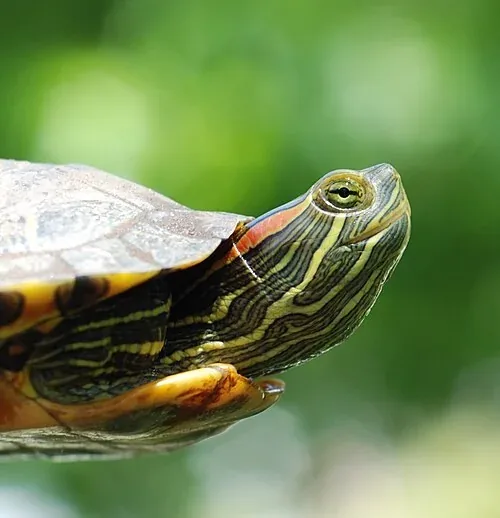
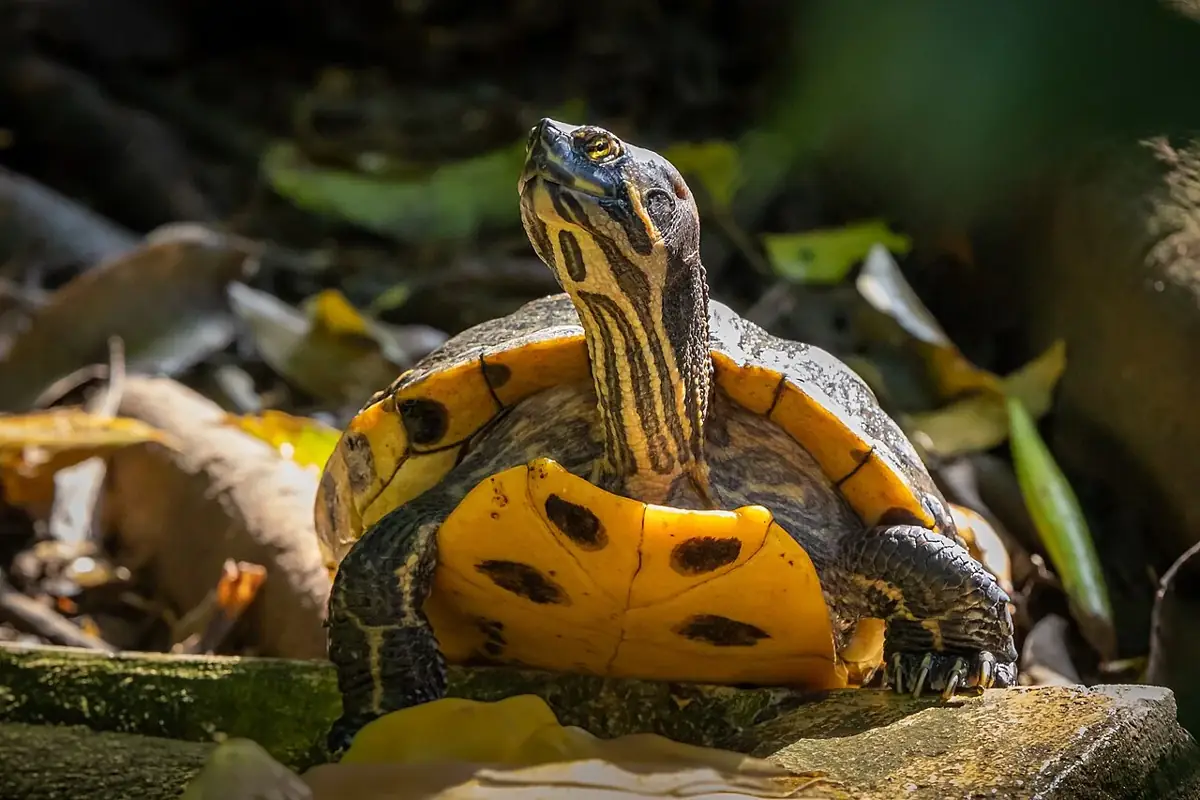
Keeping a red-eared slider requires a long-term commitment to maintaining an aquatic enclosure. Plan around adult size, filtration and water changes before acquisition, and consider a rescue animal. These turtles are better observed in their enclosure than repeatedly removed for handling.
Housing
Our recommended minimum for one adult up to 1′ (about 30 cm) straight shell length is 6′ × 3′ × 3′ (183 × 91 × 91 cm), length × depth × height of usable internal space. Keep the full 6′ × 3′ (182.88 × 91.44 cm) swimming footprint and at least 2′ (61 cm) of water available. Add a stable dry dock or shoreline without taking away that swim route. Our planning example allows an 18″ × 3′ (46 × 91 cm) dry platform, above or beside the water, with a secure ramp. These are our layout recommendations based on veterinary scaling guidance, not experimentally established thresholds.
Use at least six straight shell lengths for swimming length and two for water depth; our turning allowance is three shell lengths wide. For a measured 8″ (20 cm) adult, the smaller example is 4′ × 2′ × 30″ (122 × 61 × 76 cm), with at least 17″ (43 cm) of water and a dry platform about 1′ × 2′ (30 × 61 cm). The water is about 85 US gallons (322 litres) before displacement. Independently check at least 10 US gallons (38 litres) of actual water per inch of shell. Measurements refer to the straight shell, not head-to-tail length or a tape curved over the shell.
The stated height includes the water: the larger example leaves 1′ (30 cm) above the waterline and the smaller one 13″ (33 cm). A dock raises the animal further. Preserve at least a 10″ (25 cm) effective barrier above the finished dock and increase the overall height if necessary; lamps need additional safe clearance outside the animal’s reach. For a mature female, add an accessible quiet nesting area with at least 1′ (30 cm) of workable slightly moist soil. Our initial nesting footprint is 2′ × 2′ (61 × 61 cm) for the 1′ (30.48 cm) adult, an editorial allowance for turning and digging that must be enlarged if she cannot use it comfortably.
House one slider under these recommendations. Females often need more room than males; enlarge every relevant dimension for an adult exceeding the stated shell length. Give youngsters resting places and easy surface access. A longer secure pond is preferred when climate and maintenance permit, but the evidence does not establish a separate numerical preferred target. Filtration, drying, safe water, UVB (ultraviolet B), nesting access and containment must all work; dimensions alone do not establish suitability.
Heat and light
For active indoor adults, maintain water around 75–81°F (24–27°C); for hatchlings use 79–82°F (26–28°C). We choose these operating bands within warm indoor veterinary guidance, not as experimentally demonstrated optima. Measure the water with a waterproof thermometer independently of the heater setting. Keep the planned range through the night for ordinary active care; seasonal cooling requires a separate health and climate plan.
Set basking air around 86–90°F (30–32°C) and check the warmed dry surface separately with an infrared thermometer; our surface target is about 104°F (40°C), following specialist heating guidance. Offer a second cooler dry area so drying does not always require maximum heat. Use thermostatic control, guarded heaters and fixtures, and splash-safe electrical installation.
Provide bright daytime light and UVB reaching UVI (ultraviolet index) 3–4 at the turtle’s basking shell height, declining to full shade. This is our use of the specialist range at the animal’s actual exposure level, consistent with the RSPCA (Royal Society for the Prevention of Cruelty to Animals)’s UVI 3–5 range measured at animal height. Begin with a 12-hour day and switch visible and UV (ultraviolet) lights off overnight. Recheck UV after changing water level, dock height, mesh or lamps.
Water management
Use effective mechanical and biological filtration; a fish filter rated for two to three times the actual water volume is a practical starting point, not proof that it can handle the turtle’s waste. Test ammonia, nitrite and nitrate routinely, particularly during setup or after filter changes. Clear water can still contain dissolved waste.
Start with about a 30% partial water change each week, then adjust the amount and frequency to the test results and waste load. Treat replacement tap water with an appropriate conditioner as labeled and match its temperature. Rising ammonia or nitrite needs prompt additional changes and investigation of feeding, trapped waste and filter performance. Rinse biological media gently in removed tank water and avoid replacing all of it at once. Keep equipment and dirty water away from kitchen and food-preparation areas.
Food and routine
Offer a varied aquatic-turtle diet combining suitable pellets, leafy vegetation and appropriate animal foods. Mature sliders need more plant matter than youngsters. Feed in water, where sliders swallow their meals, and remove leftovers. Track growth and inspect the shell and eyes during routine observation.
Avoid
Avoid all-shrimp diets, tiny decorative bowls, an inaccessible basking dock and small stones that can be swallowed. Never release a pet turtle outdoors. Wash hands after contact and clean turtle equipment away from food-preparation areas.
Plan water volume before the hatchling arrives
A hatchling’s small shell does not predict a small adult aquarium. Buy and place the enclosure with adult weight, access for water changes and long-term swimming space in mind. Provide easy routes to the surface and a dock it can climb independently. Reassess gaps around filters and ramps as the animal grows.
Use at least 10 US gal (≈ 37.854 L) of actual water per inch of shell length as the planning reference: an 8″ (20.32 cm) turtle requires about 80 gallons, or ≈ 80.044 US gal (303 L), of water before allowing for its dry area. Tank labels describe total capacity; substrate, land sections and an unfilled top reduce actual water. Footprint alone cannot establish suitability. Swimming depth, turning room, dock access and adult size must also be reviewed.
Feeding changes with age
Feed growing juveniles measured meals daily. For healthy adults, offer leafy vegetation daily and a measured meal of suitable aquatic-turtle pellets every two or three days. Rotate dandelion greens, romaine, endive and safe aquatic plants; offer earthworms or suitable whole freshwater prey as part of a planned meal, replacing some pellets rather than adding a second full meal. Our approach follows the veterinary frequency and emphasizes increasing plant intake with maturity.
Use the pellet maker’s amount for the turtle’s size and life stage as the initial portion, then track leftovers, shell growth and body condition. Feed in water and remove remains promptly. Avoid a dried-shrimp-only diet. Provide a suitable cuttlebone or calcium source, prepared according to its label. With a nutritionally complete pellet component and effective UVB, do not automatically stack vitamin powders or extra vitamin D3; diets with little formulated food need a specifically reviewed supplement plan. Weekly multivitamins are an alternative in some veterinary guidance, not an addition to every complete feeding plan.
Basking, shedding and activity
Sliders may shed thin outer shell scutes as they grow. Let these release naturally; never pull attached pieces or polish the shell. Record persistent unusual areas and obtain veterinary advice. A fully dry basking site, effective UVB and maintained water quality are routine requirements throughout growth, not occasional corrections.
Swimming routes, safe aquatic plants and changes in the position of food provide enrichment without repeated handling. Keep enough open water for unrestricted movement. During necessary transfers, support the turtle securely over a safe surface, keeping hands away from its head. Return it promptly to the prepared habitat.
Three setup problems to investigate
Cloudy or smelly water: test water chemistry, check filter flow and inspect for trapped food. Review the biological filter’s maturity and maintenance history. Partial water changes and waste removal should follow the measured problem; replacing every filter component together can disrupt established filtration.
The dock remains unused: check that the ramp grips, the platform stays stable under full weight and the turtle can leave the water completely. Measure the dry surface, verify UVB placement and reduce nearby disturbance.
The turtle has outgrown its swimming space: measure shell length and calculate actual water volume again. Check depth, turning space and equipment gaps. Arrange the larger setup before crowding becomes routine; a stronger filter cannot replace physical space.
Lifetime commitment and costs
Tree of Life Exotic Pet Medical Center gives an average of 20–30 years and notes rare much longer lives. Do not confuse a typical range with a maximum.
Price the adult water system, strong filtration, safe dry basking platform, secure support and practical access for water changes.
Include water treatment/testing supplies, filter maintenance, food, water and basking heating where needed, UVB and electricity.
References: [8]
Measure the lighting installation
Measure at the top of the shell on the dry platform. Changing the water level or platform height changes the lamp distance. Provide unobstructed UVB access and protect electrical fittings from water; a water heater does not heat or light the basking area.
Arrival and quarantine planning
Use dedicated water-change equipment and cleaning containers; keep tank water and reptile equipment away from food-preparation areas.
Prepare a separate species-appropriate arrival enclosure and dedicated equipment. Agree observation, screening and release criteria with a reptile veterinarian. Keep the animal’s identity, origin, baseline condition and care history together.
Where recommendations differ
Space advice uses different measurements. Veterinary guidance gives four to six shell lengths of swimming length and 1.5–2 shell lengths of water depth; specialist guides also require 10 US gal (≈ 37.854 L) per inch of shell. We select the upper swimming dimensions and check actual volume separately. Our three-shell-length width, dock and nesting footprints are editorial design allowances. A deep narrow tank cannot pass merely because it holds enough gallons.
For water, the RSPCA gives about 72°F (22°C) for adults and 77°F (25°C) for hatchlings. Veterinary indoor sheets give roughly 75.2–84.2 °F (24–29°C), while ReptiFiles describes a much wider 69.8–87.8 °F (21–31°C) adult indoor range. We recommend the narrower warm indoor bands above for active care; they are not an average of all these numbers. A cooler adult plan may be appropriate with an effective basking area, known health and monitored feeding and activity. The evidence reviewed does not establish a single best year-round temperature.
Diet ratios and maintenance schedules also differ. VCA describes about half plant food for adults; ReptiFiles describes about three quarters. Their portion definitions do not establish an experimentally optimal ratio. We use daily leafy food with controlled pellet and whole-prey meals, adjusting to condition instead of combining full portions from both plans. Water-change advice ranges from weekly partial changes to longer intervals with filtration; we start weekly and let measured waste determine whether more is needed.
Sources & further reading
Read the full recommendations and check details for your animal, equipment, and local conditions.
- ReptiFiles: slider overview
- ReptiFiles: slider heat
- ReptiFiles: slider filtration and water changes
- ReptiFiles: slider feeding
- ReptiFiles: slider basking area
- VCA: feeding aquatic turtles
- VCA: housing aquatic turtles
- Tree of Life Exotic Pet Medical Center: slider care
- The Unusual Pet Vets; reptile quarantine
- VCA Animal Hospitals; the new reptile visit
- ReptiFiles: slider tank size
- ReptiFiles: slider UVB
- ReptiFiles: slider shedding
- ReptiFiles: female slider nesting
- RSPCA: caring for pond sliders
Original Creature Corner guide. Editorial fact and citation checks are recorded; independent veterinary review has not been performed.