Use this guide as a starting point alongside the detailed sources below. Health concerns, unexplained changes in behavior, or feeding problems belong with a reptile veterinarian.
Adult enclosure recommendation
Our recommended minimum: 12′ × 6′ × 3′ (365.8 × 182.9 × 91.5 cm), length × depth × height.
Usable internal space for 1 adult animal. One adult up to 18″ (45.7 cm) straight shell length; smaller confirmed adults and unusually large animals have different requirements.
Height is the usable internal envelope, including the space reserved for substrate and water. Check the remaining movement space and lamp clearance after installation.
Additional furnished space is preferred; no separate numerical preferred threshold is established by the opened sources.
Apply the published 8 × 4 × 2 straight-shell-length rule. An 18″ (45.72 cm) adult requires 12′ × 6′ × 3′ (365.76 × 182.88 × 91.44 cm); a 1′ (30.48 cm) adult requires 8′ × 4′ × 2′ (243.84 × 121.92 × 60.96 cm); a 2′ (60.96 cm) adult requires 16′ × 8′ × 4′ (487.68 × 243.84 × 121.92 cm). Indoor height includes bedding; outdoor barriers require separate security design.
Use at least 8 × 4 × 2 times expected adult straight shell length for internal length, depth and height. An 18″ (45.7 cm) shell gives 12′ × 6′ × 3′ (365.76 × 182.88 × 91.44 cm), or 12′ × 6′ × 3′ (365.76 × 182.88 × 91.44 cm). A 1′ (30.48 cm) adult gives 8′ × 4′ × 2′ (243.84 × 121.92 × 60.96 cm); a 2′ (60.96 cm) adult gives 16′ × 8′ × 4′ (487.68 × 243.84 × 121.92 cm). Indoor height includes bedding; outdoor wall height and buried barriers need separate security design.
Confirmed adult no larger than 1′ (30.5 cm) straight shell length
Our recommended minimum: 8′ × 4′ × 2′ (243.9 × 122 × 61 cm), length × depth × height. The 8 × 4 × 2 shell-length rule gives permanent housing for this confirmed smaller adult. It is not the default for a juvenile of uncertain adult size.
Exceptionally large 2′ (61 cm) straight-shell adult
Our recommended minimum: 16′ × 8′ × 4′ (487.7 × 243.9 × 122 cm), length × depth × height. Apply the same 8 × 4 × 2 shell-length rule; scale continuously for other adult sizes.
- Floor space
- The default provides 72 sq ft (6.69 m²) of floor with walking and foraging routes and separate shade.
- Climbing space
- Stable low cover and broad retreats; tall climbing structures are unnecessary.
- Substrate
- At least 4″ (10.2 cm) of moist soil indoors, with deeper digging areas; provide about 1′ (30.5 cm) of soil outdoors. Total internal height includes bedding.
- Water
- Shallow full-body soaking/drinking dish, easy exits, water no higher than elbows when standing.
- Security and ventilation
- Provide opaque secure boundaries, predator protection, drainage and ventilation, with weatherproof warm shelter for outdoor care.
Meeting these dimensions alone does not establish suitability. Check the usable layout, environmental conditions, equipment clearance and the individual animal’s requirements before occupation.
References: [1]
A long-lived tropical omnivore
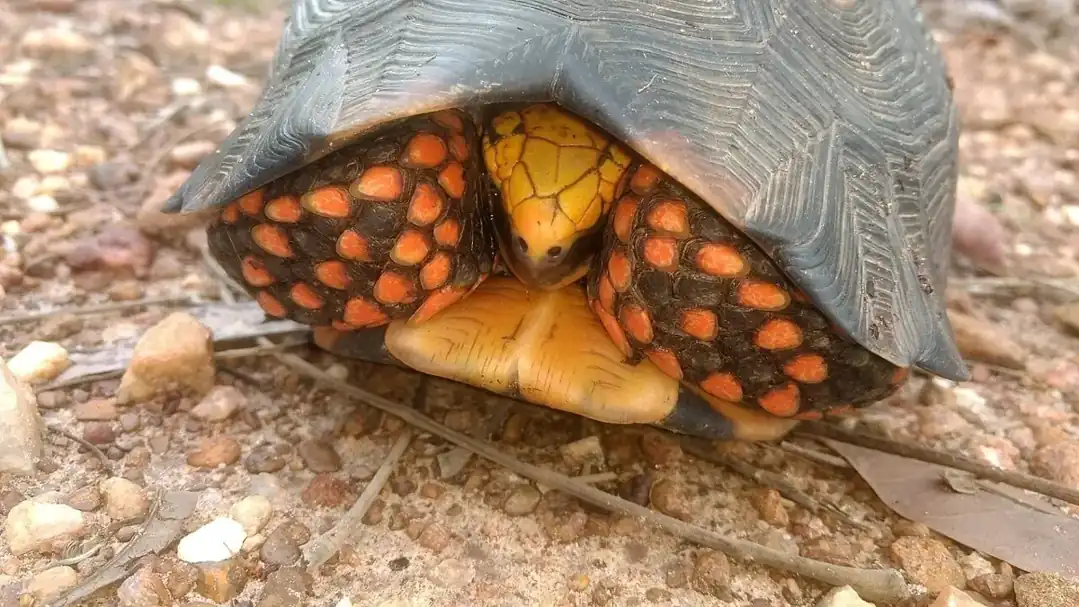
Plan for a red-footed tortoise, Chelonoidis carbonaria, to need warm humid housing for decades. Fifty years or more is possible. Keep origin and growth records and arrange future care beyond the initial household setup.
Measure shell length in a straight line from front to back, rather than over the dome. Adults commonly reach 1′–18″ (30–46 cm), with larger animals possible; eventual size drives the housing plan.
Scale permanent adult housing
Our recommended minimum for one adult up to 18″ (45.7 cm) straight shell length is 12′ × 6′ × 3′ (365.8 × 182.9 × 91.4 cm), length × depth × height of usable internal space. It provides 72 ft² (6.69 m²) of floor. More furnished space is preferred; no separate numerical preferred threshold is established.
Use at least 8 × 4 × 2 times expected adult shell length. An 18″ (45.72 cm) adult gives 12′ × 6′ × 3′ (365.76 × 182.88 × 91.44 cm), or 12′ × 6′ × 3′ (365.76 × 182.88 × 91.44 cm). A confirmed 1′ (30.48 cm) adult gives 8′ × 4′ × 2′ (243.8 × 121.9 × 61.0 cm); a 2′ (60.96 cm) adult gives 16′ × 8′ × 4′ (487.7 × 243.8 × 121.9 cm). Do not plan an unknown juvenile's permanent home around the smallest adult.
This is a specialist scaling recommendation, not a validated scientific minimum. Height includes bedding indoors. Provide walking routes, several covered retreats and safe access to water; dimensions alone do not establish suitability.
Warmth and UVB (ultraviolet B)
Provide a basking area around 90–95°F (32–35°C), surrounding choices around 75–85°F (24–29°C) and adult nights around 68–75°F (20–24°C). Keep juveniles toward the warmer end at night. Measure the basking surface and shaded air separately with appropriate instruments.
Use guarded overhead heat, thermostat control and daytime UVB around UVI (ultraviolet index) 2–3 at shell height with shade. Set a seasonal daytime cycle around 11–13 hours and keep nights dark. Indoors, remeasure after substrate depth or lamp position changes.
References: [1]
Humid ground and clean water
We recommend 70–90% humidity with ventilation and a clean humid retreat. Provide at least 4″ (10.2 cm) of moisture-retaining soil indoors, with deeper digging areas where possible; outdoor pens should offer about 1′ (30.5 cm) of diggable soil. Add leaf litter and avoid waterlogged resting surfaces.
Provide a shallow dish large enough for the whole body, with easy exits and water no higher than the elbows when standing. Replace water daily and immediately when fouled. A bath outside the enclosure should not be the only opportunity to drink.
A plant-heavy varied menu
Offer varied leafy foods and suitable vegetables as the foundation, some fruit, and a small animal-food component. Our practical starting routine is fruit about twice weekly and a small animal-food serving about once weekly within the overall menu. This follows the veterinary plan without treating its percentages as measured requirements.
Feed growing animals daily and mature adults about every other day, adjusting quantity to activity and condition. Use suitable complete forest-tortoise food as part of the menu if desired, and coordinate calcium and multivitamins with the full diet and UVB.
Active care throughout winter
Do not brumate this species. Keep suitable active housing ready when outdoor conditions become cold. Our outdoor plan provides access to a heated shelter before temperatures fall below 70°F (21°C), following the more cautious veterinary shelter guidance.
Check the temperature where the tortoise actually rests. A heated box is useful only if the entrance stays accessible, dry and easy for the animal to use.
Where recommendations differ
Chicago Exotics describes 50–70% open-air humidity with an approximately 80% refuge, while Arizona Exotics and ReptiFiles use 70–90% more broadly. These are different microclimate plans. We choose the latter for ordinary indoor care, particularly growing animals, while retaining ventilation and non-waterlogged surfaces.
Basking recommendations also range from 82–90°F (≈ 27.8–32.2 °C) in Chicago to 95–100°F (≈ 35–37.8 °C) in Arizona. We choose ReptiFiles' 90–95°F (≈ 32.2–35 °C) plan with cooler retreats, not an average or a claim of consensus. The opened evidence does not settle an optimal temperature for every individual. A clinician managing a specific health problem may choose a different complete protocol.
Arizona Exotics offers food daily, while ReptiFiles uses alternate-day adult meals. We use daily feeding during growth and measured alternate-day adult portions, adjusting for actual intake and condition. Neither schedule defines a fixed calorie requirement.
Watch portions and social space
House one tortoise within the dimensions given here. A group needs additional space, separated resources and assessment of aggression; these dimensions are not a group capacity calculation.
Keep ingredients, quantities and leftovers in the care record. Fruit or animal food can quietly displace the plant foundation when only feeding days are counted. Record weight and dated shell photographs for veterinary review.
Outdoor shelter and maintenance
Provide deep shade that remains available as the sun moves, drained ground, opaque escape-resistant walls and protection from predators and pets. Wall height must be assessed above the finished substrate, with a buried barrier separate from the internal height calculation.
Remove waste daily and inspect humid retreats for soiling before adding water. Keep newcomers separate. Females need a suitable nesting area and reproductive planning even without a male.
Sources & further reading
Read the full recommendations and check details for your animal, equipment, and local conditions.
- ReptiFiles: Red-footed tortoise care
- Arizona Exotics: Basic red-foot tortoise care
- Chicago Exotics: Red-foot tortoise care
Original Creature Corner guide. Editorial fact and citation checks are recorded; independent veterinary review has not been performed.