Use this guide as a starting point alongside the detailed sources below. Health concerns, unexplained changes in behavior, or feeding problems belong with a reptile veterinarian.
Adult enclosure recommendation
Our recommended minimum: 4′ × 2′ × 2′ (122 × 61 × 61 cm), length × depth × height.
Preferred target: 6′ × 3′ × 3′ (182.9 × 91.5 × 91.5 cm), length × depth × height.
Usable internal space for 1 adult animal. One confirmed Lampropeltis polyzona adult through 4′ (122 cm) total length, alone. This is not a Lampropeltis annulata guide.
Height is the usable internal envelope, including the space reserved for substrate and water. Check the remaining movement space and lamp clearance after installation.
The preferred layout adds digging routes, turning room and separate sheltered destinations.
Our minimum exceeds older 3′ (92 cm) examples to provide full stretch for a 4′ (122 cm) individual, following the veterinarian’s full-length criterion. Depth and height are editorial layout choices.
For confirmed polyzona longer than 4′ (122 cm), increase length to at least the snake’s total length and reassess depth, furnishing and gradients; do not reuse this 4′ (122 cm) fit automatically.
- Floor space
- Maintain 4′ × 2′ (122 × 61 cm) usable internal floor with an unobstructed full-length route.
- Climbing space
- Stable low branches and hides, with base-supported heavy objects and no access to lamps.
- Substrate
- Reserve about 4″ (10 cm) diggable bedding; the stated minimum height leaves 20″ (51 cm) above it before fixtures. Protect underground routes from collapse.
- Water
- Fresh water in a stable soaking bowl with an easy exit and a localized damp shed hide.
- Security and ventilation
- House singly, lock doors and cable gaps, ventilate the main bedding and guard equipment.
Meeting these dimensions alone does not establish suitability. Check the usable layout, environmental conditions, equipment clearance and the individual animal’s requirements before occupation.
A common name needs a scientific identity
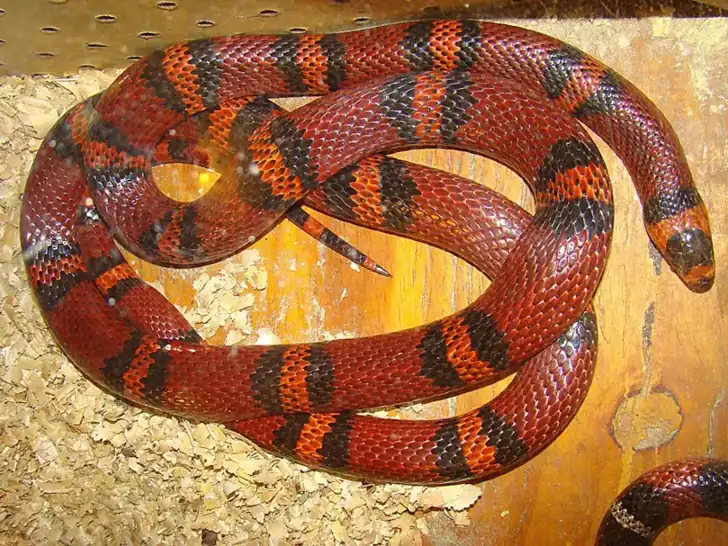
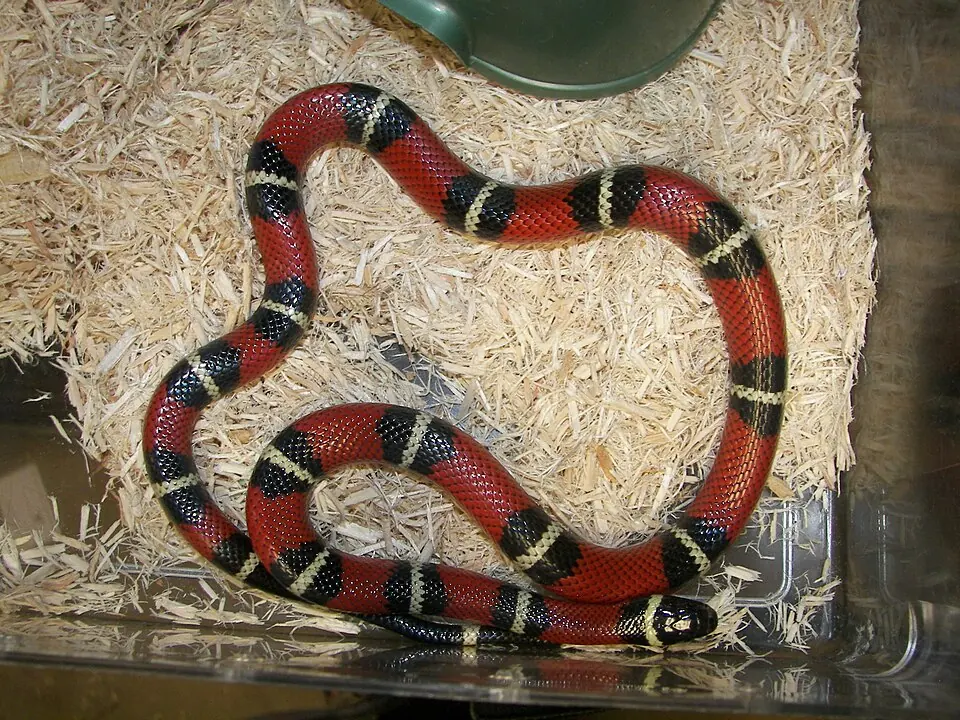
“Mexican milk snake” can refer to different snakes in trade. This record covers Lampropeltis polyzona, which includes animals historically called Pueblan or campbelli, Nelson’s and Sinaloan milk snakes. It excludes Lampropeltis annulata and uncertain hybrids. Confirm the scientific identity and breeder history instead of treating a red, black and pale pattern as identification.
This guide’s standard enclosure example applies to one adult through 4′ (122 cm) total length, including tail. Broader polyzona lineages and individual growth need attention; a small Pueblan zoo example does not establish the adult size of every trade line. Plan continuing food, equipment and veterinary care before acquisition.
Plan for a long commitment: Maryland Zoo gives 15–20 years as typical for its Pueblan milk snake account. That is useful planning context for Pueblan animals, not an exact prediction for every lineage now included in Lampropeltis polyzona.
Make the hidden space useful as well as the visible floor
Use the adult internal minimum and choose the preferred layout where practical. The minimum gives an animal 4′ (122 cm) long a full-length route rather than using the shorter retailer examples. A longer confirmed individual needs at least its own total length in enclosure length, with turning, digging and thermal choices reassessed.
Provide about 4″ (10 cm) of diggable bedding, such as dry aspen or a suitable cypress-based reptile substrate. Support heavy hides and rocks from the base so burrowing cannot undermine them. Add warm and cool hides, low branches and cover along the floor; leave room above the finished bedding for safe lamp clearance. This layout supports the concealed and underground exploration described in the Pueblan zoo account.
House singly at every stage; milk snakes can eat other snakes. Young animals need especially secure doors, vents and cable ports, with enough cover and easy access to food and water. A permanent growth plan is still required.
Keep the warm option separate from the refuge
Our selected implementation uses warm air where the animal rests or moves 82–85°F (27.8–29.4°C), cool air 70–75°F (21.1–23.9°C), a localized surface 85–90°F (29.4–32.2°C), and dark-night air 70–75°F (21.1–23.9°C). The narrow warm-air choice applies the veterinarian’s 85°F (≈ 29.4 °C) reference; the surface interpretation is editorial. Do not make the whole enclosure a 90°F (≈ 32.2 °C) zone.
Use thermostat control, separate air probes and surface checks, guarding every reachable heat source. Provide a 12-hour starting day and darkness at night. The selected ultraviolet B (UVB) opportunity has a measured peak ultraviolet index (UVI) 1–2 at reachable back height, falling to zero in shelter. This specialist recommendation traces to a manufacturer, rather than an independent species dose trial. Check actual fixture, mesh and distance; never force a hiding snake into the light.
Keep burrowing bedding ventilated and the refuge damp
A working ambient relative humidity of 50–60% overlaps the veterinarian and Pueblan specialist accounts. Provide a localized damp shedding hide, keeping the main bedding clean and unsaturated. Aspen must not sit wet, and pine and cedar are inappropriate choices. Check temperature alongside humidity rather than chasing a number with continuous spraying.
Use a stable drinking and soaking bowl with an easy exit, renewing contaminated water promptly. Inspect the tail and eye region after sheds without peeling retained skin. Persistent soaking, repeated retention or altered activity warrants environmental and veterinary review.
Feed for steady condition rather than rapid growth
Obtain an established feeder with a reliable frozen-thawed whole-rodent supply. Begin with suitably sized prey every 5–7 days for growing young and every 7–14 days for adults, adjusting to weight and condition. Do not use a line’s appetite or an adult size prediction to justify power feeding.
Thaw food safely and offer it calmly with feeding tools over a clean area. Avoid live rodents and unnecessary transfer into a separate feeding box. Complete whole prey normally needs no routine calcium or vitamin D3 dusting; unusual diets or persistent refusal need individual assessment. Remove uneaten food and keep intake records.
Choose a rodent roughly matching the snake’s widest body point. Thaw it fully in a sealed bag in cold water using a dedicated container, then warm it gently before offering with tongs; never microwave prey. Remove uneaten food and clean the feeding surface. Keep feeder preparation separate from human food utensils.
Respect hiding and keep seasonal decisions individual
A concealed or burrowing milk snake may be behaving normally. After settling and regular meals, brief supported handling can be tried if the individual remains calm. Support the body, secure the room and stop if it repeatedly tries to escape or becomes defensive. Rest it after meals and during illness or difficult sheds.
Single housing avoids predation, competition and unplanned mating. Seasonal refusal is not an automatic instruction to brumate a pet: review food, environment, weight and health first. A mature female may need laying provision even without intended breeding. Straining, swelling or progressive decline should be assessed by a reptile veterinarian.
Check the setup before the snake arrives
Prepare adult housing and growth space, locks, safe burrowing material, stable hides and branches, water, controlled heat, light and timers, air/humidity probes, a surface thermometer and UV (ultraviolet)-meter access. Test the furnished enclosure repeatedly through day and night. Arrange a whole-prey supplier, dedicated cleaning tools and veterinary care.
Quarantine arrivals and record weight, meals, waste and sheds. Check locks, water and controls routinely, remove contamination promptly and wash hands after contact or cleaning. Breathing effort, burns, weakness, unusual swellings or unexplained weight loss need care.
Remove feces, the pale urate portion of droppings and soiled bedding promptly, and clean the bowl before adding fresh water. Use a secure temporary container during deeper cleaning. Follow the chosen reptile-safe cleaner’s label, rinse as directed and dry the enclosure before replacing bedding and returning the snake.
Sources & further reading
Read the full recommendations and check details for your animal, equipment, and local conditions.
- The Reptile Database: Lampropeltis polyzona
- Pueblan Milk Snake
- Milk Snake Care Sheet
- Pueblan Milk Snake Care Guide
- Pueblan Milk Snake Care & Housing Guide
Original Creature Corner guide. Editorial fact and citation checks are recorded; independent veterinary review has not been performed.